




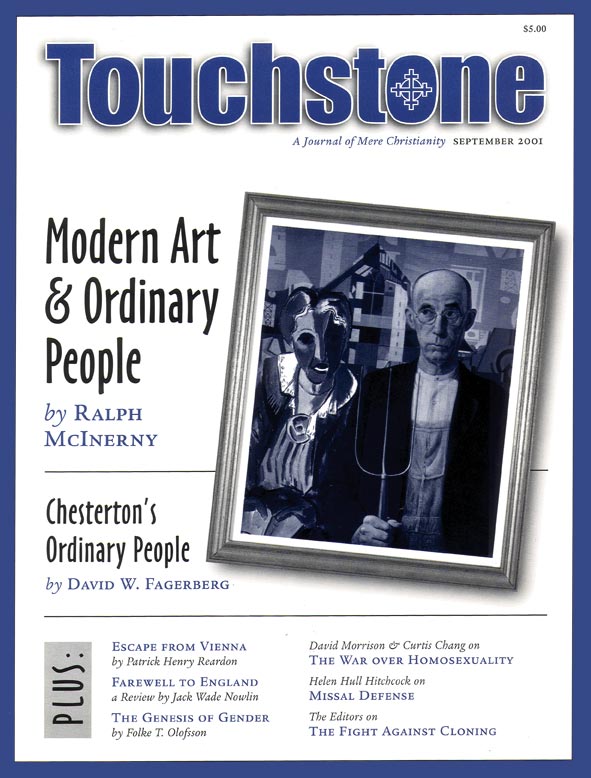
A New Resurrection?
“‘This will be the biggest leap for mankind,’ he says. ‘It is the central core of Christianity, the resurrection of Jesus, the promise of eternal life!’”
—From an article on human cloning in Wired magazine, January 2001
It is likely that 2001 will go down in history as the year the first human clone was born. Perhaps it will be the biggest leap for mankind. But it will be a giant leap backwards, back to the garden where Adam first ate of the tree of knowledge.
The technology for human cloning is now at the point where, with $50,000 and “a good cell biologist, you could do this with two people in a closet,” according to Wired’s Brian Alexander. Be assured that a number of ego-driven mad scientists are racing to have their names in the history books of the future as the reincarnation of Dr. Frankenstein.
Those of us who oppose such things will soon be labeled racists who discriminate against innocent children because of their genetic makeup. We will be compared to Nazis if we stand against the creation of this new race of people, accused of “annihilating them before they are born” if we do not support the right to clone.
The rhetoric of the future is predictable, but the gravity of this particular sin is difficult to fathom. Will it result in an even larger-scale destruction of embryonic human life than we now see in the quest for the “perfect child”? I heard one scientist proclaim that since having children was such an important event in one’s life, “who would possibly leave such a thing up to chance if he had a choice?” This is the new pro-choice: designer babies. How long will it be until the graves of the famous are excavated for traces of DNA by parents seeking to have the next Napoleon or Beethoven or Einstein?
And how will those children born to be clones of their parents or dead relatives or famous people cope with the expectations of greatness thrust upon them? We can clone cells, but we cannot clone souls. Although no human being cloned in a lab has ever been born, we do know that identical twins (who share the same DNA and are natural clones) each have separate souls. The soul isn’t cloned. Many of those who support human cloning really desire to clone their own souls—to live again in some mystical way. Eternal life, of course, is possible through Christ, but not through science. As for souls, it is most likely that few of the scientists involved in the cloning business believe they exist.
How have we come to this state of affairs? By not having spoken out against in vitro fertilization (IVF) long ago with a loud, clear voice, we Christians have allowed the foundation for cloning to be laid and to be accepted (the procedure for cloning is essentially IVF with an extra step or two added).
What is wrong with IVF? Here is how it is presented in Wired:
Today, thousands of women every year are having babies thanks to IVF. The success rate at well-run clinics has risen to between 20 and 30 percent per cycle—50 percent after repeated tries. Despite this great progress, there are still miscarriages, just like natural reproduction, and unneeded viable embryos are still discarded, two common criticisms voiced by opponents of cloning. But the downside is accepted as justified to help people have babies.
In other words, what are a few dead embryonic children when we can end up with a cute live one that we wouldn’t have had otherwise? This type of argument should not be convincing to Christian thinkers. We have no right to create life and then knowingly destroy it, even for a perceived greater good. Besides this, there are the more troublesome ethical cases where embryos are “created” with odd assortments of genetic materials from people who were hired for their services.
I have heard couples in church talk of their “miracle babies” who were conceived in test tubes (while many siblings created in the same test tube were presumably killed off). These children are, of course, welcomed into the church with open arms, but there is no recognition of the fact that their births were the result of man playing God.
Thomas S. Buchanan is the George W. Laird Professor of Mechanical Engineering and Biomedical Engineering at the University of Delaware. He has studied at UCSD, Northwestern University, and MIT, and has held visiting professorships at the University of Western Australia and the University of Aix-Marseille. He has served as department chairman, deputy dean, and institute director, president of the American Society of Biomechanics, and editor-in-chief of the Journal of Applied Biomechanics. He is on the Board of Trustees of Saint Katherine College, the editorial board of Touchstone, and the board of The Fellowship of St. James.
A Journal of Mere Christianity—Delivered to Your Door
- Essays on theology, culture, and the Church
- Contributors from across the Christian traditions

Six print issues (one year) of Touchstone, plus full online access and PDF downloads for only $39.95.

Get a one-year full-access subscription to the Touchstone online archives for only $19.95.
bulk subscriptions
Order Touchstone subscriptions in bulk and save $10 per sub! Each subscription includes 6 issues of Touchstone plus full online access to touchstonemag.com—including archives, videos, and pdf downloads of recent issues for only $29.95 each! Great for churches or study groups.
Transactions will be processed on a secure server.
more from the online archives
31.1—January/February 2018
Getting Sex Wrong Is a Foundational Error by James M. Kushiner

32.4—July/August 2019
on Probability, Death & the Existence of God by Graeme Hunter

18.8—October 2005
European Islam & the Doubtful Future of Christian Europe by William Murchison
calling all readers
Please Donate
"There are magazines worth reading but few worth saving . . . Touchstone is just such a magazine."
—Alice von Hildebrand
"Here we do not concede one square millimeter of territory to falsehood, folly, contemporary sentimentality, or fashion. We speak the truth, and let God be our judge. . . . Touchstone is the one committedly Christian conservative journal."
—Anthony Esolen, Touchstone senior editor
