




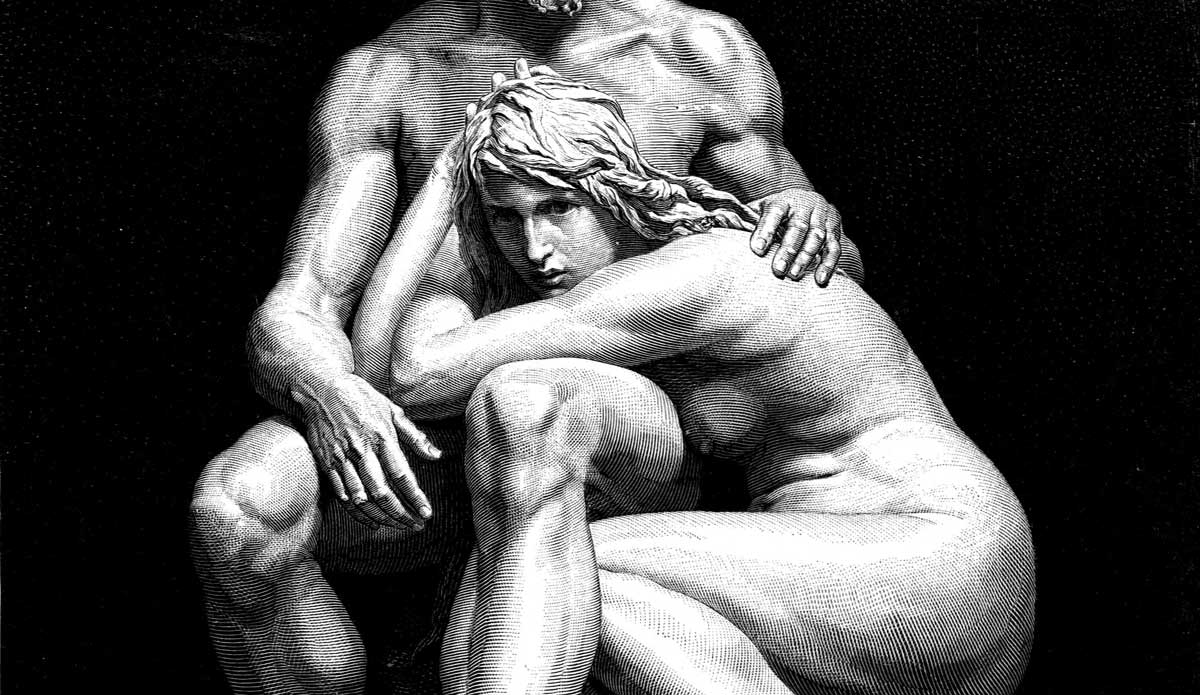
Is There No Privacy?
Eric Scheske on Universal Responsibility
One of the most beautiful chapters in literature is the “Thoughts and Teachings of the Elder Zossima” in Dostoyevsky’s The Brothers Karamazov. It recounts the last day and words of Fr. Zossima, the revered Elder of Alyosha Karamazov’s monastery, who speaks to those gathered at his bedside and asks them, through anecdote and counsel, to lead a life of virtue and love.
The love he asks them to have is a fervent and tangible love that stems from a deep sense of the intimate link between each person and every living thing. “Every one of us is responsible for all men and for everything on earth, not only responsible through universal responsibility of mankind, but responsible personally—every man for all people and for each individual man who lives on earth.”
At one point, he mentions a dying youth who asked the birds to forgive him:
That may sound absurd, but when you think of it, it makes sense. For everything is like the ocean, all things flow and are indirectly linked together, and if you push here, something will move at the other end of the world. . . . Understand that everything is like the ocean. Then, consumed by eternal love, you will pray to the birds, too. In a state of fervor you will pray to them to forgive you your sins. If you push here, something somewhere will move; if you strike here, something somewhere will wince; if you sin here, something somewhere will suffer.
These are startling observations. Everything we do has an effect on someone or something? Our isolated thoughts and actions are not isolated? We have no completely private lives? We may be responsible to others even for the things we do in private? This idea startles us because it clashes harshly against one of the most esteemed gods of modernity, the god of privacy, a god who walks hand-in-hand with the equally esteemed god of power.
Power & Privacy
In our society, the accumulation of power has been the presumed good toward which all human endeavor properly aims. It is power that brings us autonomy, that frees us from dependence. Its pursuit has contributed greatly to man’s remarkable achievements in areas like medicine, architecture, technology, physics, economics, and biology, but it has also separated us from each other.
Because our society has been concerned first and foremost with the pursuit of power, the possession of power itself became a prima facie good. It is not surprising, therefore, that privacy, too, would become highly valued because privacy gives man the power to choose what he will do with the power he has gained. The man with private time and space, the man who is free from the scrutiny and judgment of others, can pursue the things that interest him and do the things he enjoys.
Privacy obtained god-like status in the US Supreme Court decision Griswold v. Connecticut (1965), which struck down a state law prohibiting married couples from using contraception. In Griswold, the Court held that various constitutional guarantees create “penumbral rights of privacy” on the same level as the right of free speech, perhaps even higher, as evidenced by Justice Douglas’s words that the “right of privacy [is] older than the Bill of Rights,” and by the Supreme Court’s use of the right of privacy to sanction the slaughter of millions of unborn children just eight years later in Roe v. Wade.
With the help of the Supreme Court, the right of privacy became about as close to an absolute value as modern culture was willing to accept, exceeding even the right of free speech. No one can yell “fire” in a movie theater in the name of free speech, but any woman can kill her unborn baby in the name of privacy.
A Journal of Mere Christianity—Delivered to Your Door
- Essays on theology, culture, and the Church
- Contributors from across the Christian traditions

Six print issues (one year) of Touchstone, plus full online access and PDF downloads for only $39.95.

Get a one-year full-access subscription to the Touchstone online archives for only $19.95.
bulk subscriptions
Order Touchstone subscriptions in bulk and save $10 per sub! Each subscription includes 6 issues of Touchstone plus full online access to touchstonemag.com—including archives, videos, and pdf downloads of recent issues for only $29.95 each! Great for churches or study groups.
Transactions will be processed on a secure server.
more from the online archives
31.4—July/August 2018
on the Brevity & Theology of Her Recorded Words by Judith Anderson

30.3—May/June 2017
C. S. Lewis Assesses the Religion of Mohammed by Jacob Fareed Imam

31.6—November/December 2018
on the Church's Response to the Anti-marriage Tide by Diane Woerner
calling all readers
Please Donate
"There are magazines worth reading but few worth saving . . . Touchstone is just such a magazine."
—Alice von Hildebrand
"Here we do not concede one square millimeter of territory to falsehood, folly, contemporary sentimentality, or fashion. We speak the truth, and let God be our judge. . . . Touchstone is the one committedly Christian conservative journal."
—Anthony Esolen, Touchstone senior editor
