




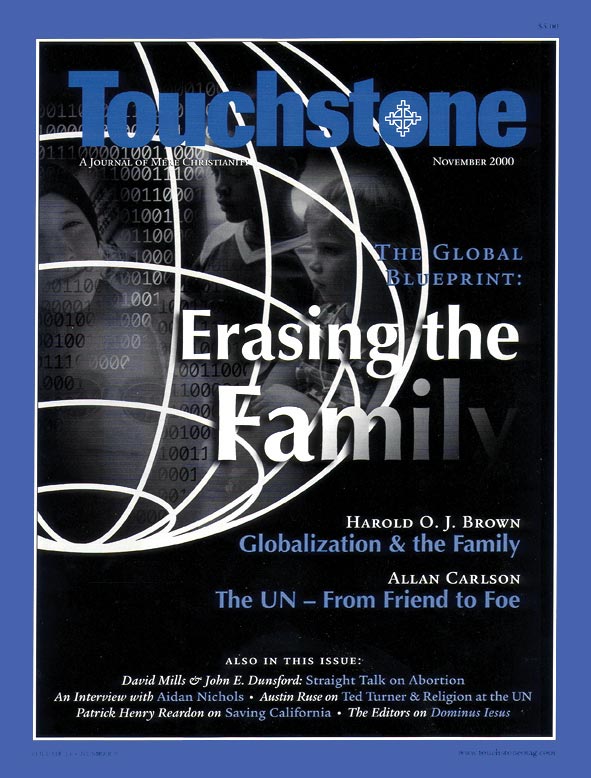
Saving California
The Man Who Founded California: The Life of Blessed Junípero Serra
by M. N. L. Couve de Murville
San Francisco: Ignatius Press, 2000
(140 pages; $24.95, cloth)
by Patrick Henry Reardon
Visitors to our nation’s Capitol in Washington are aware that each state of the Union is represented there by life-size statues of two persons important to its early history. Arguably the most conspicuous among those one hundred figures stands Junípero Serra, shod in sandals and clad in a long monastic habit girt about by the traditional Franciscan rope. Serra represents the great State of California, where he spent the last part of his life, from 1769 to 1784, as a missionary priest of the Roman Catholic Church.
Serra’s story is easily told, and it is well told in the tall, thin book here reviewed, a deluxe edition enhanced with many full-page photographs, most in color, illustrating the life and work of that venerable Franciscan, especially the missions that he planted up and down the length of California.
Born on the lovely island of Majorca on November 24, 1713, Serra joined the Franciscans at age 17. Eventually ordained a priest, he taught philosophy at the University of Palma, on Majorca, until 1749, when he was sent to the College of San Fernando in Mexico City. After the Spanish suppression of the Jesuits in 1767, Serra was appointed to head the Franciscans who were sent into California to take over and expand the Jesuit missions there. He himself was to found nine new missions, with such now-notable names as San Juan Capistrano, Santa Barbara, Santa Clara, San Jose, and San Diego. He founded the mission at San Francisco on June 29, 1776, just five days before the signing of the Declaration of Independence on the opposite coast of our continent.
By the time of his death in 1784, Father Junípero Serra had overseen the conversion and baptism of tens of thousands of native Americans into the Christian fold and the establishment of churches, schools, artistic workshops, clinics, and other institutions, along with advanced technologies in farming, viticulture, and the raising of livestock. It was entirely proper that the California state legislature nominated him to be honored by that statue in our nation’s Capitol. Manifest indications of his personal holiness, moreover, prompted Pope John Paul II to honor him by beatification in 1988.
Serra and/or his memory, nonetheless, have suffered affliction from three sources, to which he will likely continue to be an unbearable affront: philosophy, sociology, and revisionist historiography. Some comment is warranted under each of these headings.
First, philosophy. Serra, one recalls, had been a professor of philosophy during his early life, and we are fortunate to have a 404-page manuscript of class notes taken down by one of his students at various times between 1737 and 1743. These class notes, which cover logic and metaphysics, are perhaps most conspicuous by revealing the lecturer’s utter, unabashed insouciance to recent and contemporary philosophy. Serra apparently felt not the slightest interest in Leibnitz, Spinoza, Descartes, or any more recent philosophers. Not only did he not engage their thought, he did not so much as acknowledge their existence! Truly, if these notes are accurate—and there is every reason to believe they are—Serra’s lectures could have been delivered at any European university during the previous five hundred years.
But things were changing, nonetheless. In 1749, the very year that Serra made his long trip to Mexico, another young man named Jean-Jacques Rousseau was walking on a much shorter journey from Paris to Vincennes. It was in pausing to rest along the roadside that Rousseau was visited with the vision, he tells us, of several truths that left his mind in a kind of overpowering trance. Chief among these was the sudden persuasion “that man is naturally good, and that it is by our institutions alone that men become wicked.”
If Serra took no notice of Rousseau’s new theory of the “noble savage,” however, that theory would in due course serve notice to him. In 1779 the Spanish court sent a new royal governor to California, Filipe de Neve, whose views on the natives of that place corresponded very directly to Rousseau’s theory. Accordingly, he endeavored to weaken the Christianizing influence of the Franciscans, leaving the various American Indian tribes to preserve and pursue their pre-Christian culture. It was the first step in a development that would secularize California in the 1830s, a process crowned by the 1848 Gold Rush, when tens of thousands of highly secularized Americans arrived from the east to finish off what little remained of the Franciscan missionary culture.
Second, after the political disciples of Rousseau had destroyed Serra’s missions, the secular sociologists took careful aim at his ideals. Basing their criticisms on the persuasion that all cultures are of equal value (except, of course, those cultures that have the audacity to deny that all cultures are of equal value), exponents of contemporary sociology contend that the very notion of Christian missions represents an affront to humanity by introducing foreign influences (their metaphor for “gospel”) to alter and corrupt the more primitive culture native to the place. (One thinks here of the cheers that greeted Joan Brown Campbell’s condemnation of “conversion,” when she spoke this past August at Ted Turner’s nauseating World Peace Summit of Religious and Spiritual Leaders at the UN [see the special report, “Summit of the Gods,” on page 49].)
Patrick Henry Reardon is pastor emeritus of All Saints Antiochian Orthodox Church in Chicago, Illinois, and the author of numerous books, including, most recently, Out of Step with God: Orthodox Christian Reflections on the Book of Numbers (Ancient Faith Publishing, 2019).
A Journal of Mere Christianity—Delivered to Your Door
- Essays on theology, culture, and the Church
- Contributors from across the Christian traditions

Six print issues (one year) of Touchstone, plus full online access and PDF downloads for only $39.95.

Get a one-year full-access subscription to the Touchstone online archives for only $19.95.
bulk subscriptions
Order Touchstone subscriptions in bulk and save $10 per sub! Each subscription includes 6 issues of Touchstone plus full online access to touchstonemag.com—including archives, videos, and pdf downloads of recent issues for only $29.95 each! Great for churches or study groups.
Transactions will be processed on a secure server.
more from the online archives

19.10—December 2006
Training Up a Child Requires a Well-Formed Imagination by David Mills

37.5—Sept/Oct 2024
Why Law Schools Can't Teach Law
A sidebar to How Law Lost Its Way by Adam MacLeod
calling all readers
Please Donate
"There are magazines worth reading but few worth saving . . . Touchstone is just such a magazine."
—Alice von Hildebrand
"Here we do not concede one square millimeter of territory to falsehood, folly, contemporary sentimentality, or fashion. We speak the truth, and let God be our judge. . . . Touchstone is the one committedly Christian conservative journal."
—Anthony Esolen, Touchstone senior editor
