




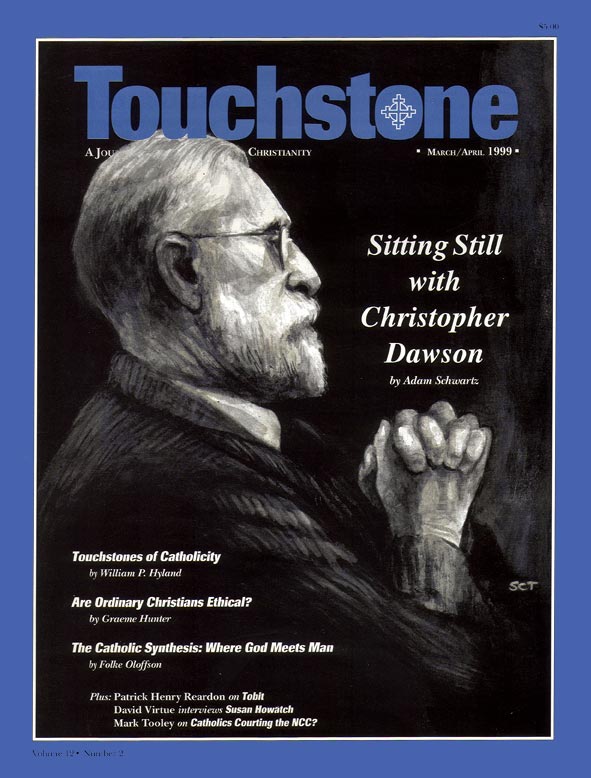
A Novelist Looks at Faith & Fiction
An Interview with Susan Howatch
by David Virtue
Susan Howatch lives in the Barbican, in the heart of London’s financial district. Her flat is spacious and comfortable. A portable typewriter rests on a table next to the sofa. She disdains computers. She tells me that she does seven or more revisions to every book before she is happy with the final product. Susan Howatch is an attentive hostess, erudite, well read, and the celebrated author of the famous Starbridge sextet of novels about the Anglican Church, its priests, their spirituality and sexuality. Over coffee we talked about her latest novel, The Wonder Worker. After an enjoyable lunch we talked further on a wide range of topics. For a number of years she lived near Westminster Abbey in London. She also lived in Salisbury opposite the cathedral, where she wrote her first group of novels with titles like Glittering Images, Glamorous Powers, Mystical Paths, and Absolute Truths. Susan Howatch’s books have sold in the millions, but she does not flaunt her wealth. She has funded a million-dollar lectureship at Cambridge University to explore the relationship between science and faith. She is outspoken, attractive, and fifty-something.
David Virtue: The Wonder Worker is a serious departure from the Starbridge novels. How did you get started on the subject of healing and wholeness?
Susan Howatch: In the Starbridge books I did deal with healing. The second Starbridge book, Glamorous Powers, did touch on it. Later, in the fifth book, Nicholas Darrow ends up in a ministry of healing in London. The Starbridge series sowed the seeds, as it were. Now I became interested in the ministry of healing while I was reading Karl Barth’s theology of the Church and the Catholic tradition, and I was doing research into the Starbridge books. But in 1990 I heard a lecture by the Reverend Christopher Hamel Cooke who used to run the Marylebone Healing Center at Marylebone Parish Church in London where he had founded a healing center. And I thought, gosh, that’s a really interesting topic, and after that I kept reading about it, and finally I knew by about 1994 what I wanted to do in a big way. So I picked up the situation of Nicholas Darrow, which I had touched on in Mystical Paths and used it as a springboard to jump off for this new topic.
Virtue: Briefly, what is The Wonder Worker about?
Howatch: The Wonder Worker is not about cathedrals; it is not even about the Church of England per se, but it is about Christian themes, a connecting link with the Starbridge novels. This novel explores the nature of the ministry of Christian healing, exploring corruption, and how you keep yourself honest, a question all Christians have to ask themselves regularly.
Virtue: Healing as we have traditionally understood it has been largely the medical profession’s business, and the Church has been a Johnny-come-lately to the subject. We talk about Jesus being the Great Healer based on Luke’s Gospel, and Luke himself was a doctor. Why has there been such a gap in the Church’s history, and why is the subject so popular now?
Howatch: It is part of a growing trend to be more independent of institutions. Orthodox medicine, like the law, like the Church, was a great edifice, and you had to look up to it and respect it. Alternatives were derided. Towards the end of the twentieth century we are becoming much more open, more suspicious of authority and open to ways of trying new things. That’s the sociological explanation. The theological explanation is obviously the movement of the Spirit. In England, Bishop Morris Maddocks revived the ministry of healing in the middle of this century, and it caught on from there. It chimed with the charismatic movement, although you can do healing without being charismatic. Psychology comes into it too. We now know much more about consciousness, about the mind. If we are all linked together at some level, it makes sense to assume that we can all touch each other and heal each other on that same level of consciousness.
Consciousness is the great new thing in science. Studying consciousness is linking up with that. That’s why the Church lost track of it. Maybe it has to do with authority. The Church doesn’t like people doing their own healing outside the Church, though in The Wonder Worker I am doing it in the context of the Church of England. It’s a dangerous thing if it is done wrong. The ministry of healing is wonderful if it is done well, but of course it is a field riddled with charlatans and crooks, frauds and con men. That is why the Church became quite wary.
Virtue: The ending of The Wonder Worker seems somewhat ambivalent, would you agree? Some might think that Alice was the Wonder Worker, having captured the heart of Nicholas.
A Journal of Mere Christianity—Delivered to Your Door
- Essays on theology, culture, and the Church
- Contributors from across the Christian traditions

Six print issues (one year) of Touchstone, plus full online access and PDF downloads for only $39.95.

Get a one-year full-access subscription to the Touchstone online archives for only $19.95.
bulk subscriptions
Order Touchstone subscriptions in bulk and save $10 per sub! Each subscription includes 6 issues of Touchstone plus full online access to touchstonemag.com—including archives, videos, and pdf downloads of recent issues for only $29.95 each! Great for churches or study groups.
Transactions will be processed on a secure server.
more on Literature from the online archives
20.6—July/August 2007
The Beowulf Poet Was a Shrewd Christian Apologist by Douglas Wilson

24.1—January/February 2011
Ruminations on the Monstrous Envy of the Soul-Devouring State by Anthony Esolen
32.2—March/April 2019
Misguided Mercy & Dante's Infernal Purgation by Joshua Hren
more from the online archives
24.2—March/April 2011
Certain Death & the Last Lectures of Socrates & Jesus by Randall B. Smith
33.3—May/June 2020
On Flight & Fight in the Present Tribulation by Douglas Farrow
35.2—Mar/Apr 2022
on Fatigued Christians Deciding to Engage the Culture by Keith Lowery
calling all readers
Please Donate
"There are magazines worth reading but few worth saving . . . Touchstone is just such a magazine."
—Alice von Hildebrand
"Here we do not concede one square millimeter of territory to falsehood, folly, contemporary sentimentality, or fashion. We speak the truth, and let God be our judge. . . . Touchstone is the one committedly Christian conservative journal."
—Anthony Esolen, Touchstone senior editor
