




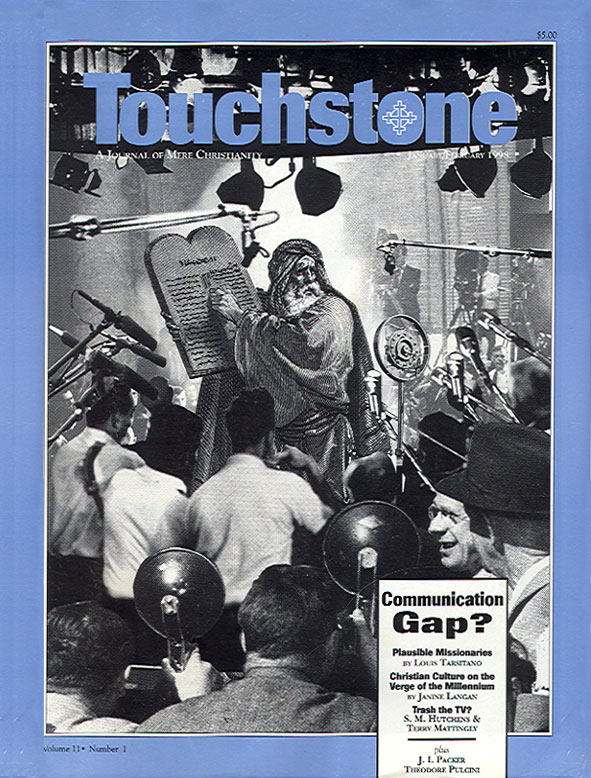
Plausible Missionaries
Preaching the Gospel in a Language “Understanded of the People”
by Louis R. Tarsitano
In one of the many dystopian movies of the early 1970s, the hero, in the last line of dialogue, announces a horrific discovery. “Soylent Green,” the food product of the title, “is made from people.”
A quarter century later, whether it horrifies us or not, orthodox Christians must confront a real-life fact that many of our heterodox opponents have assimilated. For the foreseeable future, the language that communicates to ordinary men and women (the language “understanded of the people” as the XXIVth Anglican Article of Religion puts it) “is made from people.”
How this culture moved from using words, facts, and arguments to employing images of people, and the emotions these images invoke as a primary means of communication is open to debate. Yet Christians must address this change in language if we are to fulfill our calling to witness to the Faith in this time and place.
From Reason to Emotion
Let us begin, then, by considering how and why the common language has changed, before we turn to examining how Christians can communicate in this new language without conforming to the culture that produced it.
Perhaps the transformation of the common language from words to “people” began when newsmagazines like Time and Newsweek were swallowed up by their celebrity news departments and began to yield to magazines like People and to the tabloids. Perhaps it began on television, when newscasters became celebrities themselves; or when anyone could become a celebrity on “Oprah” or “Donahue,” for an hour, if his life were dysfunctional enough.
Perhaps it began as long ago as “talking pictures,” when a new predigested reality took its audience beyond Coleridge’s “willing suspension of disbelief” and reversed Aristotle’s “purgation of pity and fear” by inciting emotions that seemed more real and true than those of everyday life. When these larger-than-life sounds and images were transferred to the intimacy of television, everyday life itself became smaller. Only those images of life that fit the confines of the smaller screen, confirmed by their presence there, were accepted as real.
Pictures & Programs
Although an hour of educational television delivers less information, less usefully, than fifteen minutes of disciplined reading, even educators are turning to video. But pictures always lie, as much as by what they include as by what they exclude from the frame. This falsification is the essence of special effects and movie magic: innocent enough when applied to entertainment, but wildly dangerous when used to define “reality.”
Louis R. Tarsitano (d. 2005), a former associate editor of Touchstone, was a priest of the Anglican Church in America and rector of St. Andrew?s Church in Savannah, Georgia. He also was the co-author, with Peter Toon, of Neither Archaic Nor Obsolete: The Language of Common Prayer & Public Worship (Brynmill Press, Ltd., 2003).
A Journal of Mere Christianity—Delivered to Your Door
- Essays on theology, culture, and the Church
- Contributors from across the Christian traditions

Six print issues (one year) of Touchstone, plus full online access and PDF downloads for only $39.95.

Get a one-year full-access subscription to the Touchstone online archives for only $19.95.
bulk subscriptions
Order Touchstone subscriptions in bulk and save $10 per sub! Each subscription includes 6 issues of Touchstone plus full online access to touchstonemag.com—including archives, videos, and pdf downloads of recent issues for only $29.95 each! Great for churches or study groups.
Transactions will be processed on a secure server.
more from the online archives
27.5—Sept/Oct 2014
The Culture of Death's Campaign Against the Catholic Church by Brantly Millegan

30.2—March/April 2017
on Reading Don Quixote in Its Original Christian Context by Luis Cortest

31.1—January/February 2018
Getting Sex Wrong Is a Foundational Error by James M. Kushiner
calling all readers
Please Donate
"There are magazines worth reading but few worth saving . . . Touchstone is just such a magazine."
—Alice von Hildebrand
"Here we do not concede one square millimeter of territory to falsehood, folly, contemporary sentimentality, or fashion. We speak the truth, and let God be our judge. . . . Touchstone is the one committedly Christian conservative journal."
—Anthony Esolen, Touchstone senior editor
