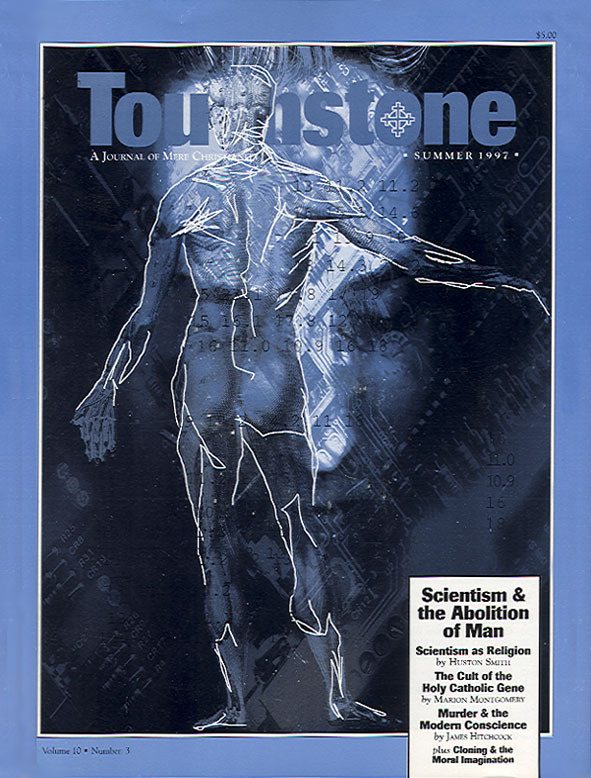
Scientism: The World’s Littlest Religion
How Theology Must Confront the New Global Religion of Scientism
by Huston Smith
This article is published with the permission of the author and has been adapted from his lecture, “Doing Theology in the Global Village,” given at the University of Saskatchewan in 1995 and published in Religious Studies and Theology, a journal of the Religious Studies Department of the University of Saskatchewan.
Traditionally, when people wanted to know the big picture or ultimate nature of things they turned to their sacred texts; or if they were primal peoples, to the great orienting myths that their ancestors bequeathed to them. Since modern science arose, however, Westerners have looked increasingly to it to tell them what things are like. An intellectual historian has estimated that already a hundred years ago more Westerners believed in the periodic table of chemical elements than they believed in any of the distinctive things the Bible speaks of. The reason for the shift is obvious. Modern science can prove its theses through controlled experiments. A moment’s reflection on how much those theses have changed our world will convince anyone that they have a firm grip on the way nature works.
This about-face from Scripture to science has worked heavily against theology’s overview. In his Understanding the Present: Science and the Soul of Modern Man, Brian Appleyard asks us to imagine a missionary to an African tribe. Conversion is slow work until a child comes down with an infectious disease. The local medicine men are summoned and do their best, but to no avail. The child’s condition steadily worsens until the missionary administers the penicillin she thought to bring with her, whereupon the child recovers.
With that single move, Appleyard concludes, it is all over for the tribe’s traditional culture. Elijah has challenged the priests of Baal, and has won. “Elijah” is science here, and its victories continue both at home and abroad. Stephen Carter reports a discernable increase in America’s culture of disbelief in the last twenty years alone. “There is less respect for religion, less of an appreciation of it as an important force that can genuinely be the motive force in people’s lives without being somehow a symptom of something neurotic.”1
How should theology conduct itself in a global village in which religion is increasingly on the defensive? I will propositionalize my proposals. They are heavily opinionated, and eschewing nuances. I shall state them categorically to make the issues stand out as starkly as possible.
1. Theology should recognize scientism as its principal enemy.
Science deserves no reproach, but scientism goes beyond the findings of science to assume that the scientific method is the only reliable (or at least most reliable) road to truth, and that the things science deals with are the most fundamental things that exist. In slipping into these assumptions, it turns into a religion that challenges traditional, orthodox ones to the core. Rarely is its position stated. It proceeds surreptitiously, by innuendo and surmise, and this makes it difficult to combat. If it came out into the open, the arbitrariness of its premises would become apparent and it would cease to be the problem that it is. It would be wrong to blame scientists for scientism; the proportion of them who are taken in by it is no greater than the population at large.2 No individuals or groups are responsible. It is the marvels of science and its technology that have made scientism the working assumption of our era.
2. In addition to the foregoing marks of scientism, theologians should be aware of its inherent imperialism.
The imperialism is not calculated, so again blame is out of place; but the imperialism proceeds anyway and Spinoza helps us to see why. Everything, the blessed Spinoza taught, possesses an inbuilt conatus, a propensity not just to maintain itself but to enlarge its domain until it runs into something that stops it. This holds for institutions as well as organisms; and as there is nothing currently strong enough to stop science, it crests into scientism.
A Journal of Mere Christianity—Delivered to Your Door
- Essays on theology, culture, and the Church
- Contributors from across the Christian traditions

Six print issues (one year) of Touchstone, plus full online access and PDF downloads for only $39.95.

Get a one-year full-access subscription to the Touchstone online archives for only $19.95.
bulk subscriptions
Order Touchstone subscriptions in bulk and save $10 per sub! Each subscription includes 6 issues of Touchstone plus full online access to touchstonemag.com—including archives, videos, and pdf downloads of recent issues for only $29.95 each! Great for churches or study groups.
Transactions will be processed on a secure server.
more from the online archives

calling all readers
Please Donate
"There are magazines worth reading but few worth saving . . . Touchstone is just such a magazine."
—Alice von Hildebrand
"Here we do not concede one square millimeter of territory to falsehood, folly, contemporary sentimentality, or fashion. We speak the truth, and let God be our judge. . . . Touchstone is the one committedly Christian conservative journal."
—Anthony Esolen, Touchstone senior editor