Feature
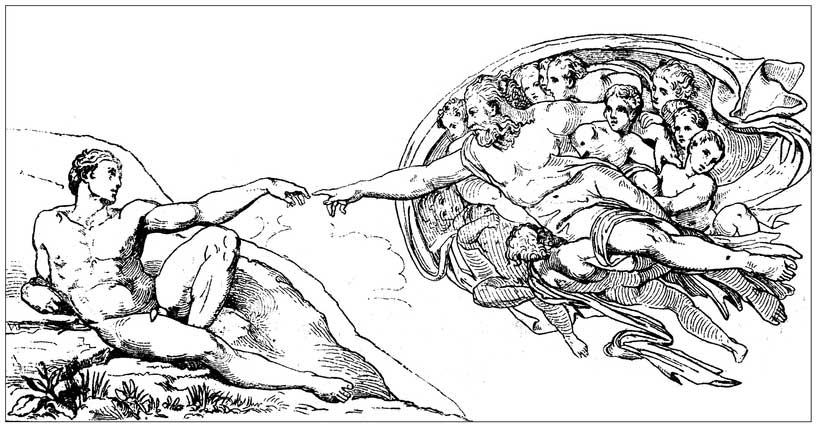
The Icon of Materialism
Why Scientism's Cherished Progress Narrative Fails
Contemporary academic culture is sick with a dogma masquerading as dispassionate scientific inquiry, a dogma called scientism. If a man murders another man, or pens a beautiful poem, or steps into the path of a bullet to save a stranger, scientism insists the action can be explained by reference to some purely physical cause such as genetic predisposition. Scientism has no place for explanations that rest on the divine, or for the idea of human decisions as the free choices of free moral agents.
The dogma is so pervasive that it can seem unassailable. But it's actually quite vulnerable, since it rests on a story of progress that collapses under scrutiny. Rather than summarizing this story, I want to relate an incident in which a proponent of scientism, Steve Matheson, employs the story in the heat of battle, in a clash with intelligent design proponent Stephen Meyer.
Meyer, a former geologist with a Ph.D. from the University of Cambridge in the history and philosophy of science, employs a design argument that begins with his noting that the historical sciences reason using the principle of causal adequacy—looking for causes, active in the present, with the demonstrated ability to leave behind the set of clues in question. The influential nineteenth-century geologist Charles Lyell summarized the principle in the title of his most famous book: Principles of Geology: Being an Attempt to Explain the Former Changes of the Earth's Surface, by Reference to Causes Now in Operation.
Historical scientists proceed like a detective at a crime scene. They begin by identifying one or more causes "now in operation" capable of producing the clues under investigation. Then they accumulate additional clues in order to narrow the field. The idea is that, if, after patient study, they can narrow the field to only one type of cause with the demonstrated ability to explain the various threads of the mystery, they can pinpoint that cause as the best explanation. So, for instance, careful study of a large Arizona crater and of various natural processes has convinced geologists that an ancient meteor left the crater.

This mode of reasoning, common to the historical sciences, has been described by philosophers of science as inference to the best explanation (IBE), and Meyer argues that IBE points decisively to the work of a creative intelligence in the biological realm.
Here's the argument in a nutshell: one clue we find in the present is information in living things, such as the sophisticated digital information encoded in DNA. How did this information first arise? A long, broad, and intensive exploration has uncovered only one type of cause with the demonstrated power to generate information: creative intelligence. Therefore, the IBE mode of reasoning, common across a host of historical sciences, points to intelligent design as the best explanation for the origin of biological information.
The Materialists' Grand Narrative
Now return to the debate I mentioned between Meyer and evolutionary biologist Steve Matheson. In the forum, Matheson actually agreed with Meyer's argument up to a point. "You said that we reason backwards from what we know works, which is that intelligence makes codes," he said. "I'll agree with that. . . . We reason back and say, therefore, this is the one explanation we know that can do this. I buy that. I get it. It's obvious."
But Matheson wasn't conceding defeat. His next move was to point to something he believed would neutralize Meyer's tidy argument. "Everywhere I look, and every time I look," Matheson said, "if I wait long enough, there is a natural and even materialistic explanation to things." This strong historical trend, he insisted, decisively counseled against Meyer's design inference.
In essence, Matheson took the lower-level historical pattern of information always leading back to mind, and trumped it with what he sees as a higher-level historical pattern—materialism's manifest destiny, if you will.
Jonathan Witt is a senior fellow and writer in residence at the Discovery Institute in Seattle. He and his wife Amanda have three children, whom they home school.
A Journal of Mere Christianity—Delivered to Your Door
- Essays on theology, culture, and the Church
- Contributors from across the Christian traditions
Six print issues (one year) of Touchstone, plus full online access and PDF downloads for only $39.95.
Get a one-year full-access subscription to the Touchstone online archives for only $19.95.
bulk subscriptions
Order Touchstone subscriptions in bulk and save $10 per sub! Each subscription includes 6 issues of Touchstone plus full online access to touchstonemag.com—including archives, videos, and pdf downloads of recent issues for only $29.95 each! Great for churches or study groups.
Transactions will be processed on a secure server.
more on science from the online archives

more from the online archives
calling all readers
Please Donate
"There are magazines worth reading but few worth saving . . . Touchstone is just such a magazine."
—Alice von Hildebrand
"Here we do not concede one square millimeter of territory to falsehood, folly, contemporary sentimentality, or fashion. We speak the truth, and let God be our judge. . . . Touchstone is the one committedly Christian conservative journal."
—Anthony Esolen, Touchstone senior editor