




CONTOURS OF CULTURE
The Five Books of Peterson
Until about nine years ago, I had never paid much attention to the many books written by Eugene Peterson. I knew that he had been a respected Presbyterian pastor for most of his career, and that he had later taught at Regent College in Vancouver, an institution for which I have much respect. But his books on devotional subjects had never gotten my attention. This may be due in part to the way his contemporary-language paraphrase of the Bible, The Message, had been marketed. It seemed too eager to project "relevance," and it seemed to dumb down Holy Writ.
Sometime in 2003, a friend suggested that I might be interested in Peterson's new book, called Christ Plays in Ten Thousand Places: A Conversation in Spiritual Theology. I was told that a glance at the table of contents would persuade me to interview Peterson. The title of the book, I soon discovered, was from a Gerard Manley Hopkins poem ("As Kingfishers Catch Fire"), which was definitely a point in Peterson's favor. When I obtained a copy of the book, I saw that it was organized in three large sections: "Christ Plays in Creation," "Christ Plays in History," "Christ Plays in Community." This was "spiritual theology" aiming to combat the dualistic temptation of so much of American Christianity.
THIS ARTICLE ONLY AVAILABLE TO SUBSCRIBERS.
FOR QUICK ACCESS:
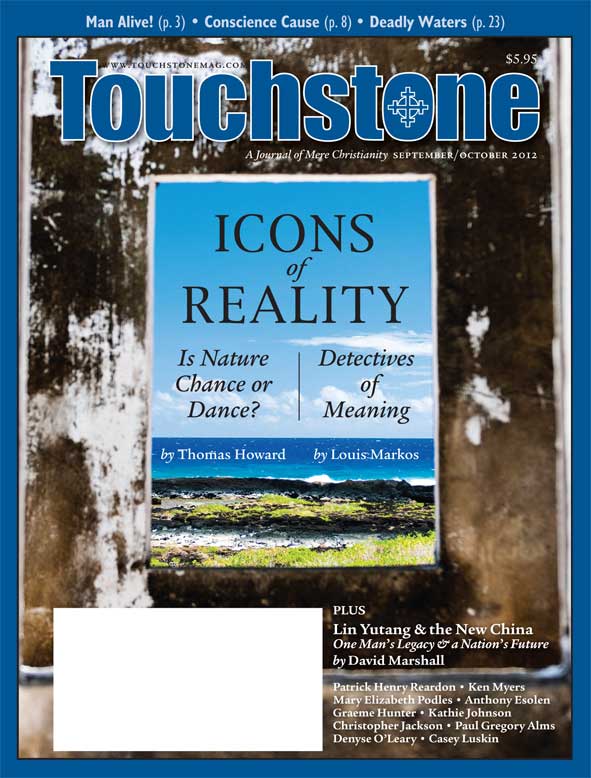
Ken Myers is the host and producer of the Mars Hill Audio Journal. Formerly an arts editor with National Public Radio, he also serves as music director at All Saints Anglican Church in Ivy, Virginia. He is a contributing editor for Touchstone.
subscription options
Order
Print/Online Subscription

Get six issues (one year) of Touchstone PLUS full online access including pdf downloads for only $39.95. That's only $3.34 per month!
Order
Online Only
Subscription

Get a one-year full-access subscription to the Touchstone online archives for only $19.95. That's only $1.66 per month!
bulk subscriptions
Order Touchstone subscriptions in bulk and save $10 per sub! Each subscription includes 6 issues of Touchstone plus full online access to touchstonemag.com—including archives, videos, and pdf downloads of recent issues for only $29.95 each! Great for churches or study groups.
Transactions will be processed on a secure server.
more from the online archives

33.1—January/February 2020
on the Consequences of One Birth Before Roe v. Wade by Craig Kellogg Galer


24.1—January/February 2011
Ruminations on the Monstrous Envy of the Soul-Devouring State by Anthony Esolen
calling all readers
Please Donate
"There are magazines worth reading but few worth saving . . . Touchstone is just such a magazine."
—Alice von Hildebrand
"Here we do not concede one square millimeter of territory to falsehood, folly, contemporary sentimentality, or fashion. We speak the truth, and let God be our judge. . . . Touchstone is the one committedly Christian conservative journal."
—Anthony Esolen, Touchstone senior editor
