




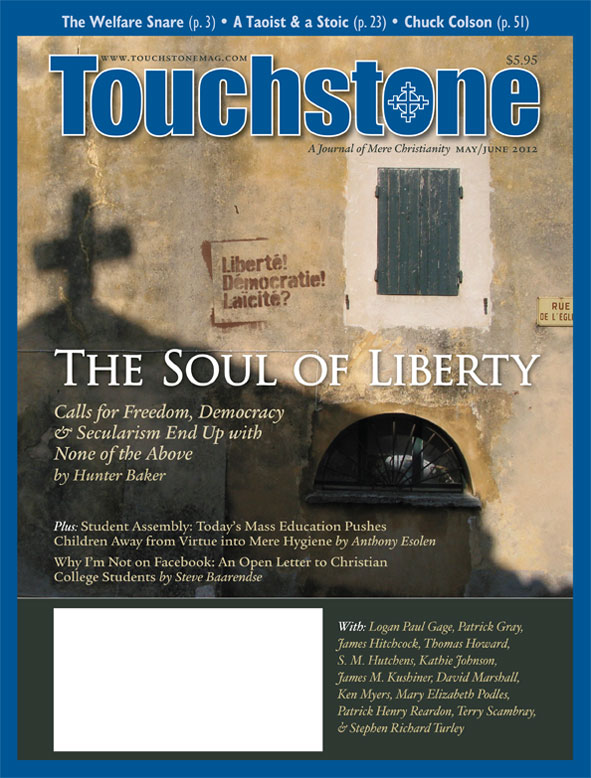
INTERVIEW by James M. Kushiner
The Centurion
Prison Fellowship Founder Charles Colson’s Final Mission for Christian Faith & Culture
Charles (Chuck) Colson, former White House aide to President Richard Nixon, pled guilty to obstruction of justice in Watergate-related charges and spent seven months in Alabama’s Maxwell Prison, entering in 1974 as a new Christian. He founded Prison Fellowship in 1976. It has become the world’s largest outreach ministry to prisoners, ex-prisoners, and their families. In 1993 Colson was awarded the Templeton Prize for Progress in Religion, donating the $1 million prize to Prison Fellowship. He has written over 30 books, including his autobiographical Born Again (1976) and How Now Shall We Live? (co-authored with Nancy Pearcey, 1999). In 1991 he launched BreakPoint, a daily radio commentary, now aired on 1,300 stations in the U.S. In 2009 he, Robert George, and Timothy George spearheaded the Manhattan Declaration on life, marriage, and religious liberty, which has collected over a half-million signatures. More recently, he has founded the Chuck Colson Center for Christian Worldview.
Touchstone Executive Editor James Kushiner interviewed Charles Colson after he and Robert P. George received the Edwin Meese III Originalism & Religious Liberty Award from the Alliance Defense Fund at a luncheon on October 25, 2011, in Washington, D.C.
James M. Kushiner (JMK): I first wrote about you in 1988, then interviewed you in 1998 for Touchstone. It’s now 14 years later, and I have continued to follow the work of Prison Fellowship. You’ve been involved with prison ministry for over 35 years. What has your experience of meeting thousands of prisoners taught you about society and human needs? Could you single out any particular lessons?

Charles Colson (CC): Yes, something that I said earlier today because it is so important: everybody has a need to be treated with dignity, because it goes to the essence of their humanity. They were made in the image of God. I find people in prison—this has been a universal truth—they feel like that dignity has been stripped away, that they’re not being treated as being fully human. So, you’ve got to punish them—you’ve got to do something to punish people when they break the law—but don’t do it such a way that you dehumanize that person, because that will be the hardest thing for him to handle, and it will impede his successful transition back into society.
The second human need is family, because you find people in prison—women especially—just agonizing over their kids. I find this in big, tough convicts behind bars, tattooed all over. I think of one guy in particular in Indiana—I was walking by his cell and he said, “Are you that guy that does Angel Tree [Christmas gift program for children of prisoners]?” I said, “Yeah.” He’s a big, tough dude, and I started to walk over towards the bars of his cell and as I got closer and closer, he started sobbing. He said, “You’re the one who took care of my kids’ Christmas.” They agonize for family, and the separation from family hurts.
The third thing is the chief cause of the increase in prison population—tenfold since I got out of prison—and that is the breakdown of the family, the lack of moral training during the morally formative years. So if there is one human need that stands out, out of everything I have experienced in prison ministry, it is the desperate need for families to stay together and create an environment in which character can be learned and experienced, and virtue can be taught and absorbed. Character can’t be taught like arithmetic; character has to be learned by example. That’s how someone who is in his morally formative years learns—in a family environment. [James Q.] Wilson and [Richard J.] Hernstein say that this lack of moral training within the family is the chief cause of crime. Those formative years are from age five to ten or twelve. After that, you play catch-up.
Legalities & Inmates
JMK: Prisons are full in part because of illegal drug trafficking. Wouldn’t the legalizing of drugs, say marijuana, mitigate the situation and help fix that?
CC: Certainly. You can legalize murder, and you’ll get rid of all the death rows. I mean, the law is the best moral teacher. And the minute you say something is okay in the law, you are saying it’s morally okay. It’s not okay morally for people to get stoned.
James M. Kushiner is the Director of Publications for The Fellowship of St. James and the former Executive Editor of Touchstone.
A Journal of Mere Christianity—Delivered to Your Door
- Essays on theology, culture, and the Church
- Contributors from across the Christian traditions

Six print issues (one year) of Touchstone, plus full online access and PDF downloads for only $39.95.

Get a one-year full-access subscription to the Touchstone online archives for only $19.95.
bulk subscriptions
Order Touchstone subscriptions in bulk and save $10 per sub! Each subscription includes 6 issues of Touchstone plus full online access to touchstonemag.com—including archives, videos, and pdf downloads of recent issues for only $29.95 each! Great for churches or study groups.
Transactions will be processed on a secure server.
more on culture from the online archives

31.6—November/December 2018
Victimhood Culture Scapegoats Its Very Source by Michael P. Foley

19.4—May 2006
The Culture War Is Between Religious Believers on Both Sides by Howard P. Kainz
more from the online archives
32.3—May/June 2019
on the Implications of Changing the Pater Noster by John M. McCarthy

31.4—July/August 2018
The Difficulty of Apologetics for Dead Souls in the Real World by R. J. Snell
calling all readers
Please Donate
"There are magazines worth reading but few worth saving . . . Touchstone is just such a magazine."
—Alice von Hildebrand
"Here we do not concede one square millimeter of territory to falsehood, folly, contemporary sentimentality, or fashion. We speak the truth, and let God be our judge. . . . Touchstone is the one committedly Christian conservative journal."
—Anthony Esolen, Touchstone senior editor
