





Feature
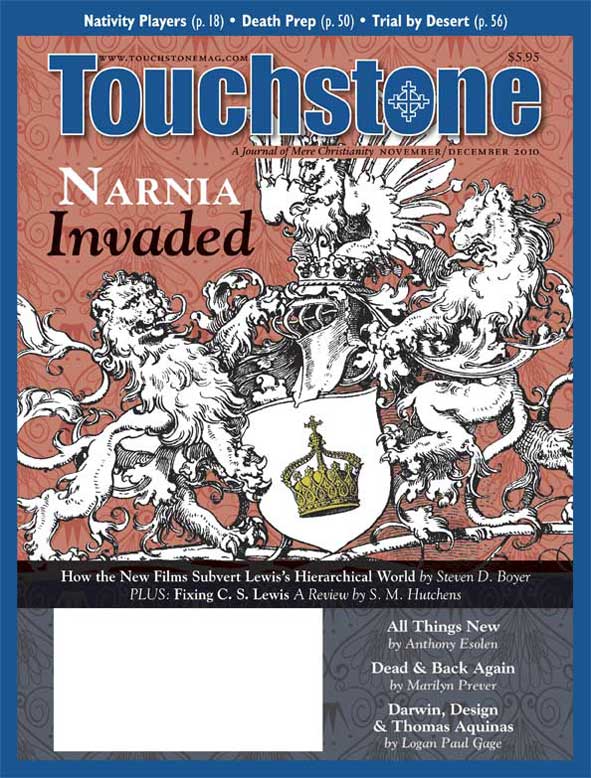
All Things New
Pagan Despair Ends with the Hope & Charity of God in Christ
I was standing before a hundred or so people, parents and students, giving a special Family Day lecture, to show what sorts of things we talk about in our Development of Western Civilization program and, more than that, to show just a bit of what can happen in a school whose classrooms are all marked with a crucifix.
“Where is hope to be found?” I asked, remarking that at the end of Rome’s civil war, with the accession of Augustus Caesar, the poet Virgil had attempted to resuscitate in epic poetry the old Roman virtue of pietas. That virtue had embraced one’s duty to one’s father, to the patria or fatherland, to the household gods (tutelary ancestral shades), and to the great gods. But in Virgil’s vision it seems also to embrace what the Italian language, centuries later, would mean by pieta: mercy for weak and suffering mankind.
THIS ARTICLE ONLY AVAILABLE TO SUBSCRIBERS.
FOR QUICK ACCESS:
Anthony Esolen is Distinguished Professor of Humanities at Thales College and the author of over 30 books, including Real Music: A Guide to the Timeless Hymns of the Church (Tan, with a CD), Out of the Ashes: Rebuilding American Culture (Regnery), and The Hundredfold: Songs for the Lord (Ignatius). He has also translated Dante’s Divine Comedy (Random House) and, with his wife Debra, publishes the web magazine Word and Song (anthonyesolen.substack.com). He is a senior editor of Touchstone.
subscription options
Order
Print/Online Subscription

Get six issues (one year) of Touchstone PLUS full online access including pdf downloads for only $39.95. That's only $3.34 per month!
Order
Online Only
Subscription

Get a one-year full-access subscription to the Touchstone online archives for only $19.95. That's only $1.66 per month!
bulk subscriptions
Order Touchstone subscriptions in bulk and save $10 per sub! Each subscription includes 6 issues of Touchstone plus full online access to touchstonemag.com—including archives, videos, and pdf downloads of recent issues for only $29.95 each! Great for churches or study groups.
Transactions will be processed on a secure server.
more from the online archives

30.3—May/June 2017
C. S. Lewis Assesses the Religion of Mohammed by Jacob Fareed Imam

33.1—January/February 2020
on a Saint's Charism That Cures Toxic Perfectionism by Colleen Carroll Campbell
calling all readers
Please Donate
"There are magazines worth reading but few worth saving . . . Touchstone is just such a magazine."
—Alice von Hildebrand
"Here we do not concede one square millimeter of territory to falsehood, folly, contemporary sentimentality, or fashion. We speak the truth, and let God be our judge. . . . Touchstone is the one committedly Christian conservative journal."
—Anthony Esolen, Touchstone senior editor
