





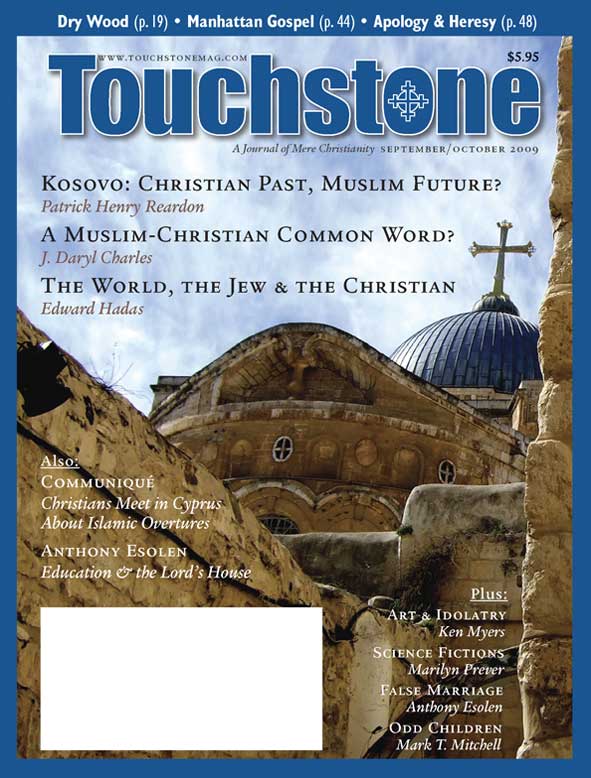
Education Normal
Mark T. Mitchell on the Oddity of Giving Children a Moral Imagination
“Are you ever afraid that homeschooling your kids will make them, um, oddballs?” We were staring into the campfire. The kids had all been tucked more or less comfortably into their sleeping bags, and we parents were savoring the opportunity to talk. With the cool night crowding us closer to the fire, the conversation was lively, though tinged by a reflective mood.
As anyone who is the parent of small children will know, the conversation eventually turned to kids. Soon we were talking about how to raise godly children in a culture that, in many ways, seems intent on undermining their faith. And not only their faith. Many of today’s cultural forces create impediments to a sound education as well as a solid faith. These must be resisted. But that persistent question remains.
Books versus TV
Are we raising kids who won’t fit in? I have asked this of myself regularly over the past few years. My wife and I are educating our three boys at home. We don’t watch television (only an occasional video). We emphasize books. We read to the kids and make them memorize poetry. We pray together on our knees. In many ways, our kids are culturally ignorant. They don’t know about Disney World. The other day, my five-year-old asked, “Who is Mickey Mouse?”
So I guess the answer to the question has to be yes. But the “yes” is a qualified one, for when one considers the concept of “odd,” one should ask, “compared to what?” This moves us in a helpful direction, for if “normal” is merely what everyone else does, then what is normal changes with the times. What is odd in one time might not be odd in another. On the other hand, if “normal” refers to a proper way of being human, and if human nature is unchanging, then what is odd, in the sense of being opposed to the majority, may in fact be normal.
As we consider exactly what, in our culture, sets the odd kids apart, it seems to me that the clearest and brightest line can be drawn when we ask the following question: Will your kids be raised primarily on books or on television? To put it another way: Will your children be educated in a logocentric environment, where the written and spoken word is the primary conveyer of meaning, or will they ingest most of their information through electronically generated images?
Now, of course, emphasizing books over television is not the entire story, for books vary in quality and there are plenty of books that cultivate misshapen virtues and a cynical view of life. But I think it is safe to say that parents who make the effort to emphasize books as a way of life will generally be those who have been powerfully moved by books themselves. They have experienced the wonder and joy and goodness of certain books and will introduce these to their children even as one introduces a family member to a much-loved friend.
But setting the content of the books aside (for only a moment), those whose minds are shaped by an ongoing encounter with language will develop mental habits that include patience, perseverance, the ability to think abstractly, and an imagination that does not require the constant stimulation of external images. The imagination of the reader (guided by the author) creates the images, whereas the child raised on television merely imbibes what has already been fully rendered by the camera.
More than Rules
There are two facets to educating a child well. The first is to recognize that education is not merely the accumulation of facts, but that it has an unavoidably moral aspect. A suitable education must do more, therefore, than simply teach facts, even moral facts. Education must seek to cultivate the moral imagination of the child, for reducing moral education to a list of rules is bound to fail.
Mark T. Mitchell teaches political theory at Patrick Henry College in Virginia. He is the co-founder of Front Porch Republic.
A Journal of Mere Christianity—Delivered to Your Door
- Essays on theology, culture, and the Church
- Contributors from across the Christian traditions

Six print issues (one year) of Touchstone, plus full online access and PDF downloads for only $39.95.

Get a one-year full-access subscription to the Touchstone online archives for only $19.95.
bulk subscriptions
Order Touchstone subscriptions in bulk and save $10 per sub! Each subscription includes 6 issues of Touchstone plus full online access to touchstonemag.com—including archives, videos, and pdf downloads of recent issues for only $29.95 each! Great for churches or study groups.
Transactions will be processed on a secure server.
more on education from the online archives
28.5—Sept/Oct 2015
on Our Sacred Duty to Teach the Devil to Death by Marcus Johnson

24.5—Sept/Oct 2011
on Wondering or Wandering Through College Education by Anthony Esolen
27.2—March/April 2014
Higher Education Should Advance the Glorious Liberty of the Sons of God by Anthony Esolen
more from the online archives


33.1—January/February 2020
Speaking Truth About the Sexes Is Not Optional by Anthony Esolen

34.1—January/February 2021
What the World Needs Now It Hardly Knows by Anthony Esolen
calling all readers
Please Donate
"There are magazines worth reading but few worth saving . . . Touchstone is just such a magazine."
—Alice von Hildebrand
"Here we do not concede one square millimeter of territory to falsehood, folly, contemporary sentimentality, or fashion. We speak the truth, and let God be our judge. . . . Touchstone is the one committedly Christian conservative journal."
—Anthony Esolen, Touchstone senior editor
