





Book Returns
Wasted by Watching
Neil Postman’s Amusing Ourselves to Death: Public Discourse in
the Age of Show Business
by J. Daryl Charles
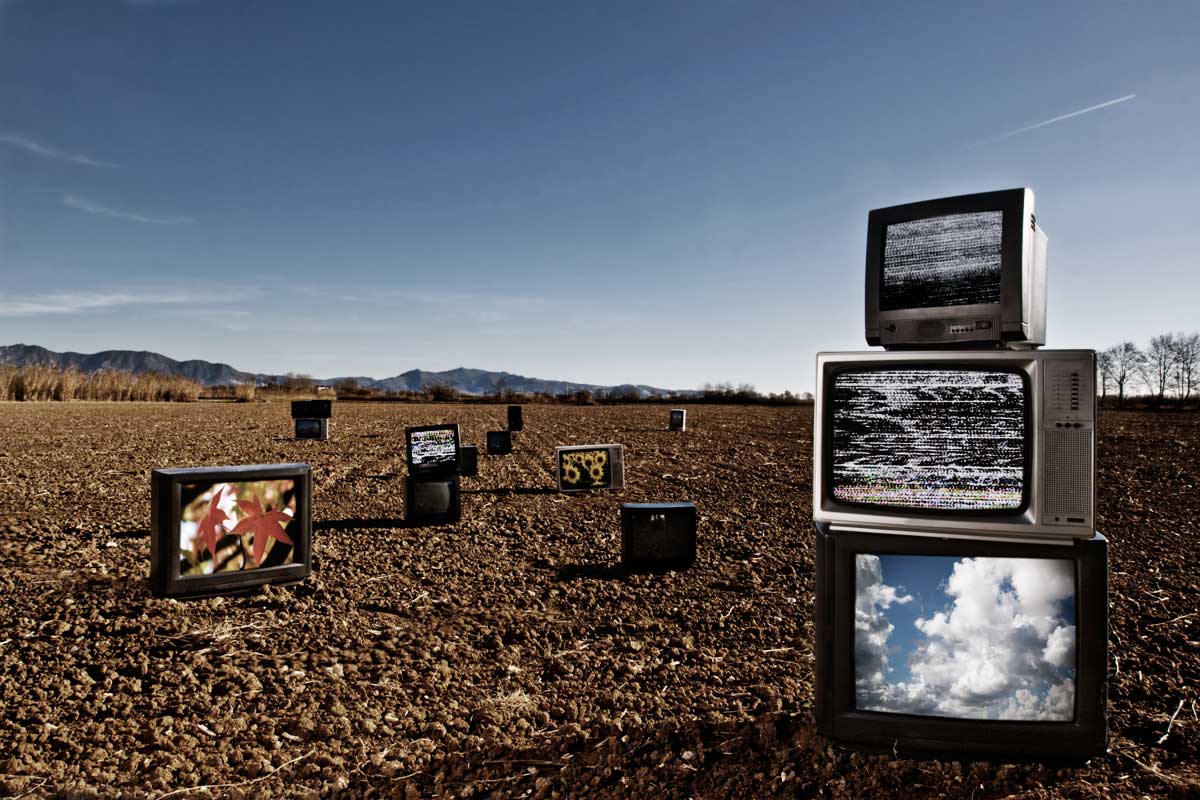
It is twenty-four years ago that the late Neil Postman published what was arguably his most significant piece of cultural criticism. Therein Postman argued that television is our culture’s principal mode of knowing about itself. Thus, how television stages the world becomes the model for how the world is properly to be staged. It is not merely that entertainment on the television screen has becomes the metaphor of all discourse; it is that, off the screen, the same metaphor prevails. Americans no longer talk to each other; they entertain each other. They do not exchange ideas; rather, they exchange images.
Amusing Ourselves to Death was intended simultaneously to be “an inquiry into the most significant American cultural fact of the second half of the twentieth century”—the decline of “the age of exposition” and the ascendancy of the age of television—and a lamentation. The changeover lamented by Postman has “dramatically and irreversibly shifted the content and meaning of public discourse.” As a result, the substance of American cultural life—from politics to education to business to religion—“must be changed and re-cast in terms that are most suitable to television.”
A Discerning Social Critic
Despite knee-jerk reactions from Hollywood and New York City at the time, Postman cannot be thought (then or now) a mere cultural handwringer by any stretch of the imagination. This becomes clear to anyone who has read his other works—particularly The Disappearance of Childhood, The End of Education, Teaching as a Subversive Activity, Conscientious Objections and Technopology. Rather, Postman’s work has shown him to be a social critic of the first order and a supremely discerning observer of cultural trends.
Indeed, Postman’s cultural analysis, even when more than two decades removed, finds confirmation and parallels in more recent social critiques that deserve to be taken seriously. One thinks, for example, of Francis Fukuyama’s The Great Disruption, James Davison Hunter’s The Death of Character, and Morris Berman’s The Twilight of American Culture.
Berman, a cultural historian, offers a secularized—though far more readable—version of Alasdair MacIntyre’s After Virtue. Both writers are united in the conviction that ours is a society of moral cave dwellers. By both accounts, we have undergone a catastrophic shift in understanding that has warped our ability to do moral reasoning at all, plunging us into a new “dark age” of sorts. Berman’s call for a “new monastic option” to preserve what is enduring in the midst of this period of cultural decline is primarily literary in character. In this way he stands in broad agreement with Postman: A major factor in this cultural collapse is the replacement of reading and communication with entertainment.
Prophetic Sources
In his opening chapter, titled “The Medium as the Metaphor,” Postman acknowledges his debt to two principal sources. Marshall McLuhan was an unknown English teacher when Postman met him in the 1950s. “I believed then, as I believe now,” Postman writes, “that he spoke in the tradition of Orwell and Huxley—that is, as a prophesier, and I have remained steadfast to his teaching that the clearest way to see through a culture is to attend to its tools of communication.”
Postman’s “media as epistemology” argument is owing to yet another source of inspiration—a source that in standard reviews of his work receives short shrift or goes entirely unnoticed.
[M]y interest in this point of view was first stirred by a prophet far more formidable than McLuhan, more ancient than Plato. In studying the Bible as a young man, I found intimations of the idea that forms of media favor particular kinds of content and therefore are capable of taking command of culture. I refer specifically to the Decalogue, the Second Commandment of which prohibits the Israelites from making concrete images of anything. . . . I wondered then, as so many others have, as to why the God of these people would have included instructions on how they were to symbolize, or not symbolize, their experience. It is a strange injunction to include as part of an ethical system unless its author assumed a connection between forms of human communication and the quality of a culture. . . . The God of the Jews was to exist in the Word and through the Word, an unprecedented conception requiring the highest order of abstract thinking. Iconography thus became blasphemy so that a new kind of God could enter a culture. People like ourselves who are in the process of converting their culture from word-centered to image-centered might profit by reflecting on this Mosaic injunction. (emphasis added)
J. Daryl Charles is the Acton Institute Affiliated Scholar in Theology & Ethics. He is the author or editor of twenty books, including Retrieving the Natural Law (2008), Natural Law and Religious Freedom (2018), and, most recently, Just War and Christian Traditions (forthcoming). He is also co-editor of Abraham Kuyper, Common Grace: God's Gifts for a Fallen World, Volume 3 (2020). He is a contributing editor to Touchstone.
A Journal of Mere Christianity—Delivered to Your Door
- Essays on theology, culture, and the Church
- Contributors from across the Christian traditions

Six print issues (one year) of Touchstone, plus full online access and PDF downloads for only $39.95.

Get a one-year full-access subscription to the Touchstone online archives for only $19.95.
bulk subscriptions
Order Touchstone subscriptions in bulk and save $10 per sub! Each subscription includes 6 issues of Touchstone plus full online access to touchstonemag.com—including archives, videos, and pdf downloads of recent issues for only $29.95 each! Great for churches or study groups.
Transactions will be processed on a secure server.
more on culture from the online archives

35.2—Mar/Apr 2022
on Fatigued Christians Deciding to Engage the Culture by Keith Lowery

32.2—March/April 2019
Reality Shows, Even in a Popular TV Series by C. E. Smith
more from the online archives

33.2—March/April 2020
on How Bodily Resurrection Informs Social Justice by W. Ross Blackburn
22.6—July/August 2009
on the Integration of Anger into the Virtuous Life by Leon J. Podles

calling all readers
Please Donate
"There are magazines worth reading but few worth saving . . . Touchstone is just such a magazine."
—Alice von Hildebrand
"Here we do not concede one square millimeter of territory to falsehood, folly, contemporary sentimentality, or fashion. We speak the truth, and let God be our judge. . . . Touchstone is the one committedly Christian conservative journal."
—Anthony Esolen, Touchstone senior editor
