





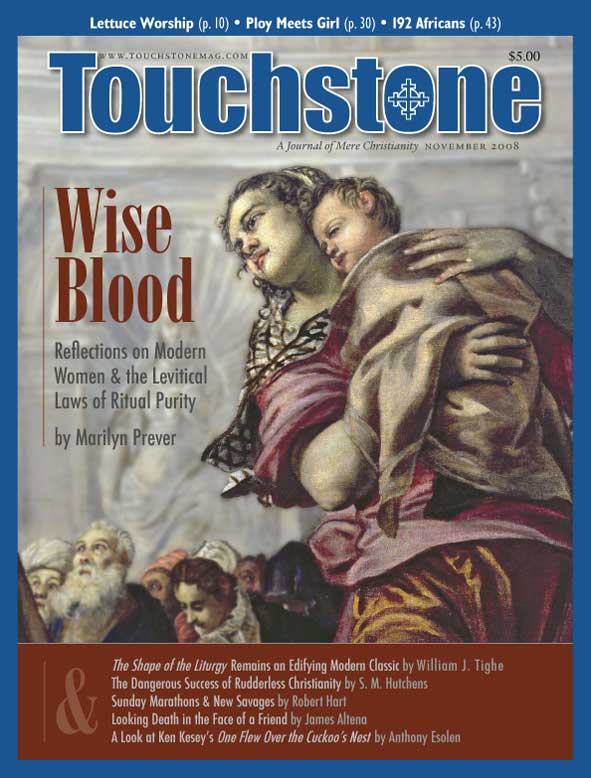
Living Truth
Discerning the Mystery: An Essay On the Nature of Theology
by Andrew Louth
Eighth Day Press, 2007
(150 pages, $25.00, paperback)
reviewed by Robert W. Grano
“Since the end of the eighteenth century, theology has been hagridden by the spectre of the Enlightenment with its rejection of ways of understanding handed down by tradition and its endorsement of ‘scientific’ procedures as the sole way of attaining truth. This book seeks to exorcise this ghost.”
THIS ARTICLE ONLY AVAILABLE TO SUBSCRIBERS.
FOR QUICK ACCESS:
Robert W. Grano is a freelance writer from Pittsburgh, Pennsylvania. He is a regular book reviewer for All Hallows: The Journal of the Ghost Story Society. He is a convert to Eastern Orthodoxy via the Assemblies of God and the Episcopal Church.
A Journal of Mere Christianity—Delivered to Your Door
- Essays on theology, culture, and the Church
- Contributors from across the Christian traditions

Six print issues (one year) of Touchstone, plus full online access and PDF downloads for only $39.95.

Get a one-year full-access subscription to the Touchstone online archives for only $19.95.
bulk subscriptions
Order Touchstone subscriptions in bulk and save $10 per sub! Each subscription includes 6 issues of Touchstone plus full online access to touchstonemag.com—including archives, videos, and pdf downloads of recent issues for only $29.95 each! Great for churches or study groups.
Transactions will be processed on a secure server.
more from the online archives
37.5—Sept/Oct 2024
A Battle Plan for Peace While Growing Old by Anthony Esolen

18.8—October 2005
European Islam & the Doubtful Future of Christian Europe by William Murchison

32.1—January/February 2019
Answers Secular & Religious by Allan C. Carlson
calling all readers
Please Donate
"There are magazines worth reading but few worth saving . . . Touchstone is just such a magazine."
—Alice von Hildebrand
"Here we do not concede one square millimeter of territory to falsehood, folly, contemporary sentimentality, or fashion. We speak the truth, and let God be our judge. . . . Touchstone is the one committedly Christian conservative journal."
—Anthony Esolen, Touchstone senior editor
