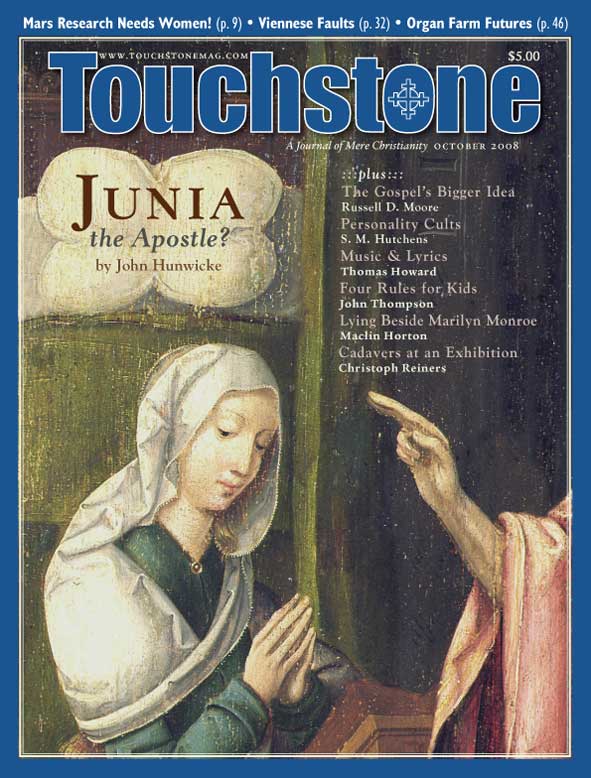
Junia Among the Apostles by John Hunwicke
Junia Among the Apostles
The Story Behind a New Testament Saint & the Egalitarian Agenda
Junia—The First Woman Apostle
by Eldon Jay Epp
Augsburg Fortress Publishers, 2005
(138 pages, $16.00, paperbook)
A review by John Hunwicke
In this important work, Epp investigates the mysterious disappearance of
Junia from the traditions of the church. Because later theologians and scribes
could not believe (or wanted to suppress) that Paul had numbered a woman
among the earliest churches’ apostles, Junia’s name was changed
in Romans 16:7 to a masculine form . . . calling Junia an apostle seemed
too much for
the tradition. Epp tracks how this happened in New Testament manuscripts,
scribal traditions and translations of the Bible. In this thoroughgoing study,
Epp
restores Junia to her rightful place.
Thus the publisher’s press release introducing Eldon Jay Epp’s
book, Junia—The First Woman Apostle. And thus our minds are
transported back to an ancient fantasy world which by now we know extremely
well; a sinister world of oppressive patriarchy; a world in which cunning and
manipulative ecclesiastics falsify records to eliminate whatever threatens
their status or their prejudices; a Dan Brownish or Elaine Pagelsish world
of truths concealed for centuries, of cowled, conspiratorial monkish scribes
in dark and mysterious cells busily destroying evidence.
Poor Epp must have been very distressed and embarrassed if he read this passage,
because, to be fair to him, his book is not at all about scribes suppressing
the fact that Junia was a woman. It is not at all about tracking how this happened
in manuscripts. And, so far from giving Tradition a walloping,
Epp in fact demonstrates that Tradition, and the New Testament manuscripts,
got Junia’s gender right.
Linda Belleville, only months before Epp’s book was published, made
most of the same points as he does, and came to the same conclusions in a rather
less pompously written article, which is a much better read ( New Testament
Studies [ NTS] 2005). She prefaced her work with a decidedly
less tendentious argumentum than the one dreamt up by Epp’s
publishers: “Christian tradition from the Old Latin and Vulgate versions
and the early Greek and Latin fathers onwards affirms and lauds a female apostle.
Yet modern [my emphasis] scholarship has not been comfortable. .
. .” (Epp’s book justifies part of his own description of it as “lengthy
and tedious”; I write “part” because I do not want to contradict
all of Beverly Gaventa’s claim in her Foreword that it is “slender
and important.”)
Source of the Sex Change
Most readers will probably know the main facts about Junia, her gender, and
the continuing controversy about whether she was “an apostle.” She
occurs, linked with Andronicus, in Romans 16:7 as one of many recipients of
St. Paul’s greetings as he writes to recommend himself to the Christians
of Rome, and she does so in a Greek accusative Iounian. Depending
on what sort of accent you put on it, the corresponding nominative can be either Iounias (masculine)
or Iounia (feminine).
So which accent do the early manuscripts have? Neither; because early manuscripts
lack all accents. As soon as accents started to be added to Greek
texts, the feminine accent was added; and as soon as the invention of printing
made mass production possible, the feminine accent was that chosen by editors.
As far as translations are concerned, the Latin Vulgates give either Juniam or Juliam, a
manifestly feminine name; and the sixteenth-century English translations, including
the Authorized Version and the Roman Catholic version from Rheims, regarded
the name as feminine. Belleville and Epp show that the overwhelming number
of writers and commentators in the first Christian millennium and a half believed
St. Paul was addressing a female Junia; and like Burer and Wallace, whose 2001 NTS article
(arguing that Junia was not an apostle) ignited the present phase
of this controversy, they agree that the feminine form of the name is overwhelmingly
more probable (or, to use Eppspeak, certain).
So how did the idea get around that the female Junia was really a male Junias?
Perhaps a monkish hand can, after all, be detected in this; the ex-Augustinian
Martin Luther seems to have set this ball rolling. It is probably due to him
that some north European Protestant translations went for “Junias” (masculine),
while versions in Spain and Italy, where the dead repressive hand of Romish
tyranny had more influence, stayed with “Junia” (feminine). But
even despite Luther’s influence, with only one exception, Greek New Testaments
down to 1927 continued to give her the feminine accent. Yes! Even through the
dark oppressive decades of Victorian patriarchy, Junia’s femaleness remained
unproblematic as far as editors were concerned.
Who, then, is guilty of the sex change? Stand up the thirteenth (1927) edition
of Nestle: the standard Greek Testament beloved of twentieth-century “scientific” and “modern” biblical
scholarship! Again—Yes! Not Dark Age monks; not obscurantist popes; not
medieval misogynist conspirators; not pre-Enlightenment bigots; it is the brightest
and the best of liberal European and North American modern scholarship that
took a reconstructive scalpel to Junia’s groin. All subsequent Greek
Testaments, including the influential United Bible Society editions, slavishly
followed the obviously infallible magisterium of the younger Nestle
without qualm or hesitation.
The only printings of the Greek Bible between 1927 and 1994 which allowed
Junia to retain her feminine gender were those which consciously reproduced
the Textus Receptus, that is, the old “pre-critical” text
based on “late” and “poor” manuscripts and used in
Byzantine Christendom; a text long despised by most of the confident exponents
of Modern Scholarship. (My own mentor in New Testament textual criticism, the
great eclecticist George Kilpatrick, believed that “TR” was as
useful a text-type as any other; and, back then in the 1960s, what a lonely
furrow he seemed to be plowing in making even as modest a claim as that.)
Bias & Emphasis
The best part of Epp’s book is the section in which he demonstrates
how devoid of evidence, how motivated by untested assumptions and culpably
lazy gut prejudice, was the assumption of so many of the big names in modern
liberal biblical scholarship that Iounia(s) must have been a male.
He writes, with all the naïve surprise of the earnest liberal, about a “pervasive
sociocultural bias that has operated in New Testament textual criticism and
exegesis for an entire century of what we might have regarded as the period
of our most modern, liberal, and detached scholarly enquiry.”
Entertainingly, Epp fails to realize that he may be sawing off the branch
upon which he is himself sitting. If the self-confidence of twentieth-century
scholars who loved to undermine the authority both of Scripture and of the
Great Tradition, on the basis of their own ephemeral and careless theorizing,
was so ill-conceived, so time-conditioned, one might wonder at his own and
his publishers’ unworried assurance to us that he has written
a “definitive” “last word” on the subject he treats;
and, a fortiori, at the implication (writ large from his dedication
page onwards) that his discoveries drive reliably towards a more “egalitarian” polity
in both church and society.
Eighty-five of his 98 pages deal with what is largely undisputed and was
believed by nearly every scribe, church father, and Bible reader before the
sixteenth century: that the person St. Paul greets was a woman and that she
was called Junia. A mere thirteen pages are devoted to the unresolved and far
more important questions: Was she an apostle; and, if so, what does the word “apostle” mean
in her case? Could Epp here be guilty of an intentional suggestio falsi?
The incautious and impressionable reader, picking up his book and seeing that
so much plodding erudition is displayed to prove the one point, may
assume that all you need to show is that Junia was a woman, and then you can
at once move rejoicing into the broad sunlit uplands of Feminism and Mrs. Jefferts
Schori. Look at the last paragraph of his Preface if you do not believe me.
A Question of Status
But first, there is the curious question of whether Romans 16 really is part
of Romans. Until comparatively recently it was one of the favorite certainties
of the fashionable, dominant school of Modern Biblical Scholarship that the
New Testament books are riddled with interpolations. The last couple of chapters
of Romans were commonly dismissed, on what always seemed to me wholly frivolous
grounds, as not part of the original text. Indeed, Epp argues that textual
critics may need to abandon the search for a single “original text,” and
appears to leave it open whether we should “exegete” Romans with
or without chapter 16.
I, too, have long felt that in a culture where orality is dominant, the concept
of an “original text” may be misleading when dealing with the Gospels
and Acts; papyrological advances have suggested a similar caution with regard
to the text of Homer. (Incidentally, Epp’s discussion here subverts—and
rightly—the cheerful schoolboy confidence with which the United
Bible Societies editions highlight “certain” readings with
the letter A.) But I do rather incline to Beverly Gaventa’s
feeling in her Foreword that there must have been a text of St. Paul’s
letter that Phoebe held in her hand and delivered to Rome.
However that may be, it is curious that Epp does not devote a couple of dozen
pages to discussing a point so basic to his thesis as the status of Romans
16; and, all the more so, since he can find space to argue (in detail but on
the basis of similarly slender evidence) that 1 Corinthians 14:34–35 is an
interpolation into what he (apparently now conforming to what he has earlier
disdainfully called “the old ‘canons of criticism’”)
seems to regard as an Original Text of 1 Corinthians. Or perhaps this is not
so curious when one recalls that while the latter passage appears to exhort
women to be silent in church, Romans 16, which mentions a large number of women,
has provided fertile ground for feminist writers.
What a shame St. Paul never gave Junia a puff in Ephesians; had he done so,
that letter would undoubtedly have been shifted out of the “pseudonymous” category
to which much Modern Scholarship has consigned it, and would now be held up
as central to the Pauline corpus. As it is, Epp asserts without argument
that Ephesians and Colossians (being in his eyes unsatisfactory on gender matters)
are “deutero-Pauline” and that 1 Timothy (2:8–15 does not
suit him) “from the customary critical standpoint, is the composition
of a later Paulinist.” Really? And would that be the same sort of Customary
Critical Standpoint as the one that led Nestle and his uncritical followers
to award Junia an accentual penis?
I am not a “fundamentalist”; I have no problems with the concept
of New Testament pseudepigraphy (although I have never followed the unargued
but common assumption that judgments in this field have an adverse effect upon
the canonicity of the documents concerned). What does set me wondering is the
immediate and sometimes hysterical uproar occasioned by possible discoveries
that sit uncomfortably with the Customary Critical Standpoint.
Anthony Kenny’s A Stylometric Study of the New Testament, arguing
that, in respect of 96 stylistic features, Ephesians, Colossians, and both
the Timothies are closer to Romans than 1 Corinthians is (Titus being the only
stylistically rogue member of the corpus), never seemed to get onto
many undergraduate reading lists. And a plausible claim that papyrological
evidence might date 1 Timothy to before A.D. 70 inspired comparatively few
writers even to trouble to refute it. Skeat’s codicological researches
into the formation of the New Testament Canon received little notice, despite
their revolutionary implications. Our culture is one in which any new theory,
fantasy, or piece of potential evidence that appears to cast doubt on the authenticity
of traditional Christianity is welcomed and is sold on to the secular media
within hours; anything that might run the risk of bolstering it is buried.
Now there’s a real conspiracy.
Philology & Common Sense
Andronicus and Junia were episemoi en tois apostolois; does this
mean distinguished among the apostles or merely well known to
the apostles? Epp’s treatment of this central question is light
and unimpressive.
Preliminaries are in order. This is not entirely a matter of the highest
philology; a fair bit of it is nearer what we call Common Sense. “ X is
well known/renowned/notorious among Y”: This can have two meanings— inclusive, where X
is a member of the class of objects Y; and exclusive, where X is not a Y.
But it is often far from clear whether a particular statement is inclusive,
exclusive, or both.
“The New York Times is well known among politicians”:
That is quite clear; the newspaper is not itself a politician and so the sense
is exclusive—politicians know the newspaper well.
However, take “Condoleeza Rice is well known among politicians.” Surely,
this can bear the implications both that other politicians know Dr.
Rice well (“exclusive”) and that the world at large knows
her well as belonging to the category “politician” (“inclusive”).
Because both propositions are true, we probably will not often need to try
to distinguish.
If we were to distinguish, we would need information external to
the proposition itself. Consider three examples. (1) “William the Conqueror
is well known among historians.” Since (external information) we assume
that the Bastard was not a historiographer, it is fairly clear that this means “Historians
know William well.” (2) “Mephistopheles McPherson is well known
among historians.” Because you do not know whether M.M. is or is not
a historian, you will not know whether this is meant inclusively or exclusively
unless I tell you, thereby giving you additional information external to the
statement. (3) “Winston Churchill is well known among historians.” I
think you will need to search in the wider context that contains this statement
(external information) before you know whether this is meant inclusively or
exclusively; after all, Churchill did write history (so the statement could
be inclusive), and he is, as a well-known world leader, an appropriate
object for the attention of historians (so it could be exclusive).
I suspect that these considerations account for the fact that Burer and Wallace
on the one hand, and Belleville on the other, come so easily to different conclusions
about some of the evidence they discuss. Sometimes, indeed, external information is
available, as in the case of Euripides’ Hippolytus 103: “Yet
she [Aphrodite] is revered and famous among mortals”; we know that the
sense must be exclusive because we know that Aphrodite is not a mortal. (It
seems a little unfair for Euripides’ evidence to be dismissed as a bit
too early for comparison with Romans by writers who are willing to rely heavily
on some words of Chrysostom; is he not a bit too late?) More often, matters
are less clear because external information—or, if you like, context—is
lacking.
Plausibility Problems
It seems to me hard to reconstruct a plausible and natural context in which
this usage, in Romans 16:7, can be inclusive. St. Paul has carefully associated
Andronicus and Junia with himself as fellow Jews ( suggeneis) and
fellow captives ( sunaikhmalotous; he is very fond of compounds with sun);
if they were apostles, it would be natural for him to go on to describe them
as fellow apostles ( sunapostolous), or (cf. Romans 1:5) as sugkoinonous
tes autes kharitos kai apostoles hes kago, but he does not.
And Belleville’s discussion has led her to a conclusion that many on
both sides of this argument may feel creates more problems for her than it
solves. She finds herself obliged to translate episemos in a passage
of Lucian as “most distinguished,” and to attach this rendering
to Andronicus and Junia (“most distinguished among the apostles”).
But can they really have been that high up in apostolic circles?
That they were real, pukka apostles, fully paid-up members of the club, might
be demonstrable. But “ most distinguished”? Senior or
equal to the stuloi and dokountes of the Jerusalem Church?
This couple who, on the most favorable estimate, occur once in the middle of
a list and have left in history and tradition no other evidence of their existence,
still less of their apostleship, and least of all of their leading role
in the apostolic group? Are Calendar makers really now to give them
an entry at the same liturgical rank as St. Peter? And (to return to Romans
16:7), we may wonder why St. Paul, instead of merely saying that they became
Christians before he did, does not say that these “most distinguished” apostles
had attained apostleship before himself (cf. Galatians 1:17).
Oddest of all, for Belleville’s and Epp’s views, are Junia’s
place in the middle of a list and the way her status apparently needs to be
expressed and yet seems to be tossed aside in passing. If she is an apostle—nay
more, one of the two “most distinguished” apostles—then Romans
16 is rather like a letter I might write sending greetings to my fellow Anglicans
in America which ran, “. . . and give my best wishes to Tom, Dick, and
Harry, to Molly, Mildred, and Maureen, to Katharine Jefferts Schori—she’s
a primate in the Anglican Communion, y’ know—to Phil, Jill, and
Jack. . . .” Or like a list of political friends in which, sandwiched
between Uncle Donald and Auntie Condie, we suddenly found “and say hullo
to Dubya: y’ know, he’s a pretty well known head of state.”
The scenario we are asked to accept is just downright improbable to anybody
who tries to see the wood rather than merely taking a microscope to a little
bit of bark on one of the trees.
Context & a Dilemma
Epp, among other writers on Junia, seems to need to steer clear of anything
too detailed about the contextual purpose of Romans 16. But this does not prevent
him, in a footnote, from challenging his critics to supply a context. So I
will stick my neck out and do so. St. Paul intends, I believe, to visit Rome
so that the Roman Christians may help him on his way to preach the gospel to
the rest (the western half) of the world. Just as he had needed the koinonia of
the Philippians to support his mission in the East, he needs Roman sponsorship
in the West.
But the Jewish members of the Roman Church, in frequent contact with Antioch
and Jerusalem, may have heard ill of St. Paul, especially as the result of
intemperate expressions such as those in Galatians (“If they’re
so keen on circumcision, why don’t they just cut the whole thing off?”).
So he expresses his views more moderately in Romans, makes a “collection” among
his Gentile converts by which to commend himself to Jewish or Judaized Christians,
and compiles a list of Christians in Rome who are influential and know him
and may be prepared to speak well of him; whose judgment may carry weight with
those Roman Christians possibly suspicious of Paul as an apostate from Judaism.
In this context, it helps his case to assure the Roman Christians that Andronicus
and Junia are extremely highly regarded by the apostles, using that term in
the same sense as he had in Galatians 1:19 to refer to the senior members of
the Jerusalem Church.
Not, of course, that this is the only way in which the term “apostle” is
used either in Paul or in the rest of the New Testament. If it does mean “leader
of the Jerusalem Church,” it seems odd that a couple apparently resident
in Rome are among “the most distinguished” leaders at Jerusalem.
Epp in fact spends but a page and a footnote in skating over this matter. Belleville
records the speculation of some Latins that Andronicus and Junia may have been
among the Seventy-two who were sent out by the Lord, although this hardly puts
them in the top league (“most distinguished”) of apostles.
Those who, believing her to be an apostle, are concerned to maximize the
status of Junia, appear to be on the horns of a dilemma. Either they
can make her out to be a leading apostle in a maximal sense of that
word, together with Peter, James, John, and Paul—in which case they have
a major problem explaining her almost-invisibility in the records; or they
can assign to her an apostleship in a minimal sense of that term,
perhaps like that of Epaphroditus in Philippians 2:25—in which case,
they have not proved anything that will be of much use to them in their sociocultural
agenda.
The Fathers whom Epp and Belleville list as regarding Junia as an apostle
do not seem—despite the fact that “something of a women’s
liberation movement [was] at work . . . at the turn of the millennium” but
disappeared “in succeeding centuries”—to have been in the
least worried by her and her status. I know of no suggestion that she was regarded
as one of the New Patriarchy of Twelve upon which the Lord founded his New
People, nor that Tradition assigned to a female Junia a role of founding apostle-bishop
of one of the churches.
If it had, it is not easy to see how St. Ignatius could have so easily assumed
and asserted that the episkopos was the tupos tou patros, Image
of the Father. In an age (we are told) of growing misogyny, in which sacerdotium was
confined to men, nobody, as Gaventa admits, seems to have been either aware
of, or in the least disconcerted by, any reflection that Junia subverts this
restriction.
It is true that the women mentioned in the New Testament afford a legitimate
and interesting field for study, and do bear witness to the divine givenness
of the leadership roles of so many women in the church of every age. But has
not the church of our own day been given Blessed Teresa of Calcutta? And what
about Mother Angelica, the nun with the television station who won such an
amusing victory over her local (liberal) bishop? (“What an outstanding
apostle that woman is,” I would cry if I were not afraid of
being misunderstood.)
If Junia is needed to validate the “leadership roles” of such
women as these, then good luck to her. But there are no reasons for seeing
Junia and her status as having any relevance to the question of the admission
of women to the presbyteral or episcopal priesthood of the ancient churches,
in which the sacerdos images the Father and is the Bridegroom of
his church. Whether it has or has not any bearing upon the admission of women
to the non-sacerdotal ministries of the Reformation tradition, I would not
presume to discuss.
Gynophile Gospel
Epp’s general agenda is clear, even if its every term is not spelled
out. From the programmatic dedication to his grandsons (“May they live
in a more egalitarian world”) to his concluding rhetoric (the “significant
and regrettable [and] unnecessary alienation of women”), the subtext
is of change. Since all the mainstream liberal Protestant sects have, for some
decades, been enthusiastically committed to the fullest incorporation of women
into ministries both liturgical and nonliturgical, it is difficult to construe
his purpose in terms other than as a determination to carry his gynophile gospel
into the last resisting redoubts; the Catholic and Orthodox Churches and any
surviving biblical Protestant communities.
His influence is clear in a paper written in 2006 by a brace of English Anglican
bishops. David Stancliffe (Salisbury) and Tom Wright (Durham) felt the need
to attack a paper by Walter Kasper in which the cardinal had begged the Church
of England not to terminate the movement towards communicatio in sacris by
admitting women to the episcopate. They followed Epp in his simplistic conviction
that the only thing needing to be proved is Junia’s gender. If this is
to be established, they claim, “then even Roman tradition might be forced
to recognize the possibility that women could be apostles, and therefore presumably
could hold ordained ministry in the apostolic succession.” This is quite
staggering in its implication that if New Testament women exercised “leadership
roles,” this feeds in directly to a conclusion that women be ordained
to priestly ministries.
For nearly two millennia, women have unashamedly (and laudably) exercised “leadership
roles” in the Church, but nobody in all the centuries before Epp’s
generation was clever enough to spot that this points to their call to ministerial
priesthood. Recent popes have made powerful women saints “doctors of
the Church” or “patrons of Europe” without—the pontifical
simpletons!—apparently realizing that these actions logically imply that
women can be called to episkope. Most Christians for some eighteen
hundred years have regarded Junia as a woman, without its for one moment occurring
to their confused minds that this makes her some sort of proof of, or paradigm
for, women in the sacerdotal ministry of the Catholic Church.
The conviction that all you need to do is to prove that Junia was a woman
(which the Tradition had in any case overwhelmingly asserted until modern liberal
scholarship decided it knew better) in order to demonstrate the need to expunge
the semiotics of gender from the theology of priesthood, simply shows that
Epp and his running dogs have not begun to understand what the discussion is
all about.
Junia’s life, in the last decade or so, has been a rich and fulfilling
one. After being rescued from the sexually ambivalent embraces of Erwin Nestle,
she has been an associate of St. Mary Magdalene in the kipper trade; with her,
she met Jesus when he was working as a healer, during his Year Out, in the
spa at Tiberias; probably (like so many women clergy) a divorcee, she has ditched
Chouza and acquired Andronicus as her “partner” (the term is Gaventa’s),
changed her name, and helped to found a Church in Rome.
We are clearly in a new age of rich mythopoeia, worthy to compete with the
most imaginative that the medieval cultus of the saints could offer. The fertile
need of modern feminism to provide justification and aetiology for its novel
dogmas has surpassed the inventiveness even of the hagiographers whose trade
it was to promote pilgrimages, shrines, and relics. What a jocose lady Clio
must be.
John Hunwicke is the former Head of Theology at Lancing College in England and is now Senior Research Fellow and Pusey House, Oxford. |