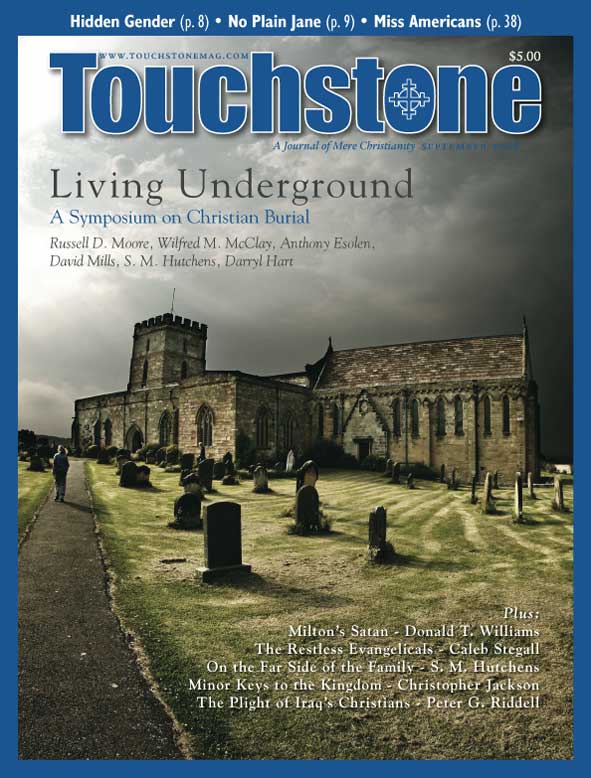
Living Underground by Russell D. Moore + Wilfred M. McClay + Anthony Esolen + David Mills + S. M. Hutchens + Darryl Hart
Living Underground
A Symposium on Christian Burial
Burial
Plots & Parking Lots by Russell D. Moore
Our Buried Sentiments by Wilfred M. McClay
Landscapes of the Dead by Anthony Esolen
The Grave Not Taken by David Mills
Stone Sobriety by S. M. Hutchens
In Grave Country by Darryl Hart
Burial Plots & Parking Lots
by Russell D. Moore
Drive by your local booming suburban church, or the up-and-coming congregation
everyone’s talking about in your community. You might find a state-of-the-art
children’s complex, complete with antibiotic soap dispensers in every
corner. You might find a Family Life Center—previously known as a gym—with
a basketball court, foosball tables, maybe even an Olympic-size pool. You’ll
almost certainly find a feeding hall, perhaps with a franchised gourmet coffee
kiosk nearby.
What you will not find is a graveyard.
Grave Reminders
Not many churches have graveyards anymore. In some ways, that’s understandable.
Churches that are growing and evangelistic rightly conclude that sharing the
gospel with the living is more important than remembering the dead.
We all know churches that carefully manicure their graveyards and remember
who is buried where. They also remember who paid for what pillar—so don’t
you try to remove it to create additional space for your children’s Bible
fellowship area. For them the graveyard is a symbol of a concern more for maintaining
their family genealogies and the memories of the past than forging forward
for the Kingdom.
But, still. I wonder if we are losing something by outsourcing the care of
our dead to the funeral industry. Did we lose something important, maybe even
something biblical, when we paved over our graveyards?
The church graveyard might serve to remind us of something that we as contemporary
Christians, with all our flash and verve, seem to forget too often these days.
We are going to die.
Too often we seek reminders of God’s power in the buzz and energy of
a campus Bible study or a youth rally or a celebrated church service. We believe
that God is present among us if there are beautiful, vital young people around
us. We believe there is dynamism present if our services are seamless, and
if our celebrities smile or cry on cue.
And often the Spirit is there, with power. But sometimes the excitement
is just that—excitement—not the longing of a people for a crucified
Messiah.
Perhaps, though, a graveyard in our peripheral vision as we get out of the
car for worship might remind us of the gravity of the task before us. Maybe
a cemetery would serve as an icon that all our Babels will collapse, all our
wood, hay, and stubble will be incinerated before the Judgment Seat.
Centuries ago, Gregory of Nyssa warned the youths who heard him preach of
the illusory nature of pride. He pointed to their agile feet, their rosy cheeks,
their polished shoes, and asked, “Are you not ashamed, you little clay
doll, soon to be dust, blown up like a bubble with your own momentary puff,
full of pride, all swollen with inflamed delusion and inflating your mind with
empty conceit?”
The antidote for such pride is to consider one’s end. “Have you
not seen in the burial ground the mysteries of our existence?” he asked. “Have
you not seen the heap of bones piled on each other, skulls stripped of flesh,
staring fearsome and horrible from empty eye-sockets? Have you seen the grinning
mouths and the rest of the limbs lying casually about? If you have seen those
things, then in them you have observed yourself.”
A Check on Pride
Such a warning is not just a check on the pride of individuals, but of churches
as well.
After all, our church buildings—even the most state-of-the-art of them—will
someday decay and collapse. Your church sign may someday hang silently above
the rubble, battered and torn, like the Statue of Liberty in the final scene
of the Planet of the Apes. Maybe its faded wording will still announce
to the silences around it, “The Church Alive Is Worth the Drive,” but
no one will care how good the sound system used to be.
Our hymnals and our bulletins and our PowerPoint presentations and our systematic
theology texts will one day wither away into mold and dust. The Library of
Congress itself, with the record of all our best-selling Evangelical Bible
study guides and praise-song recordings, will be swept away like refuse. The
celebrity preachers’ and singers’ once-celebrated vocal cords will
vibrate no more, and the bright eyes and clear complexions photographed for
book covers and publicity shots will one day melt away into dirt.
Only the gospel, only the power of Christ, will remain.
The church graveyard also reminds us that we are a peculiar people. When
we are gathered together to our fathers, we don’t simply lie under the
funeral home tent in Shady Grove #5 with all the others in the region of the
last place to which we moved. We are laid to rest by our brothers and sisters,
those who wait with us for Something to happen.
I still ponder how much more effective we would be in preaching the gospel
to our neighbors if we showed them—even with our landscape around us—that
we are more than a community group. We’re a Kingdom, a Kingdom that spans
the ages and includes the dead and the unborn, mighty as an army with banners.
I’m realistic enough to know that the church graveyard is a thing of
the past. We probably won’t see seminars on how to plan for a really
good graveyard at any pastor’s conferences in our lifetime. The plans
for planting new churches won’t include acres for a graveyard.
But maybe we would see something of what we’re missing if we took the
time to walk among the tombstones once in a while. Find an old graveyard and
walk through it. Walk about and see the headstones weathered and ground down
by the elements. Contemplate the fact that beneath your feet are men and women
who once had youthful skin and quick steps and hectic calendars, but who are
now piles of forgotten bones.
Think about the fact that the scattered teeth in the earth below you once
sang hymns of hope—maybe “When the Roll Is Called Up Yonder I’ll
Be There” or “When We All Get to Heaven.” They are silent
now. But they will sing again. They will preach again. They will testify again.
They will laugh again.
Awakened by a Shout
And, while you’re there, think of the promise every generation of Christians
has held against the threat of sword and guillotine and chemical weaponry.
This stillness will one day be interrupted by a shout from the eastern sky,
a joyful call with a distinctly northern Galilean accent.
Maybe if we spent more time in graveyards, we might reconsider the need for
them. Maybe we’d be able to speak more honestly to a people scared to
death of death if we offered them and ourselves a visible sign that we, too,
know what death is, and that we hate it, too.
But the graveyard is not just a sign that we haven’t forgotten our
dead. It’s a sign that we’re just waiting for them—and for
ourselves—to hear one last invitation hymn. And when those quiet little
mounds begin bursting, with headstones flying about, and a clap of thunder
resounds across the sky, then at last it can truly be said, “Man, this
church is alive.”
(top)
Our Buried Sentiments
by Wilfred M. McClay
A few years ago, a woman walking her dog in Noble, Georgia, stumbled on the
remains of a human corpse. Investigators found many more corpses, eventually
hundreds of them, which had been thrown out there by the Tri-State Crematory,
a family-owned business that received bodies from funeral homes in Georgia,
Alabama, and Tennessee. Some of the corpses were “stacked like cordwood,” as
one observer said, while other “human bones, weathered white, were scattered
through the woods like leaves, skulls mixed with leg bones in a ghoulish jumble,” as
the New York Times reported.
The story generated universal and sustained outrage around the country, but
as the outrage mounted, I began to ask myself, “Why?”
Why such vehemence? Why, when so many Americans see nothing exceptional in
the taking of a pre-born life, when they are becoming inured to the warehousing
of the elderly and infirm, when they regard the protection of embryonic life
as itself a laughable proposition, when they routinely accept cremation, and
the dismemberment of corpses for science, did this bizarre episode strike horror
in so many?
And why, in this most Christ-haunted region of the South, not far from the
home of Flannery O’Connor, was such opprobrium attached to the mistreatment
of a body from which the spirit had departed, an inert “stiff” in
which, literally, nobody was at home anymore? Why did those who took so low
a view of the body that they were quite willing to have it disposed of by cremation,
find this crematory’s neglectful mistreatment to be, not merely regrettable,
but an act of beyond-the-pale barbarity? Why draw the line here?
We Do Care
It was not a consumer-protection issue, in which the next of kin felt that
they had not gotten what they paid for. No, the answer is something simpler,
but also more profound.
It goes to the fact that there is something of primal importance about the
way we treat the dead, and especially our ancestors. Nothing tells us more
about a culture’s regard for the human person, and its sense of itself
as an entity persisting in time, than the character of its funerary rituals,
its ways of acknowledging and remembering the dead.
We may be able to pretend to ourselves in twenty-first-century America that
disposing of the dead is merely an elaborate form of taking out the trash,
because there is “nothing there” but used-up protoplasm. But an
incident like the one in Georgia puts such self-deceptions in a glaringly bright
light, and undermines all our equivocations and sleights of hand.
We do in fact care what happens to the body. We can’t help it. We still
believe, viscerally, in the dignity of the human body. But we can mount no
articulate defense of this belief. And so we have allowed ourselves through
the practices we routinely employ to accept a diminution of one of life’s
most fundamental passages, and a violation of our elemental dignity, that amount
to a negation of the human person himself.
As Robert Pogue Harrison has observed in his luminous book The Dominion
of the Dead, civilization is built upon the awareness of our dead predecessors. “Only
the dead can grant us legitimacy,” he writes. “Left to ourselves
we are all bastards.” We bury the dead less to separate ourselves from
them than to join ourselves to them. By burying them in our midst, we also
humanize the grounds on which we ourselves live.
One might even say that burial has a certain civilizational priority, that
what we make of the dead creates the foundation for what we make of ourselves.
After all, as Harrison neatly puts it, “human beings housed their dead
before they housed themselves.”
Prehistoric nomads established permanent habitations of the dead, such as
caverns, mounds, and barrows, and these were the chief settled landmarks and
points of return, often also serving as shrines and sacred places with particular
access to the spirit world. Only later did such men exchange their mobility
for settled habitations, cities of the living built amid reminders of the dead.
Which is why Lewis Mumford was right to proclaim that “the city of the
dead antedates the city of the living” and is “the forerunner,
almost the core, of every living city.”
Dangerous Practices
If this is true, then what are we to make of the fact, as Joseph Bottum has
observed recently, that the modern city of San Francisco has proscribed the
building of cemeteries and the interment of the dead inside its city limits?
What does this tell us about the future of San Francisco, and us?
Will a civilization that comprehensively denies death by banishing every
visible reminder be like a house without a foundation, destined to be blown
away by the storms that will surely come? Will it be like a tree that has been
deprived of its taproot, and is destined to wither and die for lack of nourishment?
Or will we be granted insight into the effect of separating ourselves from
the bodies of our ancestors? Might the Tri-State Crematory episode provide
just such a landscape-illuminating lightning bolt?
I think that it did, and that the rage, and the shudder of horror, so many
felt at the news of the Georgia events disclosed a part of their souls that
had not yet been anesthetized. Their reaction suggested that they knew, however
dimly and unconsciously, that we have drifted into profoundly dangerous attitudes
and practices.
Our disdain for the dead, and our desire to keep ourselves at the furthest
possible distance from them, reflect back upon us. In this mirror we see clearly,
if fleetingly, that we will need to remember where we came from if we are ever
to understand, and ever to be able to explain cogently, why it is wrong to
stack bodies like cordwood. For the measure we give is surely the measure we
will receive.
(top)
Landscapes of the Dead
by Anthony Esolen
One of the nicer features of Rhode Island, where I live, is that everywhere
you turn, there’s what the state calls a Historical Cemetery, probably
close to a thousand in all, or about one for every square mile. A few of them
are fairly large, covering the area of a baseball diamond. Most of them, though,
have ten or twenty tombstones, in a little plot raised above the surrounding
earth by a stone wall, or fenced in with iron paling.
Some, built on what used to be farmland, now abut a car wash or an exit ramp.
Others are like oases of memory on private property. Sometimes you’ll
see a towering oak or maple sprung up right in the middle, heaving the ground
up and tilting the tombstones at a jaunty angle.
You can’t use riding mowers on these, because there’s no room.
Small mowers and clippers have to do. In the meantime, wind and rain and the
slow reclamation of dust do their natural work, rubbing away the names in the
old, soft limestone, and making it impossible to read the cursive lettering
without running your finger along to trace it out: “Born in County Cork,” “Daughter
of Elijah and Mary Harris,” “My Hope is in the Lord.”
Fashioned by the Ages
The Christian names are often old-fashioned, in the sense that the ages have
fashioned them, Biblical names, names of virtues, Germanic and Celtic names
passed along from father to son or uncle to nephew: Samuel, Prudence, William.
And the surnames shed some dim light still upon the towns and villages about. “These
here,” the careful cemetery haunter muses, “might be those same
Fiskes that dammed the river and built the mill.”
There you see the old neighborhood, transplanted till the resurrection of
the dead. Here are the Cromptons, here are the Clydes. Here is the uncle whom
the family stowed away on a boat with a couple of sovereigns in his pocket
when he was fourteen, to flee the potato famine and make something of himself
in America. The grandson of one such, a Harkins, became bishop of Providence
and founded my college. The cemetery presumes that those filaments of memory
and of communion are sacred.
It’s not egalitarian, either. Death, they say, is the great equalizer,
but the cemetery protests, as well it should. God has not sowed the earth with
trees all of a height, or flocked the sky with birds all of a feather; nor
made men all of the same grace and light.
So I do not mind the ambitious obelisks for the grocer’s family, or
the great marble vault for the lawyer’s, or the humble limestone slab
for the plowman’s. Mostly they are all in good taste, and if damnable
pride has brought Mr. Burrill to the everlasting bonfire, who am I to begrudge
him a little showiness in his last highway marker?
The reader may guess with what nausea I view the modern cemetery, wherein
what is natural and human must submit to the exigencies of the machine. Vast
flat fields, with one flat stone indistinguishable from another, invisible
and illegible unless you are standing above them, a great Soviet of death,
a McGraveyard, with the mower driving thru.
It is hardly relieved by the occasional “personal” touch, like
an engraving of a Model T on the headstone of a car aficionado. All men equal
in their individuality, equally alienated, equally warehoused, equally flat.
And when it snows, they vanish entirely, as if they never were.
(top)
The Grave Not Taken
by David Mills
The young woman wanted to empty her savings account—money needed for
college and saved over a year of nannying demanding and ill-behaved children—to
help bury her grandfather, who had left instructions that he was to be cremated.
This was characteristic of him: to be buried as he had lived, no fuss, no bother,
no public display, no postmortem assertion of self, costing his widow as little
money and work and worry as possible.
I explained that the process had already been set in motion, and that her
grandmother would never agree, and that even raising the subject would upset
her unnecessarily. And there was, I added, something to be said for respecting
her grandfather’s wishes, as she would want her own children someday
to respect hers.
About two and a half years later, her other grandfather died. At the funeral,
the minister began with what she thought were comforting words. The body, she
said, was only a shell, and shells get old and break, and when they do they
open to let out the spirit, which freed from the body can then go to God.
Yet sitting behind her was the man’s body, in a plain wood coffin just
carried into the church with ceremony and reverence—our eldest son and
I among the pallbearers—which seemed fairly pointless if his body were
merely a discarded shell, and one that had prevented him from seeing God. That
man-sized box belied her gnostic attempt to palliate the pains of death.
It Feels Wrong
The young woman is our eldest daughter, and the first grandfather to die
my father and the second her mother’s. We had never discussed burial,
as far as I can remember, but the idea of cremation repelled her, and when
my father died she begged me repeatedly to find some way to have her grandfather
buried rather than burned. That I could not do so is a pain I still feel.
She could not explain her objection, but I understand it, and share it. I
know, and explained to her, the arguments allowing cremation. As the Catechism
of the Catholic Church tersely puts it, “The Church permits cremation,
provided that it does not demonstrate a denial of belief in the resurrection
of the body.”
But still, it feels wrong to burn a body that could be laid to rest. It may
be “licit,” in the technical language of canon law, but it does
not seem to me proper. It may be permitted, but that does not mean it is good
when you can accomplish the ideal.
My daughter and I were both thinking of what it means, what it symbolizes,
to bury and to burn the body. You burn something to destroy it, often, as in
burning brush, because that is the easiest and cheapest way to dispose of it.
Nothing, except the human body, do we reduce to ashes and then treat the ashes
as if they were the original. Ashes are in every other case something you throw
away. They are waste, trash, leavings, debris, a burden and often an expense.
Sometimes, of course, we burn things as a gesture of contempt and defiance
of the realities for which they stand. Think of book burnings and flag burnings.
Think how you would react to the news that someone had set down a Bible on
the town square, soaked it with gasoline, and lit it.
We bury things we want to preserve, like time capsules, or to transform,
like seeds and bulbs. Planting is the main symbol we think of when we think
of burying something. It is an act of hope, of trust. And so we bury things
we reverence, like the bodies of those we love, in the hope of their rising
again.
There is a reason the pagans burned their dead, and still do, while Jews
and Christians buried them. I suspect, but could not now argue, that there
is some connection between the growth in cremation among Christians and their
declining birth rate. We burn what we will not bear.
The Natural Instincts
I don’t think belief in the Resurrection will long survive cremation,
once it becomes the standard among Christians, since it goes so hard against
the natural instincts, guided by the natural symbols, to lay to rest those
we have loved. The coffin means something different than the urn.
After my father’s memorial service, we left the church and went home.
After my father-in-law’s, we carried the coffin out of the church, again
with ceremony, and in a long procession of cars drove it slowly to the cemetery
near his home, where it—where he—was carried from the hearse to
the grave and then put into the ground.
Her father’s grave is a permanent blessing for my wife and for our
children, my father’s lack of one a permanent and irreparable loss for
me, for my children, and, perhaps, for our grandchildren and their children.
Temple of the Holy Spirit
A few months ago I passed on to some
colleagues a remark from a Christian writer who said that the dead
body was “a vacated temple,” in response to the argument
that it was the Temple of the Holy Ghost and deserved reverence.
His metaphor was “very disturbing,” I wrote.
“It’s all right there in
Plato, as the professor would say,” Russell Moore responded.
The writer forgot “that the vacancy is only a temporary one
since we believe in the resurrection of the flesh. Burning down
the temple while its worshipers are on summer vacation is more
akin to what’s happening in cremation.”
Steve Hutchens wrote that in talking
with a friend whose sister wanted to have their mother cremated,
he came to the Catechism’s conclusion: “that
the symbolism of burial is important to Christians, and makes it
highly preferable to cremation. The Church understands that sometimes
destruction of the body by fire simply cannot be avoided, and knows
that the body’s elements will dissolve eventually by one
means or another. It does not make unnecessarily heavy weather
of these matters, but points to the best way.”
He did not think “the Holy Spirit’s
supervenience of the dead body as incompatible with the idea that
the Temple is vacated—simply because it is. Someone
doesn’t live here any more, but in some mysterious way it
is kept by God as its elements dissolve, as he was present with
its elements as he brought them together—and will bring them
together again.
“We must, it seems to me, have
both. If we begin treating the temple as if it were not vacated,
we will run into problems that compliment the equal and opposite
error that it is a ‘mere’ shell. A shell it is, but
not ‘mere.’ An analogy would be those who regard the
Lord’s Supper as cannibalism versus those who in some way
deny the Words of Institution.”
“Disturbing?” wrote Patrick
Reardon. “It’s heresy. It violates every Christian
sentiment to imagine that the Holy Spirit abandons the Christian’s
body at death. On the contrary, that body will rise from the dead because of
the Holy Spirit’s presence in the body.” The writer,
he added, believed in the resurrection of the cremated body, but “I
don’t believe that faith in the Resurrection will survive
several generations of this practice.”
—David Mills
|
(top)
Stone Sobriety
by S. M. Hutchens
There is no better place to be alone with thought, no place, I think, where
the mind is better concentrated in Dr. Johnson’s sense—where one
senses the high measure of truth in Heidegger’s description of human
life as Sein zum Tode (“being toward death”)—than
in a turn through an old cemetery. I don’t mean a tourist’s jaunt,
or a visit in the company of others, but a solitary walk, alone among the dead,
pausing where one wishes and staying as long as seems good.
As it happens, the opportunity to visit mature cemeteries has come to me
most often in places where I have gone to deliver a paper at some convocation.
There are few men freer than the scholar, done with that labor and delivery,
and likely looking forward to nothing more onerous than the panel discussion
for which he needn’t return until three.
The churning mind has earned its rest, and seeks it. Where is it better found
than among the remains of others who have also given their papers and taken
their rest?
Muted Voices
The voices one hears in the graveyards are muted, and say little, but they
say what needs to be said. I leave them and return to the clamor with mild
feelings of regret, for it has always seemed to me the world’s apprehension
of reality is mournfully low, and that no one is better grounded in it than
the dead.
I remember a handsome stone from the late eighteenth century, hard by the
wall of an old church in the Old South. It marked the grave of a young woman
who had died in her late teens, and the infant daughter who shared her death
day. The husband and father had spent much on it, for it was large and full
of tender writing. Next to it was a smaller stone, the man’s second wife.
Next to that a smaller one yet—his third. Finally there was the marker
of the man himself, now revealed to have been considerably older than the first
wife, whom he had buried with such evident grief, a man whom the later experiences
of life had likely changed. Just how they had wrought in him we cannot say,
but the mind cannot help considering the possibilities, and being humbled thereby.
In another cemetery, this time in Maine, I saw the single stone of a man
and wife with no death-date yet inscribed. Next to it there were two very small
ones with their family name, different ages, same death day. This kind draws
out a prayer with arms reaching in many directions.
There is perhaps no place where Sobriety itself rises so palpable and strong—not
monstrous, nor even stern, but of humble aspect and great beauty—born
there with her sister Hope when man sinned, and one of Wisdom’s wisest
daughters. Her method of teaching, for those who will visit her, is quiet remembrance,
full of holy fear and longing.
But since the Lord’s resurrection it has been rumored that she takes
a bit of wine betimes, and, holding her Sister’s hand, dances gravely
among the stones. Perhaps she laughs, too, but I have no reliable reports of
that.
(top)
In Grave Country
by Darryl Hart
I started spending time in cemeteries after learning that the subject of
my dissertation, J. Gresham Machen, was buried in the city where I lived. I
had actually known the whereabouts of his remains well before starting grad
school, but only after becoming better acquainted with him did I feel the need
to pay my respects.
A native of Baltimore and scion of a prominent legal family, Machen lived
most of his adult life in Princeton and Philadelphia, where he taught New Testament
first at Princeton Seminary and then at Westminster Seminary. When he died
on January 1, 1937, he was buried with his family in Baltimore’s Green
Mount Cemetery, amid some of Baltimore’s wealthiest and most influential
citizens.
Romantic Death
For many years I would drag my wife to his grave on the anniversary of his
death to lift a shot glass and say a prayer. As ghoulish as it might seem,
I have since discovered the delights of other public cemeteries. Most of the
faculty who instructed Machen, such as Benjamin Warfield, are buried in Princeton,
New Jersey’s graveyard, along with notables such as Grover Cleveland,
John Witherspoon, and Jonathan Edwards.
Finding those graves, positioned in seemingly random parts of the cemetery,
is never easy. But the reward is a lesson that death humbles the most accomplished,
and humbles even the efforts of descendents to honor them.
To my shame, though living in Philadelphia I have yet to explore the city’s
own contribution to the rural cemetery movement, Laurel Hill. During the middle
decades of the nineteenth century these rural cemeteries replaced the church
graveyard as the resting place for wealthy Americans, and they captured a different
regard for death.
The church graveyard reminded passersby of death’s finality and the
ultimate questions posed by a person’s departure from this world. Its
design and stark ornamentation expressed this, with images and texts on gravestones
typically evoking the Last Day and the judgment that awaits all creatures who
bear God’s image.
The rural cemetery presented a romantic view of death. It feted its inhabitants
with monuments and stylized graves while segregating death in a preserve of
natural beauty intentionally removed from harsher realities of everyday life.
So distant were the realities of this world—even death—that rural
cemeteries, according to Blanche Linden Ward, were the Victorian version of
public parks. Owing to their lush landscaping and ornate monuments, rural cemeteries “functioned
as ‘pleasure grounds’ for the general public.”
This may have been their intent. Rural cemeteries do seem to undercut the
sober truths conveyed by the church graveyard. No doubt, they also promote
the accomplishments of the deceased in ways at odds with either the gospel’s
call to humility or Scripture’s constant reminder of human frailty and
feebleness.
An obvious complaint is that the rural graveyard, and its successor, the
more efficient and less ornate lawn cemetery, hide eternal truths about death
and judgment behind nature or art. Like nursing homes designed in the image
of resorts, rural cemeteries divert the attention of visitors—for residents
such diversions don’t work—from the finality and agony of death.
Unintended Honor
But in a culture where pleasures cannot be simple, where developers disregard
the past in pursuit of prime real estate, and where the human body no longer
stands at the pinnacle of the created order, the rural cemetery may have ironically
filled a niche quite distinct from its creators’ intentions. If only
for the health of urban centers, rural cemeteries have kept malls and condos
at bay while preserving space for leisurely contemplation, maybe not of life’s
ultimate purpose, but at least of what it might mean to have lived a good life.
Even better, the rural cemetery honors the human body. From body piercing
to cremation, the leading cultural indicators do not indicate much respect
for the one creature endowed with the image of God.
Of course, the rural cemetery does overestimate the accomplishments of the
bodies assembled. But by devoting such care and space to the remains of men
and women, boys, girls, and infants, these cemeteries are welcome reminders
that the human body is not material to be disposed of but, in the words of
the psalmist, the one part of creation made a “little less than God,” “crowned
with glory and honor.”
The quote from Blanche Linden Ward is taken from her Silent
City on a Hill (1989).
Anthony Esolen is Professor of English at Providence College in Providence, Rhode Island. He has translated Tasso's Gerusalemme liberata (Johns Hopkins Press) and Dante's Divine Comedy (Random House). He is a senior editor of Touchstone. S. M. Hutchens works as a reference librarian in Kenosha, Wisconsin. He holds a doctorate in theology. He is a senior editor of Touchstone. Wilfred M. McClay holds the SunTrust Chair of Humanities at the University of Tennessee at Chattanooga, and is the author of The Masterless: Self and Society in Modern America (North Carolina) and A Student?s Guide to U.S. History (ISI Books). He is a member of the Presbyterian Church, U.S.A. David Mills is deputy editor of First Things. He was editor of Touchstone from 2003-2008. His most recent book is Discovering Mary: Answers to Questions About the Mother of God (Servant Books). He lives with his wife and four children outside Pittsburgh, where they attend St. Joseph’s Catholic Church in Coraopolis. Russell D. Moore is the author of Adopted for Life: The Priority of Adoption for Christian Families and Churches. He lives with his family in Louisville, Kentucky, where he serves as Dean of the School of Theology and Senior Vice-President for Academic Administration at The Southern Baptist Theological Seminary and as preaching pastor at Highview Baptist Church. He is a senior editor of Touchstone. |