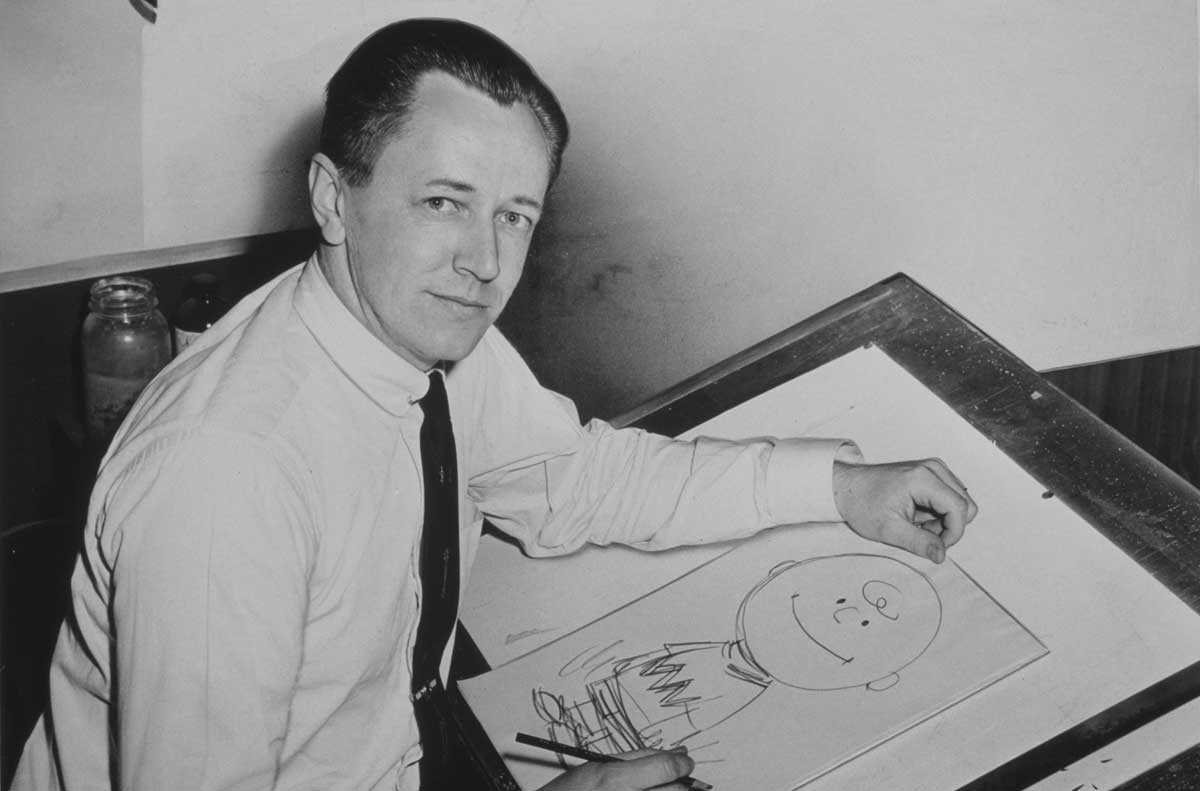

Tragic Comic by Russell D. Moore
Tragic Comic
Schulz and Peanuts: A Biography
by David Michaelis
HarperCollins, 2007
(655 pages, $34.95, hardcover)
reviewed by Russell D. Moore
Very early in my ministry, I found myself in a bitterly divided congregation.
I saw things I wished I’d never seen and heard things I wished I’d
never heard. More depressingly, I thought things I wish I’d never thought.
Finally, I did the best thing I knew to do for my family and for me, and
resigned my position. While the church voted to accept my resignation, I sat
at home wondering if I really wanted to serve in church ministry—or even
to go to church—knowing what I knew about human depravity. I turned on
the television for some background noise to quiet my mind, to see the opening
credits of A Charlie Brown Christmas.
As a child of the 1970s, I had seen this thing a thousand times, with all
of its maudlin sentimentalism about commercialism and the “real meaning
of Christmas.” But then the cartoon figure of Linus, dressed as a shepherd
complete with blanket headdress, recited Luke 2, a text I had heard thousands
of times before. This time was different, though, and I wept violently, shaking
in the chair.
“And the glory of the Lord shown round about them, and they were sore
afraid.” The gospel was true, and it was beautiful, and nothing else
mattered.
A Sad Story
I thought about that television special as I opened the cover of the promised
definitive biography of Charles M. Schulz, the creator of the Peanuts comic
strip. It appears that the Charlie Brown Christmas special plays
a revealing role in the Schulz story—a story that should speak sadly
to any Christian, whether or not he has ever opened the Sunday funny pages.
In Schulz and Peanuts: A Biography, David Michaelis, who previously
penned a biography of the illustrator N. C. Wyeth, tells the story of the shy
Minnesotan whose imaginations now float along in the Macy’s Thanksgiving
Day Parade and smile out from every first-grader’s stuffed toy collection.
He traces Schulz’s life and career from Midwestern barber’s son
to smalltime graphic artist to (in the words of a Democratic National Committee
member courting the cartoonist for the Adlai Stevenson campaign) the nation’s “youngest
existentialist,” to hand-over-fist moneymaking entrepreneur.
A Christmas program was a natural next step once the Peanuts brand
proved to be marketable. The powers-that-be at CBS butted heads with Schulz
immediately: Over the musical score (Schulz wanted only classical music, the
network wanted a “bluesy jazz,” and the network won); over a laugh
track (Schulz despised the “hyena hilarity of canned merriment” and
opposed any pre-recorded laughter, and Schulz won); and finally over Linus’s
rendition of Luke 2, which the network found in poor taste (Schulz, of course,
won that one too).
“We can’t avoid it—we have to get the passage of St. Luke
in there somehow,” Schulz told the network. “If we don’t
do it, who will?”
That sense of Christian mission was, it seems, a leftover from Schultz’s
devotion to a gospel and a community he found within the conservative Evangelical
Protestant denomination the Church of God after his service in World War II. “I
started going to church just out of a feeling of gratitude that I had survived
all of that,” he said, a gratitude that grew into a commitment to his
church and to the faith he found there.
Despite an only nominally religious family background, Schulz threw himself
into the life of small congregations within this communion, often carrying
the finances of tiny churches with his massive tithe. When he started his cartooning
career in the 1940s, Schulz seemed to have a profound sense of the Christian
moral ethic, in areas of life ranging from sexual morality to personal humility.
A Syndicated Life
But as his career took off and he moved his family to California, out of
the orbit of the Church of God denomination, Schulz slid slowly into doctrinal
unorthodoxy and personal despair. When asked why he no longer went to church
at all, he replied, “I don’t know where to go. Besides I don’t
think God wants to be worshipped.”
Through all of this, he seems to have lived his life passively in reality
and actively through the alternative universe of his comic strip. According
to Michaelis, the shadow sides of Schulz’s life, its fleeting joys and
its mammoth disappointments, are all there, syndicated for the world to see.
The little red-haired girl, for instance, for whom Charlie Brown pines in
unrequited love, is an echo of Schulz’s passive passion for a woman who
had long since forgotten him.
Charlie Brown’s depression and Lucy’s shrewish tirades trace
out his marriage to his first wife, Joyce. Schulz would look down at his drawing
board to ignore the complaints of his wife, as Schroeder focuses on the piano
before him to ignore the nagging girl on the other side.
It was, said cartoonist Walt Kelly, the creator of Pogo, “a
perfect parody of what American life is supposed to be—the ineffectual
male and the domineering female.” Michaelis concludes: “At the
marriage’s outset, Schulz had been Charlie Brown to Joyce’s Lucy,
but as time went on, he was ever more Schroeder, immersed in his art, aloof,
withholding.”
When his wife, through an examination of their long-distance telephone bills,
discovered him to be carrying on an affair with a younger woman, he wrote into
the strip Snoopy’s long-distance relationship with a female beagle. “By
golly, you’d better start behaving yourself!” Charlie Brown yells
at the dog. “And stop making those long-distance telephone calls!”
Schulz’s loss of faith was reflected in the disappointments of his
characters. As Michaelis puts it: “The cult of Beethoven, the cult of
suppertime, and the cult of the Great Pumpkin all served to show how the exclamatory
avowal of one’s beliefs could only place more obstacles between man and
God.” Schulz’s daughter Amy recalls having a tabletop crèche
at Christmastime. “But,” she says, “no one ever told us what
it was for.”
Those with eyes to see could perceive the hidden angst of Peanuts, Michaelis
argues. Thomas Merton employed Snoopy drawings in his correspondence with the
nurse with whom he was having an affair in 1966, when Merton was considering
leaving his order. For them, Snoopy’s “doghouse became a working
abstraction for the monastery, with Snoopy on the roof like an abbot or knight
on his tomb, thinking ‘It’s nice to have a friend.’”
His Real Children
Schulz’s comic-strip life was more real to him than his own children.
Amy once heard an interviewer ask her father, “How are your kids?” only
to hear him begin talking about his characters. Only when the interviewer specified
that he was speaking of Schulz’s five children did he turn to his family. “Were
we his everything?” the daughter tells Michaelis.
“No. His strip was his everything.”
Schulz and his wife sent another daughter, Meredith, to Japan for an abortion
when she became pregnant as a teenager. When Meredith and her mother returned
from the abortion mill, they were outraged to be greeted at the door by Schulz,
who, “without so much as one question about the ordeals that mother and
daughter had just undergone,” then “asked Joyce whether she had
seen anything of the Japanese countryside,” interested as a cartoonist
in “the land of the woodblock print.”
Unlike Schulz’s view of comic strips—they should never have an
ultimately unhappy ending—the end of Schulz’s life was the capstone
of his despair. The man who, like Charlie Brown, always feared that no one
could truly love him, died, in the words of another cartoonist, “angry
at God, angry with friends, angry with fate—angry [about] all the troubles
he could never let go of.” This fellow artist concludes: “He had
control over the [ Peanuts] universe for fifty years, but he had no
control over his death. He didn’t accept it graciously. He wasn’t
ready.”
Michaelis concludes: “The strip had allowed him an illusion of eternity.
Comics never end, no story is every finished, four more blank panels await
the next installment. When finally, he fell ill, the fantasy was irrevocably
broken, and he discovered that he was a creature of time, ordinary after all.”
Among Schulz’s last words in his waning days in the hospital were: “You
know, that poor kid, he never even got to kick the football. What a dirty trick—he
never had a chance to kick the football.”
Modern Vanity
Unlike Linus reading Luke 2, this book is anything but inspirational. For
Christians, though, it is, like the Peanuts strip itself, a kind
of modern-day Ecclesiastes. In the biblical text, Solomon grasps at pleasure,
wisdom, labor, prosperity, and finds that, “Vanity of vanities . . .
all is vanity” (Eccl. 12:8).
Indeed, as Michaelis argues, this was the reason for the strip’s success.
Schulz’s public “consisted of good, plain people who felt guilty
at being discontented in an epoch of unprecedented prosperity. Peanuts struck
a chord with those who had thought they had everything they wanted only to
discover that they didn’t and needed an acceptably gentle reminder of
this insight.”
The book is a reminder that the alternative to a genuinely hopeful view of
reality, a hope that can be grounded only outside of us in a resurrected Galilean,
is not tragedy but meaninglessness. The existentialist’s lament, whether
in Solomon or Sartre or Schulz, is true enough if “Christ is not raised” (1
Cor. 15:17).
That kind of vanity, that kind of despair, is found all around us, even next
to us in the pew. This book is a sober call to us to remember, to pray for,
and to love those especially who will never believe they can be loved.
It is also a reminder that the story of human life is indeed dark, so dark
that a true assessment of it forces men to construct an alternative story,
a story they can draw, in Schulz’s case, or, more typically, imagine.
In either case, death looms.
Only by finding himself in Christ’s story can a person find a way out
of the illusions of eternity. In a biblical pattern, he can see himself as “hidden
in Christ” (Col. 3:3): crucified with him, buried with him, resurrected
with him, seated at the Father’s right hand with him. His story isn’t
self-constructed or imagined but objectively before us, received in faith.
According to this book, Schulz’s deathbed was, to him, a pumpkin patch
on the day after Halloween, haunted only by disappointment in a Being who never
showed up. I hope the biography is wrong and that Charlie Brown’s maker
made peace with his own.
This past Christmas, I watched once again the Charlie Brown Christmas special,
this time with my four young sons. And just as before, I wept at the lisping
recitation of King James’s Luke. Charles Schulz may not have believed
it, but, somewhere within him, a large-headed kid with a blanket did.
I can only hope that Linus had the last word.
Russell D. Moore is the author of Adopted for Life: The Priority of Adoption for Christian Families and Churches. He lives with his family in Louisville, Kentucky, where he serves as Dean of the School of Theology and Senior Vice-President for Academic Administration at The Southern Baptist Theological Seminary and as preaching pastor at Highview Baptist Church. He is a senior editor of Touchstone. |