Retaking Mars Hill by Russell D. Moore
Retaking Mars Hill
Paul Didn’t Build Bridges to Popular Culture
by Russell D. Moore
Take your choice: Christian boy bands or The Gospel According to the
Simpsons. The era of the Christian who boycotted the local “movie
house” is long gone—and, in many ways, that’s a good thing.
But in place of the certainty that the gospel required Christians to keep
themselves separate from the world of popular culture, many Christians are
now just confused about how to relate the two.
Offering one answer to this confusion, many contemporary Christians often
speak of the need to “engage” popular culture. What they most often
mean by this is that they seek to speak in a language people shaped by popular
culture can understand or that they want to “redeem” popular culture
for the glory of Christ.
In my world, the world of American Evangelicalism, at least two groups have
clear ways to do this. One group wants to imitate pop culture but Christianize
it. Another group wants to find ways in which that culture itself presents
the gospel. Both want to use pop culture to reach the wider culture, and both
find their justification in Paul’s talk on that first-century Athenian
hilltop described in Acts 17.
And they are right to try: If Christians are going to speak to people, Christians
as well as others, who have been deeply formed by popular culture (as we must)
without losing our souls, we’re going to have to decipher how to relate
Mars Hill to Rolling Stone.
Off-Brand
The first model of Evangelical pop-culture engagement is that of those I
call “off-brand Evangelicals.” They seek to take trends in pop
culture and reproduce them in Christian dialect for use within the Evangelical
subculture, with the hope of making it more attractive not only to those outside
but to those within.
The impulse is deeply biblical. After all, God sanctifies commonplace, so-called
secular aspects of human culture—from the rearing of sheep for sacrifice,
to the goat hair used to construct the Tabernacle, to the bread and wine of
the Lord’s Table. Pagans have victory suppers whentriumphant in war—so
does the church, but in a uniquely Christian way.
Adapting current cultural forms for use as Christians is not, in itself,
a bad idea. In fact, in many ways it is unavoidable. If our pulpits are successful
in persuading Christians that Jesus is to be the central focus of the believer’s
life, we should not be surprised but joyful when young Christians gifted to
be hip-hop artists rap about Jesus rather than about pimps and firearms.
Still, there is a danger in a kind of co-option of popular culture for Christian
use that does not discern the limits of the evangelistic and apologetic potential
of such a strategy. This is especially true when the impetus behind so much
of it is not ecclesial or missionary but commercial.
GQ magazine sent one of its reporters to a Christian music festival
in Pennsylvania, to check out what goes on in the “Religious Right” subculture. “Christian
rock is a genre that exists to edify and make money off of Evangelical Christians,” the
author concluded after scoping out the Evangelical version of Woodstock.
He remarked that the most essential quality of Christian popular music was
its parasitism. “Remember those perfume dispensers they used to have
in pharmacies—‘If you like Drakkar Noir, you’ll love Sexy
Musk?’” the journalist asked. “Well, Christian rock works
like that.”
He pointed out that Christian pop music recruits “off brand” performers
to ape and mimic current popular artists, to “edify” believers
all over North America. Oh, and to make money off them, too.
It’s hard not to wince at the magazine’s assessment. Christian
bookstores often include “comparison charts,” pointing listeners
to Christian versions of the secular bands and artists they enjoy. “If
you like Eminem, you’ll love Twisted Fisher.”
At its best, Christians who follow this model of pop-culture engagement identify
the “language” of the contemporary context and speak through it
a distinctly Christian witness. At its worst, they watch what’s happening
in the culture (that is, what’s making money), and then find people slightly
less talented but more in love with Jesus (or at least able to play it on TV)
to do something similar (that is, make some money forthemselves).
South Park
The second model is that of those I call “South Park Evangelicals.” They’re
reminiscent of the culturally libertarian hipster right-wingers who bill themselves
as “South Park Conservatives” because they support a free market
and a hawkish foreign policy while enjoying the crude humor of the R-rated
cartoon South Park.
Of course, most of them are not as coarse and vulgar as their secular libertarian
counterparts (although a few are). The similarity is at the level of identity.
The “South Park Conservatives” wish to distance themselves from
their dour fellow conservatives by assuring liberal opinion-makers that they
can be both right-wing and cool. They will shock more traditional conservatives
to point out to them (and to the watching world), “We’re with you,
but we’re not like you.” Some Evangelicals follow much the same
impulse, restrained as it often is by the Holy Spirit and Evangelical mores.
This model is popular among a generation that humbly dares to call itself “the
emerging church,” although it includes aging baby boomers who have been
writing movie and music reviews for Christianity Today and Campus
Life since the Partridge Family last had a hit record. Consciously, sometimes
conspicuously, rejecting the separatism of their Evangelical fathers, and declaring
that “all truth is God’s truth,” they enjoy everything from
Broadway musicals to NC17 movies and nihilist grunge bands.
They turn up their noses at Christian pop culture and look for “signs
of redemption” in the products Hollywood and Manhattan create. Young
Evangelical bloggers seek to reach the culture “where they’re at” by
showing that they can discuss the “redemptive value” of Million
Dollar Baby without “quibbling” over “culture war” concerns
about the ethics of assisted suicide.
House of Culture
These Evangelicals often compare their reading of pop culture to the missiological
contextualization Christians attempt when working with other cultures. It is,
therefore, of little value to criticize pop culture—such criticism is “fundamentalist,” “simplistic,” and “anti--evangelistic.”
“Preaching against culture is like preaching against someone’s
house,” one Evangelical missiologist says. “It’s just where
they live.” Contrasting the messages of pop culture with the messages
of a Christian world-and-life view is the rhetoric of “culture scolds” rather
than that of evangelists.
In this model, one seeks to know pop culture, not in order to imitate it,
but first to enjoy it as an aspect of common grace, and second to share a common
cultural dialect with unbelievers. You don’t fight a “culture war” with
Hollywood, you seek to redeem Hollywood instead, by finding the aspects of
contemporary music and film that are consonant with biblical truth. Christians
are to highlight these commonalities, and downplay thedivergences.
Again, there is much that is commendable here. These Christians recognize
that insights about God, man, and redemption cannot be found simply in the
piety of believers. Even at the end of the Scripture story, at the New Jerusalem,
the Apostle John tells us that “the glory and the honor of the nations” will
be brought into the City, a glory that surely includes expressions of human
culture—perhaps even popular culture. Moreover, these Evangelicals wish
to avoid a “Christian ghetto” in which Christians are unable to
speak the same basic cultural discourse as the people to whom they are called
to bring Christ.
The pitfalls with this approach also include a commercial Christian industry
that by its very nature, perhaps unintentionally, militates against wisdom,
discernment, and balance. As with the “Off Brand” market, money
is involved here, too. It’s just subtler. The younger, cooler wave of
Evangelicals would never fall for a Christian version of the Backstreet Boys,
much less the crass evangelistic showmanship of the last generation’s
Petra or Carman musical acts. Instead they consume anti-consumerist Evangelical
acts, such as Derek Webb.
Webb has traveled the country with religiousleftist Jim Wallis preaching
against the “market-oriented” and “legalistic” tendencies
of contemporary conservative Protestantism. He sings songs mocking an Evangelical
subculture in which “they’ll know us by the T-shirts that we wear.”
Of course, Webb is making a killing selling CDs, downloadable songs, and,
yes, Derek Webb T-shirts. One has to work a little harder for his nickel among
the soul-patched Evangelicals, but the market is still there.
From Mars Hill
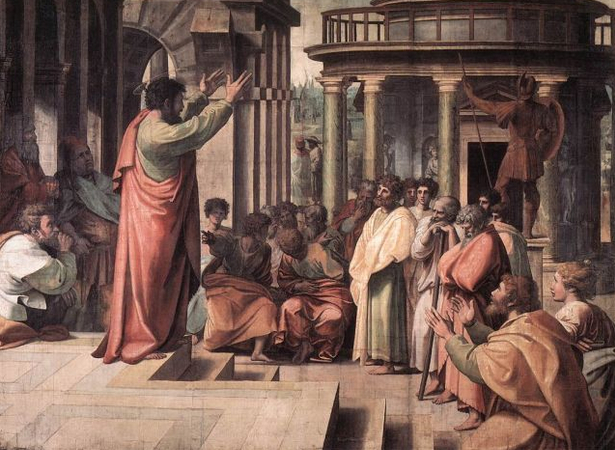
Christians seeking to “engage popular culture” point to the Apostle
Paul’s speech before the Areopagus, in which he cited the lyrics of pagan
poets and the architecture of pagan temples. Christians, they argue, should
follow Paul and use popular culture to “build a bridge” with its
consumers, finding in popular works a “common ground” through which
we can attract their interest and later communicate the gospel.
The appeal to Paul’s speech is nothing new. Previous generations of
Protestant liberals found in it justification for appealing to the “cultured
despisers” of religion on their own terms.
If the culture embraces Darwinism, don’t unsettle them with Genesis,
point to the order and beauty of the natural order. Or build a bridge from,
say, existentialist philosophy to the gospel. First convince the culture of
the need for a “Ground of Being” and “an ethic of authenticity” and
you’ve got the inroad you need to preach the God of Abraham, Isaac, and
Jacob.
But is this what Paul is doing on Mars Hill? The answer is no . The
Apostle might say, “God forbid.” Often those pointing to Acts 17
wish to begin with Paul’s address itself, which starts in verse 22. But
we must look first at how Paul found himself on the Hill in the first place.
He was summoned there because of a controversy he evoked among the populace “because
he was preaching Jesus and the resurrection” (Acts 17:18).
Paul did not start speaking in Athens with a “common ground” idea
of a generic god, and then reason along to Jesus. He started with the gospel
of Jesus of Nazareth, proclaiming among the Gentile philosophers exactly what
he had proclaimed among the Jewish rabbis: that God had raised him from the
dead. Where Paul starts is also where he ends: with the guarantee that God
will bring about judgment found in the resurrection of Jesus from the dead
(17:31).
Yes, Paul takes note of the altar to the unknown god, and yes, he quotes
pagan poets. But in neither case is he “building a bridge,” at
least not in the way the “engagers” wish to do. He is not saying, “You
see part of the truth already, so let me show you what you already partlybelieve.”
He points to the altar of the unknown god to demonstrate that the Athenians
themselves acknowledge ignorance. How can you pontificate about the nature
of the divine, he is asking, when even you tell me that there’s something
important out there you admit you don’t know?
Paul does not find in the poets some form of “redemptive analogy” he
can use among a people who don’t acknowledge the authority of Scripture.
He uses them to demonstrate that Athenian philosophy and culture are self-contradictory.
How can you claim that these temples house the gods, he asks, when even your
own culture-mavens say the divine can’t be housed in edifices made with
hands? The poets lead him not to finding “common ground” with his
hearers but to calling them to repentance on the basis of a scripturally revealed
storyline of humanity (17:26–27,30–31).
Unhinging the Greeks
Paul’s discourse on the Areopagus is strikingly different from many
Christians’ attempts to be relevant to popular culture. He points to
the Athenians’ culture not so much to bring out what they know as
what they deny.
Paul systematically unhinges key facets of Hellenic thought: the multiplicity
of gods, their representation by images, their dwelling in temples, Greek racial
superiority, the distance of the gods from humanity. He boldly challenges the
Greeks’ tribal pride in being “sprung from the soil of their native
Attica” (in the words of the New Testament scholar F. F. Bruce) by pointing
to the common ancestry of humanity from “one man,” with God determining
the “bounds of their habitation” and “removing all imagined
justification for the belief that Greeks were innately superior to barbarians.”
Moreover, the very nature of Paul’s message was an affront to the ideological
underpinnings of Athenian culture. He constantly returns to the resurrection
of the body. Nothing was more alien to Epicurean and Stoic thought, both of
which sought to combat the fear of death by separating the prison of the body
that dies from the spirit that survives. How different is Paul’s view
of death and resurrection from that of, for instance, the Stoic philosopher-king
Marcus Aurelius, who in his Meditations compared death with birth
from the womb, “when your soul will emerge from its compartment,” the
body.
Paul does indeed see a common humanity and a common imago Dei at
work in Athenian culture. But he sees this common grace twisted and perverted
by human rebellion. This is why he is “provoked” by the idolatry
in the city (17:16). This is why he refutes the culture’s affirmation
that gods can be made of gold and silver, and propped up in a man-made house
(17:24–29). And this is why he warns the Athenians, in the strongest
terms imaginable, to flee the wrath of the God of Jesus by repenting before
his throne (17:30–31).
Contemporary attempts at engaging popular culture are partly right. We cannot
ignore it. It affects life in twenty-first-century America far more than high
culture, far more, even, than the middle-brow culture of Broadway and PBS.
Broadway plays now reproduce the screenplays of Disney animated movies (such
as The Lion King), and not the other way around. American presidential
contenders announce their candidacies on The Daily Show with Jon Stewart on
the Comedy Central television network . We cannot avoid addressing
pop culture, especially among the unbelieving American populace we’re
seeking to evangelize. Like the round-the-clock televised Potemkin village
world of Hollywood’s The Truman Show, it is almost all they
know.
Pop Mission Field
This means that we must do more to engage popular culture than count curse
words and exposed body parts. We do indeed find aspects of the imago Dei and
common grace in the oddest of places, especially among those creating culture.
The Bible speaks of culture being “redeemed” eschatologically;
cultural artifacts seem to be in view as the “glory of the nations” brought
into the New Jerusalem in the new creation (Rev. 21:24–26). We shouldn’t
demand personal regeneration for artists before we can enjoy their work—whether
that artist is Mozart or George Jones.
Christians should ask why culture resonates with the Superman mythology of
a hero from beyond the stars who rescues humanity from itself. We should ask
why country-music singer Toby Keith sings about the unity-in-diversity he longs
for in his song “I Love This Bar.”
We should ask why, as the City Journal’s Harry Stein
points out, trashy talk shows such as The Jerry Springer Show always
end with a “moral lesson for the day,” despite the fact that the
rest of the broadcast has dismissed the very idea of moral absolutes. Why do
gangster-rap hip-hop artists sing so much about their rage against an absent
father?
We can see in pop culture what we can see also in the ideologies of Marx,
Freud, Darwin, and others, even “New Atheists” like Dawkins and
Hitchens: the longing for a story that makes sense of the world. In literature,
films, and ballads, we can see a flash of what we know to be true—that
man does not live by bread alone, or by orgasm alone, or by self-image alone.
We are created to find ourselves in a storyline that begins and ends in Christ—even
while, as sinners, we kick against the reality of that story.
The Christian analysis of popular culture always proceeds with a knowledge
that there is enmity between the idolatries of man and the kingdom of Christ,
that we are most tempted to evade Christ by looking to the works of our own
hands (Is. 2:8), even, or maybe especially, when these works are culturally
effective.
This means we must contrast gospels: the gospel of Jesus is always combated
by other gospels—today by one that is often embedded in music, film,
and visual art. And these messages are heard by our people in our pews. The
people in our congregations are shaped by pop culture, a culture fueled by
the advertising industry and a politically active artist guild.
And “gospel” is often not too strong a word. Sociologist Neil
Postman warned in Conscientious Objections that “important
television commercials take the form of religious parables organized around
a coherent theology.” They play out like testimonies at a revival meeting:
In television-commercial parables, the root cause of evil is Technological
Innocence, a failure to know the particulars of the beneficent accomplishments
of industrial progress. This is the primary source of unhappiness, humiliation,
and discord in life.
Embracing the Strangeness
To contrast the “abundant life” of Christ with the “abundant
life” offered by the spirit of the age, we must understand something
of what Mammon is hawking.
Previous generations needed to give heed to pop culture in order to see how Amos
and Andy radio broadcasts subtly molded their hearers’ views of
race and neighbor-love. It is necessary to see the attractively presented
use of death as an act of love in films such as Million Dollar Baby and Cider
House Rules to confront their viewers with the gospel of life.
We must bring attentive consciences to bear even on (or especially upon)
the most subtle pop-culture influences. How do Everybody Loves Raymond reruns,
with a scolding, yelling wife and a cringing husband seeking permission to
play golf, affect the way people in our churches view marriage? How does MTV’s Pimp
My Ride affect the way our teenagers and young adults read the Sermon
on the Mount? How do animated Disney films such as The Little Mermaid shape
the way children—and adults—hear the command to honor father and
mother?
Do we really believe that suspending disbelief long enough to see Morgan
Freeman as God in the film Evan Almighty—heavily marketed to
Evangelical
Christians—will not affect the way we read the prophet’s vision
of the Holy One in Isaiah 6?
This is not being a scold; it is being a shepherd. The shepherd must look
at the world in which his sheep live and warn them of its dangers, especially
the most subtle ones. But he has an even greater duty. Let us go back to Paul
in Athens.
What pop-culture-engaging Christians need to understand most from Acts 17
is the Athenians’ response. Luke tells us that what arrests the attention
of the Athenians is not the so-called bridges Paul builds by citing Athenian
cultural products. What pricks their attention at the end is what pricked their
attention at the start: Jesus and the resurrection: “Now when they heard
of the resurrection of the dead, some mocked. But others said, ‘We will
hear you again about this’” (Acts 17:32).
Often at the root of so much Christian “engagement” with pop
culture lies an embarrassment about the oddity of the gospel. Even Christians
feel that other people won’t resonate with this strange biblical world
of talking snakes, parting seas, floating axe-heads, virgin conceptions, and
emptied graves. It is easier to meet them “where they’re at,” by
putting in a Gospel According to Andy Griffith DVD (for the less
hip among us) or by growing a soul-patch and quoting Coldplay at the fair-trade
coffeehouse (for the more hip among us).
Knowing Andy Griffith episodes or Coldplay lyrics might be important avenues
for talking about kingdom matters, but let’s not kid ourselves. We connect
with sinners in the same way Christians always have: by telling an awfully
freakish-sounding story about a man who was dead, and isn’t anymore,
but whom we’ll all meet face-to-face in judgment.
An Uncool Minister
Early in my ministry, I served as a youth pastor in a Baptist church near
an Air Force base in Mississippi. Like every other Evangelical youth minister,
I received all the advertisements from youth ministry curricula-hawkers, telling
me how I could be “relevant” to “today’s teenagers.” The
advertisements promised me ways I could “connect” with teenagers
through Bible studies based on MTV reality shows and the songs on the top-40
charts that month.
All I knew how to do, though, was preach the gospel. Yes, I knew what was
happening on MTV, and I’d often contrast biblical reality with that,
but I fit nobody’s definition of cool—including my own.
A group of teenagers, mostly fatherless boys, some of them gang members,
started attending my Wednesday night Bible study. Some of them arrived at the
church engulfed in a cloud of marijuana smoke.
I found they weren’t impressed with the “cool” supplemental
video clips provided by my denomination’s publisher. They laughed at
Christian rap stars, in the same way I laughed at my high-school history teacher’s
effort to “have a groovy rap session with you youngsters.”
But what riveted their attention was how weird we were. “So, like,
you really believe this dead guy came back from the dead,” one 15-year-old
boy asked me. “I do,” I replied. “For real?” he responded.
I said, “For real.”
They were amazed at the fact that my wife and I had dinner together, and
that we didn’t really want to be somewhere else. “Dude, this is
like Nick at Nite,” one said, referencing the black-and-white
family sitcom reruns on television each night. “The mom and dad are here, ‘how
was your day,’ and the whole deal.” They couldn’t believe
that in our church, elderly people and teenagers talked to one another, that
Latino military officers joked around with white enlisted men around a Sunday-school
coffeepot.
It seemed strange. And, just as at Mars Hill, this strangeness commanded
attention. Some believed; some walked away. I was heard, and I was even loved,
but I was rarely cool.
Cool Fear
Too many attempts at reconciling Christianity and pop culture, it seems to
me, have to do with being seen as “relevant” by the culture on
its own terms. We will never be able to do that. Pop culture is a rolling stone,
and it waits for no band of Christians seeking to imitate it or exegete it.
Yes, we must learn to listen to what our culture is saying. We must remember
to listen beneath the cool to the fear of a people who know that Judgment Day
is coming; it’s written in their hearts (Rom. 2:15–16). We must
remember to listen beneath the cynicism to men and women who experience longings
that can only be fulfilled in the reign of a Galilean Carpenter-King.
Let’s not be scared to tell them that what they’re holding on
to—we can see it in their films, hear it in their music—is often
nonsense, and that they know that themselves. And let’s preach beyond
the cool to the strangeness of an old gospel story of a crucified and resurrected
Messiah. They tell us—in their own films and songs and programs—that
they want a gospel, just not the one God provides.
Christians must make sense of pop culture by judging it in terms of the story
we embrace. When that happens, we’ll find ourselves back on Mars Hill.
But let’s make sure we’re there because we are, as Paul was, preaching
Jesus and the resurrection, not because we’ve started a new business
making “unknown god” action figures. We probably won’t be
considered “cool” to the culture—whether or not we’re
able to sell music downloads to Christians.
But, once on the Hill, let’s not be surprised if, at the mention of
the resurrection of the body, a bored-looking American consumer presses the
pause button on his iPod, to listen for a while.
Russell D. Moore is Dean of the School of Theology and Senior Vice President for Academic Administration at The Southern Baptist Theological Seminary in Louisville, Kentucky. He is the author of The Kingdom of Christ: The New Evangelical Perspective (Crossway). He is a senior editor of Touchstone. |