




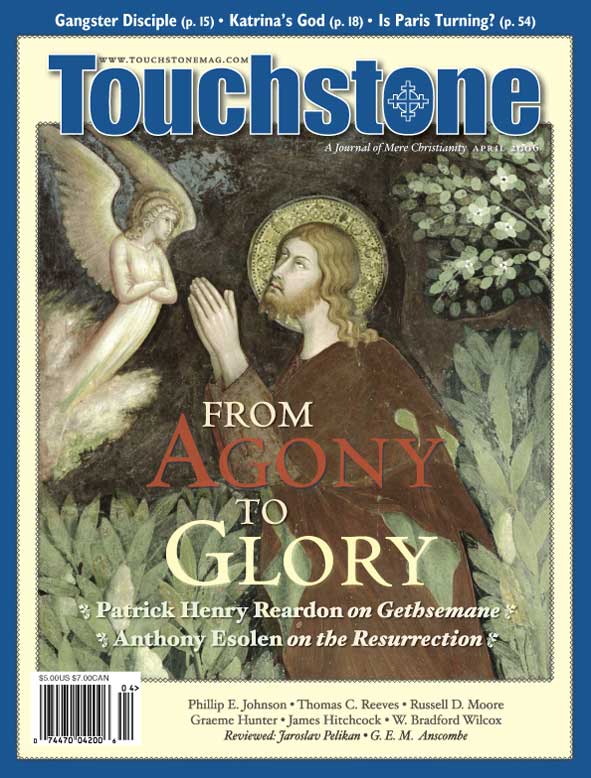
Gangster Disciple
Preston Jones on the Lesson I Remembered About the Gospel
At fifteen I found myself in the home of a gangster, probably a member of the L.A. Crips. This is what the week’s visitation program at my Baptist church in southern California had called me to. The Cripster’s house was a long way from the church, and I doubted that he had ever been there. I have no idea how the connection was made.
But as the church’s youth pastor and I went inside, I found myself moving alone toward a couch across a tiny living room from the thug and his girlfriend. I lived in a tough neighborhood. They lived in San Bernardino’s toughest neighborhood. According to lore, a teenager had been murdered nearby with a pickaxe a few days earlier, and it had taken the cops an hour to get there.
There must have been some small talk. I probably began to talk “black,” the language of my own neighborhood. I don’t think he said one word. Then I came to the point: Did he want to hear about Jesus? He nodded his head slightly, once.
The House Heard
I began with Adam and his sin, related some facts about the insufficiency of the blood of goats and bulls and of the need for a perfect sacrifice, moved to the death and rising again of the Lamb, and then to the promise of forgiveness and eternal life. “Do you want to ask Jesus into your heart?” I asked. He nodded.
So I led him in a version of the “sinner’s prayer,” which included the essential components: admit that you’re a sinner and in need of a savior; ask Jesus to be your savior. Simple.
Upon the “amen” I looked up, and he was staring at me with the same look as before—a look of indifference and boredom spurred by a third-grade reading ability. This wasn’t how things were supposed to be. After reciting the sinner’s prayer, a person cried, or at least smiled. His sins had been washed away! He was destined for heaven! But his expression was the same as before.
There was a brief, uneasy silence, and then I changed the subject. “Did you hear about the guy who stole a bag of weed from a dealer?” More recent lore. The gangster put his hand into his coat, indicating that he had a gun, and that he knew the drug dealer, and that I might be in trouble. “I don’t know the guy,” I said. “I just heard about it.” The hand on the gun relaxed. And I don’t remember what happened between then and my youth pastor’s appearance minutes later.
As we walked to the car, the pastor told me that the woman he had been talking to—the gangster’s mom? aunt? sister?—had accepted Jesus. And I distinctly remember the glow on his face as he said, “This house has heard the gospel!”
If I felt unease when he said that, I don’t remember it. And, anyway, if I did, the feeling was soon submerged in evangelistic fervor. In those days I tried never to let a day pass without telling someone about Jesus.
Preston Jones teaches history at John Brown University.
subscription options
Order
Print/Online Subscription

Get six issues (one year) of Touchstone PLUS full online access including pdf downloads for only $39.95. That's only $3.34 per month!
Order
Online Only
Subscription

Get a one-year full-access subscription to the Touchstone online archives for only $19.95. That's only $1.66 per month!
bulk subscriptions
Order Touchstone subscriptions in bulk and save $10 per sub! Each subscription includes 6 issues of Touchstone plus full online access to touchstonemag.com—including archives, videos, and pdf downloads of recent issues for only $29.95 each! Great for churches or study groups.
Transactions will be processed on a secure server.
more from the online archives

31.1—January/February 2018
on Taking the Measure of the Deserving & the Undeserving Poor by Martin Bordelon
35.2—Mar/Apr 2022
on Fatigued Christians Deciding to Engage the Culture by Keith Lowery
calling all readers
Please Donate
"There are magazines worth reading but few worth saving . . . Touchstone is just such a magazine."
—Alice von Hildebrand
"Here we do not concede one square millimeter of territory to falsehood, folly, contemporary sentimentality, or fashion. We speak the truth, and let God be our judge. . . . Touchstone is the one committedly Christian conservative journal."
—Anthony Esolen, Touchstone senior editor
