





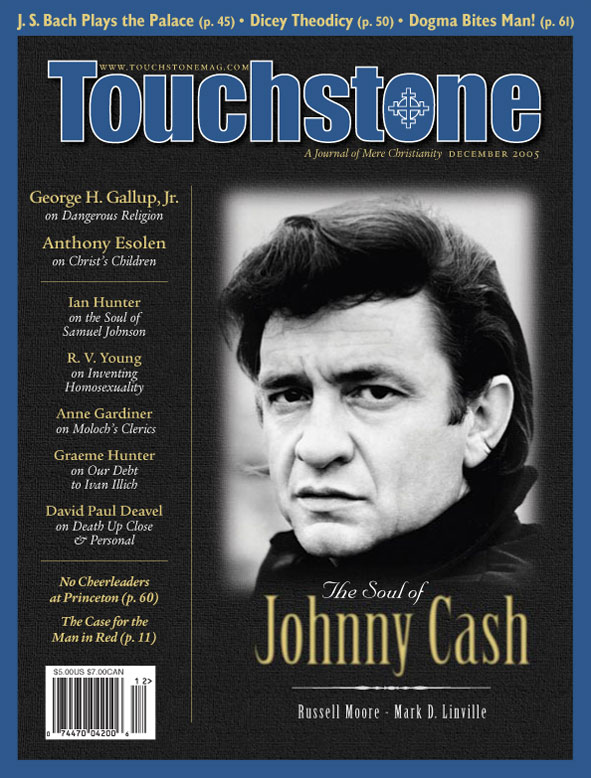
Real Hard Cash
Russell D. Moore on the Path of the Man in Black
There was an empty seat at this year’s MTV Music Video Awards. The late Johnny Cash wasn’t there. It’s not as though Cash frequented the Generation X/Y annual awards program. He was old enough to be the grandfather of the most seasoned performer on the platform. Still, two years ago, even while he was sick in a hospital, the Man in Black was there.
At the 2003 awards show, Cash’s video “Hurt” was nominated for an award—up against shallow bubblegum pop acts such as that of Justin Timberlake. Cash didn’t win. But the showing of the video caused an almost palpable discomfort in the crowd. The video to the song, which was originally performed by youth band Nine Inch Nails, features haunting images of his youthful glory days—complete with pictures of his friends and colleagues at the height of their fame, now dead.
As the camera pans Cash’s wizened, wrinkled face, he sings about the awful reality of death and the vanity of fame: “What have I become? My sweetest friend/ Everyone I know goes away in the end/ You could have it all/ My empire of dirt/ I will let you down, I will make you hurt.”
Whereas Nine Inch Nails delivered “Hurt” as straight nihilism, straight out of the grunge angst of the Pacific Northwest’s music scene, Cash gives it a twist—ending the video with scenes of the crucifixion of Jesus. For him, the cross is the only answer to the inevitability of suffering and pain.
Fleeting Fame
“It’s all fleeting,” he told MTV News. “As fame is fleeting, so are all the trappings of fame fleeting; the money, the clothes, the furniture.” This could not be in more marked contrast to the culture of the popular music industry (whatever the genre), a culture of superficiality, self-exaltation, and sexual libertinism.
Perhaps this is the reason Cash remained—to the day of his death—a subject of almost morbid curiosity for a youth culture that knows nothing of “I Walk the Line.” At the 2003 awards show, 22-year-old pop sensation Justin Timberlake, beating Cash for the video award, demanded a recount. Why would twenty-something hedonists revere an old Baptist country singer from Arkansas?
In one sense, the Cash mystique was nothing new. For the whole length of his career, onlookers wondered what made him different from the rest of the Hollywood/Nashville celebrity axis. Much of it had to do with the “man in black” caricature he cultivated. Cash joked that fans would often say to him, “My father was in prison with you.” Of course, Cash never served any serious jail time at all, but he could never shake the image of a hardened criminal on the mend. People really seemed to think that he had “shot a man in Reno, just to watch him die.”
That’s probably because of just how authentic and evocative his songs of prison life were. “Folsom Prison Blues,” for instance, just seems to have been penned by someone lying on a jailhouse cot listening to a train whistle in the night: “There’s probably rich folks eating in a fancy dining car/ They’re probably drinking coffee and smoking big cigars/ Well, I know I had it coming/ I know I can’t be free/ But those people keep a’movin’, and that’s what tortures me.”
The prison imagery seemed real to Cash because, for him, it was real. He knew what it was like to be enslaved, enslaved to celebrity, to power, to drugs, to liquor, and to the breaking of his marriage vows. He was subject to, and submissive to, all the temptations the recording industry can parade before a man. He was a prisoner indeed, but to a penitentiary of his own soul. There was no corpse in Reno, but there was the very real guilt of a lifetime of the self-destructive idolatry of the ego.
Russell D. Moore is president of the Ethics and Religious Liberty Commission of the Southern Baptist Convention. He is a senior editor of Touchstone.
A Journal of Mere Christianity—Delivered to Your Door
- Essays on theology, culture, and the Church
- Contributors from across the Christian traditions

Six print issues (one year) of Touchstone, plus full online access and PDF downloads for only $39.95.

Get a one-year full-access subscription to the Touchstone online archives for only $19.95.
bulk subscriptions
Order Touchstone subscriptions in bulk and save $10 per sub! Each subscription includes 6 issues of Touchstone plus full online access to touchstonemag.com—including archives, videos, and pdf downloads of recent issues for only $29.95 each! Great for churches or study groups.
Transactions will be processed on a secure server.
more from the online archives

29.5—Sept/Oct 2016
on the Loss of True Community & Rising Political Desperation by Karl D. Stephan

30.6—Nov/Dec 2017
Christ, Individualism & the Meaning of Cultural Diversity by Anthony Esolen
calling all readers
Please Donate
"There are magazines worth reading but few worth saving . . . Touchstone is just such a magazine."
—Alice von Hildebrand
"Here we do not concede one square millimeter of territory to falsehood, folly, contemporary sentimentality, or fashion. We speak the truth, and let God be our judge. . . . Touchstone is the one committedly Christian conservative journal."
—Anthony Esolen, Touchstone senior editor
