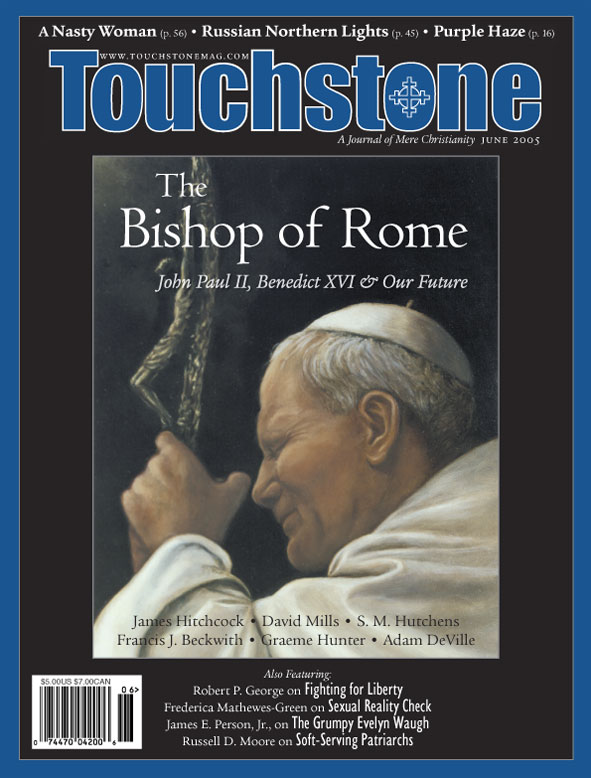
Vatican Bible School
Francis J. Beckwith on What John Paul II Can Teach Evangelicals
When my father attended St. John’s University in the late 1950s, his apologetics professor (a Catholic priest) told his class that the two greatest evils of the age were Communism and Protestantism. In the early days of Fuller Theological Seminary, Professor Harold Lindsell (later the editor of Christianity Today) offered a course on cults that included a section on Roman Catholicism.
Today, although not agreeing on every policy or program, Evangelicals have become close cultural and political allies to theologically and morally conservative Catholics. Both sides embrace a common philosophy that informs our understanding of the good, the true, and the beautiful. (I write as an Evangelical.)
For this reason, as we both celebrate the life and mourn the death of Pope John Paul II, Evangelicals should explore those writings of his that offer great insight and wisdom in the two areas in which many have found common interest with Catholics: understanding the relationship between faith and reason, and nurturing a culture of life, represented respectively in the two encyclicals Fides et Ratio and Evangelium Vitae.
Faith & Reason
In 1998 John Paul II issued an encyclical, Fides et Ratio: On the Relationship Between Faith and Reason. The most important lesson that Evangelicals can learn from this document is the pope’s insights on how certain philosophies will, because of their own internal logic, undermine confidence in the truth of the gospel message.
The pope is interested in saving souls, and he understands that bad philosophy, if not challenged by good philosophy, will make the church’s mission of soul-saving more difficult. Although he notes that there is no one correct Christian philosophy, there are limits to the extent to which a philosophy can be employed to illuminate Christian truth. For example, a Christian scholar cannot incorporate scientific materialism, deconstructionism, or moral relativism into Christian theology without distorting fundamental truths about the order and nature of things taught in Scripture and church history.
Evangelicals schooled in the sort of worldview analysis of thinkers such as Francis A. Schaeffer and James Sire will say in response to this, “Of course, that’s obvious.” But I think that they miss John Paul’s point. He is not saying that proponents of the Christian worldview must be aware of philosophy. That goes without saying. He is saying that biblical scholars and systematic theologians who think they can extract doctrine from Scripture unaided by the resources of philosophical analysis are kidding themselves, and are not doing a service to the Church.
There are two reasons for this. First, such a scholar, whether he knows it or not, approaches the biblical text with a cluster of assumptions—a philosophy—about the accessibility of theological truth as well as about texts and their meaning not derived from the biblical text itself. Second, when reading the Bible, he is confronted with scriptural truths that call for a philosophically informed and coherent theology by which to understand and make sense of them.
Consider, for example, the recent challenges on the classical attributes of God: that he is omnipotent, omniscient, omnipresent, immutable, incorporeal, and personal. Over the past several decades proponents of Open Theism (who deny that God knows the future and is immutable) and Mormonism (who deny all the classical attributes except “personal”) have challenged some of them.
Their reasoning is, not surprisingly, “biblical.” They read the text and they see, for instance, that God has regrets (Genesis 6:6), is corporeal (Deuteronomy 34:10), and is sometimes surprised (Jeremiah 32:35). So they conclude that classical theism (or some variation of it) is wrong about God because it is the result of reading the Bible encumbered by “pagan” philosophy.
Francis J. Beckwith is Professor of Philosophy and Church-State Studies at Baylor University. His most recent book is Politics for Christians: Statecraft as Soulcraft (InterVarsity Press, 2010). His writing can be found at www.francisbeckwith.com.
A Journal of Mere Christianity—Delivered to Your Door
- Essays on theology, culture, and the Church
- Contributors from across the Christian traditions

Six print issues (one year) of Touchstone, plus full online access and PDF downloads for only $39.95.

Get a one-year full-access subscription to the Touchstone online archives for only $19.95.
bulk subscriptions
Order Touchstone subscriptions in bulk and save $10 per sub! Each subscription includes 6 issues of Touchstone plus full online access to touchstonemag.com—including archives, videos, and pdf downloads of recent issues for only $29.95 each! Great for churches or study groups.
Transactions will be processed on a secure server.
more from the online archives

27.3—May/June 2014
Religious Freedom & Why It Matters
Working in the Spirit of John Leland by Robert P. George
28.2—March/April 2015
Man, Woman & the Mystery of Christ
An Evangelical Protestant Perspective by Russell D. Moore
calling all readers
Please Donate
"There are magazines worth reading but few worth saving . . . Touchstone is just such a magazine."
—Alice von Hildebrand
"Here we do not concede one square millimeter of territory to falsehood, folly, contemporary sentimentality, or fashion. We speak the truth, and let God be our judge. . . . Touchstone is the one committedly Christian conservative journal."
—Anthony Esolen, Touchstone senior editor