|
|
Subscribe to Touchstone today!
Scot on the Rock?The Faithful Poetry of Robert Burns by Ian Hunter There was once a lively debate as to the nature of Robert Burns’s religious beliefs, which appeared to end when Maurice Lindsay, author of the magisterial Burns Encyclopedia, published in 1980, called Scotland’s national poet “a wistful agnostic.” Most recent biographers have uncritically accepted his alleged agnosticism. I challenge that. Burns’s own commonplace book, his poems and letters, the fragments of autobiography we possess, all point to a quite different conclusion, namely, that he was a believing Christian who affirmed the central tenets of Christianity, albeit retaining a lingering reservation about personal immortality. The Hue & Cry Robert Burns was born in 1759 in the Scottish village of Alloway. His father, William Burnes (Robert only adopted the spelling “Burns” as an adult), was an impoverished farmer who struggled to eke out a living from hard land. William was a God-fearing, kirk-going man, and from his earliest days Robert was exposed to the Bible and to Calvinist theology. Despite a lifetime spent mostly in poverty, Burns gave generously to all who crossed his path. Yet his personal life was hardly an exemplar of Christian morality. He fathered several illegitimate children by different women, before and after his marriage to Jean Armour. Yet Christianity is a religion for sinners. As he wrote to a friend: “God knows I am no Saint; I have a whole host of Follies and Sins to answer for; but if I could, and I believe I do it as far as I can, I would ‘wipe away all tears from all eyes’.” Burns’s long letter to Dr. John Moore, written in 1787 following his first visit to Edinburgh, is the best autobiographical source we have. Burns promised Moore “an honest narrative” and “a faithful account of what character of a man I am.” Given this lack of ancestral pretension—“My ancient but ignoble blood / Has crept through scoundrels since the flood,” as he wrote in one poem—he would appear to be that rarest of authorial flora, a truthful autobiographer. He told Moore that as a boy he practiced “an enthusiastic, idiot piety.” The Presbyterian church of his youth had fractured into “Auld Lichts” (lights), strict Calvinists who preached Original Sin, divine election, and predestination, whom Burns lampooned whenever occasion permitted, and the more liberal “New Lichts,” whom he could tolerate if not support. Many commentators seem to have deduced from his contempt for such hypocrites among the “Auld Lichts” as “Holy Willie” Fisher, the subject of his most devastating satiric poem, that he had contempt for religion generally. Burns did reject the Calvinistic belief in Original Sin. To his friend Mrs. Dunlop, he wrote: “I am in perpetual warfare with that doctrine of our Reverend Priesthood, that ‘we are born into this world bond slaves of iniquity and heirs of perdition’.” He believed just the opposite, that “We came into this world with a heart and disposition to do good for it, until by dashing a large mixture of base Alloy called Prudence, alias Selfishness, the too precious Metal of the Soul is brought down to the blackguard Sterling of ordinary currency.” As Burns wrote to Dr. Moore: “Polemical divinity about this time was putting the country half-mad; and I used to puzzle Calvinism with so much heat and indiscretion that I raised a hue and cry of heresy against me, which has not ceased to this hour.” The “hue and cry of heresy” has continued, and to it has been added the charge of “agnostic.” Yet Burns was neither heretic nor agnostic. Enthusiastic Burns The first place to seek evidence of Burns’s religion is his commonplace book. It records Burns’s earliest observations, before he had any thought of publication. “Handsome Nell” is the first poem in the book, written in April 1783 when Burns was 24, but the next poems, written around March 1784, when Burns was mourning the death of his father, reveal something of his religious beliefs at the time:
The following month Burns described himself as “rapt up in a kind of enthusiasm to Him who, in the pompous language of Scripture, ‘walks on the wings of the wind’.” In August he turned again to poetry:
The second place to seek evidence is Burns’s published poetry. One of his longest poems, “The Cotter’s Saturday Night,” gives a description of the family’s household worship. The poet’s brother, Gilbert, confirmed that the cotter “is an exact copy of my father in his manners, his family devotion, and exhortations.” No reader of the poem, published in 1786, can doubt that the son shared the devout father’s beliefs. The cotter exhorts the children to “Be sure to fear the Lord always. . . . [to] Implore His counsel and assisting might; / They never sought in vain that sought the Lord aright.” Burns describes the family devotion after the evening meal with skill and tenderness, and then describes Old and New Testament characters and themes with a poet’s skill and a theologian’s knowledge. The central tenets of orthodox Christianity are the divinity, sacrificial death, and resurrection of Jesus Christ. In the poem, Burns categorically affirms the first two, describing Christ as “He, who bore in Heaven the second name” whose “guiltless blood for guilty man was shed.” He appears less certain about the resurrection, with its consequent promise of personal immortality, although the following lines seem to affirm the cotter’s hopeful prayer:
To the cotter’s devout innocence Burns contrasts the “pompous strains” of the institutional church and its rapscallion ministers:
The story concludes with the children of the family going their several ways, while father and mother kneel to “proffer up to Heaven the warm request” that God might, for them and for their children, “But, chiefly, in their hearts with grace divine preside.” The cotter’s benevolence toward his family and fellow man attracted the poet’s own life:
Even among Christian poets, like John Donne, it would be difficult to find a more robustly orthodox Christian poem than “The Cotter’s Saturday Night.” His other explicitly Christian poems include “The Address to the Unco Guid” (the self-righteous), “The Ninetieth Psalm Versified,” “A Prayer in the Prospect of Death,” “Prayer,” and “Man Was Made to Mourn.” (For what it is worth, according to James Mackay’s research in Burns A–Z; The Complete Word Finder, the word “God” appears in 84 of Burns’s poems; “godly” in another 17.) Burns’s Grasp At some point in his life, Burns apparently became a skeptic, for he told his boyhood friend, James Candlish, that he “ventured in ‘the daring path Spinoza trod,’ despising old women’s stories.” But he also went on to tell Candlish that this phase lasted but a short time, until “experiences of the weakness, not the strength, of human powers made me glad to grasp at revealed religion.” In a poem written for a young friend, Burns included this advice:
Burns first met Mrs. Agnes McLehose in Edinburgh in December 1787. Their passionate and verbose correspondence (for which he took the name “Sylvander” and she “Clarinda”) reveals a posturing Burns, one striving to impress a woman on whom he had amorous designs. But there is no reason to doubt his sincerity in this passage, written to Clarinda within a month of their acquaintance: “My definition of worth is short: Truth and Humanity respecting our fellow-creatures; Reverence and Humility in the presence of that Being, my Creator and Preserver, and who, I have every reason to believe, will one day be my Judge.” This apparently did not satisfy Clarinda, who wanted a fuller credo. Four days later Burns wrote again, providing her with the most extensive statement we have of his religious beliefs:
The mind “pervaded, actuated and governed by purity, truth and charity” does not “merit heaven,” he continued. Yet such a mind is “absolutely necessary” to obtain heaven and has God’s promise that it will attain it.
It is true that Burns says nothing here of Christ’s divinity, settling instead for the term “great Personage,” but elsewhere he does. For example, in a letter to Mrs. Dunlop he asserts simply, “Jesus Christ was from God.” Burns’s Hope Exulting On immortality, as I have said, Burns expressed doubt, but a doubt mixed with hope. Some of his modern readers have exaggerated the doubts while ignoring the hope, leading them to describe him as an agnostic, rather than the believer he was. In “The Cotter’s Saturday Night” Burns had expressed “hope exulting” that in a better place all should once again meet “while circling time moves round in an eternal sphere.” To Mrs. Dunlop, he wrote that nature and revelation both declare “That something in us never dies.” And in a poem occasioned by the death of his daughter, Elizabeth, who died at two, Burns again affirmed his belief in immortality:
Yet he retained his doubts, for he wrote to Mrs. Dunlop: “Jesus Christ, thou amiablest of characters, I trust Thou art no Imposter, and that thy revelation of blissful scenes of existence beyond death and the grave, is not one of the many impositions which time after time have been palmed on credulous mankind.” And to another friend he wrote that “every fair, unprejudiced Enquirer must in some degree be a Skeptic.”
The Protective Plan Just six weeks before his friend Robert Muir died, the poet wrote him expressing the hope that “Spring will renew your shattered frame,” but he went on: “The close of life indeed, to a reasoning eye, is ‘Dark as was chaos, ere the infant sun / Was roll’d together, or had try’d his beams / Athwart the gloom profound’.” He then wrote that “an honest man has nothing to fear,” for even if man only “moulder with the clods of the alley,—be it so at least there is an end of pain, care, woes and wants.” And if, he continued,
Even this passage, the nearest I can find to merit the description “agnostic,” affirms a destiny beyond death, ordered by a “Great Being” to whom reverence is due. Indeed, a theme running through all Burns’s writing, poetry and prose alike, is that “the Universal Plan, will all protect.” If this be agnosticism, it is a thin line indeed which divides it from belief. The same year that Burns wrote those words to Robert Muir, he wrote to Clarinda: “The dignified and dignifying consciousness of an honest man, and the well-grounded trust in approving Heaven, are the two most substantial sources of happiness.” As Burns’s own premature end grew near, he continued to have reservations about immortality, as do many believers who survey the human condition and the great unknown. Did not our Lord himself, in the final agonizing moments of crucifixion, cry out, “My God, my God, why hast thou forsaken me?” Eighteen months before his death, Burns again summarized his religious beliefs, this time for Mrs. Dunlop:
Burns’s Final Prayer Such references as these (and there are many more) convince me that Robert Burns was not an agnostic—wistful or otherwise—but a believing Christian. It is impossible to know, but it seems to me likely that “A Prayer in the Prospect of Death” summed up his state of mind when, in July 1796, at the age of 37, he gave up that spark of life it was his art and unique gift to celebrate:
Letters Welcome: One of the reasons Touchstone exists is to encourage conversation among Christians, so we welcome letters responding to articles or raising matters of interest to our readers. However, because the space is limited, please keep your letters under 400 words. All letters may be edited for space and clarity when necessary. letters@touchstonemag.com Subscribe to Touchstone today!
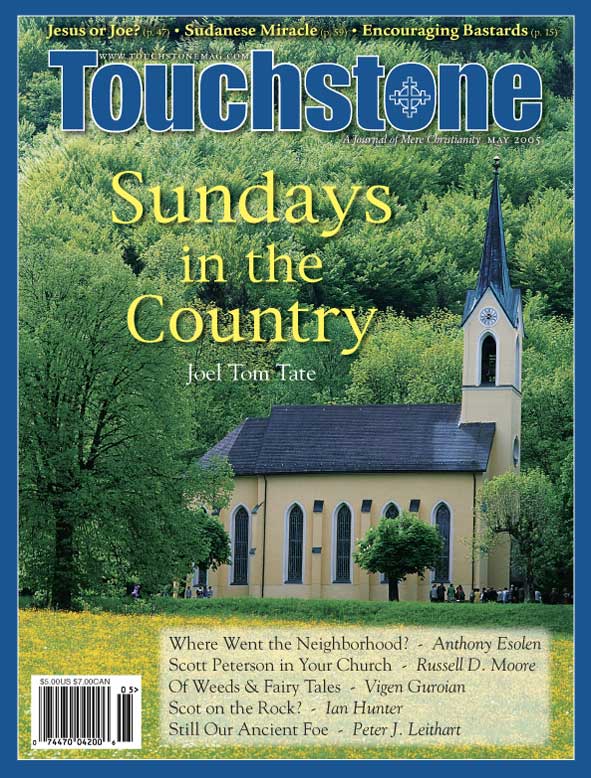
“Scot on the Rock?” first appeared in the May 2005 issue of Touchstone. If you enjoyed this article, you'll find more of the same in every issue. Click here for a printer-friendly version. An introductory subscription (six copies for one year) is only $29.95. |