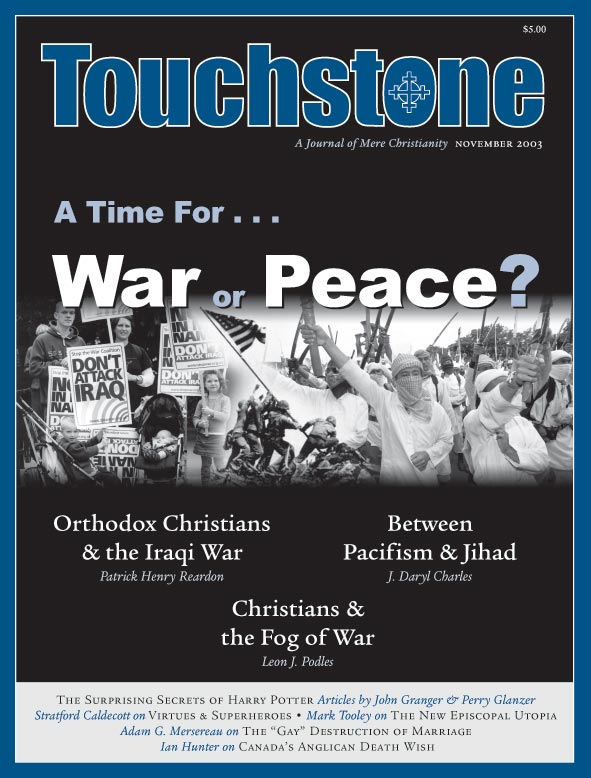
Between Pacifism & Jihad by J. Daryl Charles
Between Pacifism & Jihad
The Just-War Tradition Today
by J. Daryl Charles
The character of much current religious dissent to the use of military force
has been dispiriting. A good number of the dissenting responses lack serious
thinking about the role of the authorities in preserving the moral and social
order and protecting the citizenry, and many fail to engage in serious moral
reflection about our duty to our neighbor.
Many religious leaders seem to hold an overwhelming presumption against the
use of military force and to assume that any use of force is immoral in and
of itself. They seem to define peace simply as the absence of war. It is thought
that the use of force among the nations can be abolished within human history,
a presupposition that reflects a secular and optimistic view of human nature
and human history rather than a Christian realism rooted in the biblical story.
While American foreign policy is eminently debatable, the purpose of this essay
is to bring into focus once more an enduring aspect of the Christian moral tradition—an
aspect deemed antiquated by many—and consider its applicability to the
challenge of terrorism. I speak of just-war teaching.
The ancient question of how the use of force can serve justice and peace has
been a significant part of Christian reflection for the better part of two millennia.
Just-war thinking is relevant to the present day precisely because it acknowledges
the need of statecraft, seeks to apply consistent ethical norms to domestic
and foreign policy, and wrestles with the moral limits of engaging in conflict
(traditionally called jus ad bellum), while defining the moral limits
of what a nation may do within a conflict (jus in bello).
It agrees with pacifism that some resort to violence is morally wrong,
but rejects the notion that violence is always wrong. It is committed to bringing
to the world as much peace as is possible, but unlike pacifism, it believes
that in this fallen world some resort to force is necessary to bring peace to
peoples and nations. At the same time, it recognizes the tendency to violence
in peoples and nations and represents an attempt to restrain and regulate this
violence.
I will present a brief summary of just-war thinking later in the essay, but
first we need to consider three antecedent matters that will put it in context:
(1) what might be called the “non-fluid” character of justice; (2)
the obligations that inhere in our duty to our neighbor; and therefore (3) the
nature of Christian vocation as it applies to resisting evil. The first explains
how Christians can resolve the apparent conflict between the biblical call to
peace and the requirement to defend the defenseless; the second defines that
requirement; and the third distinguishes the duty of the individual, bound to
non-resistance, from that of the nation.
Non-Fluid Justice
Justice is developed philosophically both in pre-Christian philosophy (Plato’s
Republic is dedicated to this theme) and in the Judeo-Christian moral
tradition. Both describe justice in terms of giving to each person that which
is due him. The language of justice fills the entire Bible, and correctly so,
since justice describes how people ought to associate with one another and,
therefore, how society ought to function.
While Scripture agrees with the pre-Christian philosophical tradition that
justice is that which is due to others, it also explains why this is
so. In Scripture, the people of God are commanded to execute justice precisely
because God himself does so. Human beings bear the image of God. Thus, the Judeo-Christian
tradition affirms the inherent morality of punishment. For to be created in
the image of God is to be endowed with moral agency, and to be held accountable
for our actions is to be treated with dignity precisely because one is a moral
agent.
The Hebrew term for justice, mispat, generally refers to God-given
principles that govern how people relate to one another. These rules do several
things: They discriminate between righteousness and wickedness as well as between
guilt and innocence (e.g., Gen. 18:25; Is. 5:20ff); they erect protection for
the innocent and those without a voice (e.g., Ex. 23:6–9; Lev. 19:9–10);
they seek to prevent injustice from arising (e.g., Lev. 19:11–14); and
they rectify injustice (e.g., Is. 10:1–2). This justice, moreover, is
to be impartial (e.g., Ex. 23:3; Lev. 19:15). The Pentateuch defines the contours
of justice, the Psalms extol God for his inherent justice, and the prophetic
literature calls Israel to repent and do justice.
Justice, then, may be defined as the capacity to fulfill one’s moral duties,
both privately and publicly. It is thus a moral condition of right relations
within a society. It is that moral tissue by which and in which a moral society
coheres. It is “non-fluid” because its principles are God-given
and do not change (though the principles will be applied in different ways in
different societies).
Justice & Love of Neighbor
The virtue of love that is foundational to Christian ethics does not appear
suddenly out of nowhere in the New Testament. It is inherited from a moral tradition
extending back to the Decalogue. Love of the Creator results in proper love
of one’s neighbor (cf. Lev. 19:18). Thus, Jesus can sum up the ethical
obligations of genuine faith in the two “Great Commandments” (Matt.
19:16–22; Mark 12:28–34; Luke 10:25–28).1
In the command of Jesus, “Do not resist the one who is evil” (Matt.
5:39), we do not encounter any sort of contextualization. Furthermore, Jesus
does not indicate how we might respond in situations that involve a third party.
A principal problem with pacifism is that it misidentifies the morality of the
individual as applicable to the behavior of the state. Christian nonresistance
needs some qualification even of the Son of Man himself, who on occasion is
depicted by the gospel writers as showing wrath and indignation, using vitriolic
speech, and taking up weapons (e.g., whips) to denounce injustice.
Must Christians “turn the other cheek” of another person’s
face in the direction of an aggressor’s blows? Surely not. Indeed, the
introduction of a third party transforms the entire moral situation, and thus,
Christian ethical obligation. Nevertheless, the motivation remains the same:
neighbor-love.
Let us look at the example of the Good Samaritan, presented in Luke to illustrate
neighbor-love, to help us understand better the nature of such love and what
has been called an “ethics of protection.”2 Were the Samaritan
to have come across the actual assault and robbery, would Jesus have advocated
waiting until after the thieves’ assault and departure before coming to
the victim’s aid? And what sort of “aid” might be appropriate?
Is neighbor-love always non-resisting? A further question: Would Jesus have
supported the apprehension of the criminals who beat and robbed the victim?
While nonresisting love is free not to defend itself, as St. Ambrose
and St. Augustine believed, it must decide whether or not to defend others.
For both church fathers, defending a third party using proportionate force was
nothing less than an expression of Christian charity.
What many religious people are prone to forget, or do not comprehend, is that
love and mercy in no way eliminate the need for justice; they do not remove
the consequences of ethical violations and the need to restore the moral balance.
In the earthly realm, consequences still must be paid, for violations ranging
from speeding to stealing to strangulation. The biblical term for this state
of affairs is “restitution.”
While most Christians would never think of arguing on the basis of theological
justification through Christ that a highway patrolman not issue the speeding
ticket they had just earned, many Christians have a tendency to conflate justification
and ethics in the sphere of law and public policy. Criminal justice is impossible
if standards of justice are not fixed. In the ethical realm, biblical justice
requires that payment always be made for a violation and that this payment be
proportional to the offense; hence, the catchword “restitution”
that occurs frequently in the Pentateuch. Biblically speaking, the only category
of ethical offense for which no restitution exists is premeditated murder (cf.
Num. 35:1–33, esp. vv. 29–33).
Sobering examples from the last decade witness to this need. In an address titled
“Healing Wounded People,” the chief prosecutor of the International
Criminal Tribunals for the former Yugoslavia and Rwanda lamented that far “too
infrequently” is justice acknowledged as necessary “therapy for
victims who cannot really begin their healing process until there has been some
public acknowledgement of what has befallen them.” Richard Goldstone noted
that
where there have been egregious human rights violations that have been unaccounted
for, where there has been no justice, where the victims have not received
any acknowledgement, where they have been forgotten, where there’s been
a national amnesia, the effect is a cancer in the society. It is the reason
that explains, in my respectful opinion, spirals of violence that the world
has seen in the former Yugoslavia for centuries and in Rwanda for decades,
to use two obvious examples. . . . So justice can make a contribution
to bringing enduring peace.
What contributions can the application of justice make? Goldstone identified
four: (1) exposing the truth of specific guilt and avoiding general collective
guilt; (2) recording the truth for the historical record; (3) publicly acknowledging
the loss endured by the victims, who, as broken and terrified people, want and
need justice; and (4) applying the deterrent of criminal justice, since human
nature and potential criminals are deterred by the fear of apprehension and
punishment.3
Vocation & Resistance
Our consideration of the character of justice and its relation to neighbor-love
brings us to the third antecedent matter, the nature of the Christian vocation
as it applies to resisting evil. Christian ethics do not remove us from our
secular duties—even “untidy” duties. What is striking about
John the Baptist’s message is that he did not call tax collectors
and members of the Roman legion, in their repentance, away from their vocations.
He demanded that the former “collect no more than was due” and that
the latter not “extort from anyone by threats or false accusation”
(Luke 3:13–14). What is more, soldiers should “be content with their
wages”—hardly a call to religiously based nonresistance.
Apart from the apocalyptic writings, in which the authorities are always depicted
as evil, the New Testament at times presents what seems a shockingly uncritical
view of the magistrate. St. Peter seems to reflect the uncritical view of governing
authorities (1 Pet. 2:13–17) that we witness in Paul (Rom. 13:1–10).
“Respect” is the watchword in 1 Peter—a truly remarkable attitude
when one considers the conditions under which the author may have been writing.
Pauline instructions on the magistrate take on a more theological cast—governing
authorities are “appointed” by the Sovereign Lord and serve as divine
“servants” (13:4,6) in “executing wrath on evildoers”
(13:4). The reference to “bearing the sword” would have been patent
to the first-century reader: The apostle is here speaking of the jus gladii,
in the context of preserving the social order.
It is rare that Christian commentators take together the verses beginning
with Rom. 12:17 (“Repay no one evil for evil”) and extending through
13:10 (“Love does no wrong to a neighbor”). Yet the context requires
that we place side-by-side the proscribing of vigilante justice (12:17ff)
and the prescribing of justice meted out through the authorities (13:1ff). There
is no contradiction in Pauline thought, just as there is none in the teaching
of Jesus: “Justice” is illegitimate in one context, at the personal
level (by which Rom. 12:17–21 equates to Matt. 5:38–42), and legitimate
in another, in the hands of the magistrate.
The important distinction to be made is this: Christian ethics dare not conflate
the personal and the political.4 While Christians will differ about
domestic and foreign policy, that the governing authorities are authorized
by heaven to carry out justice in both is not in question.5 It is worth
noting that historic religious pacifism, in its Anabaptist expression, while
it did not recognize that a Christian could bear the sword or serve as a magistrate,
nevertheless confessed that the sword was ordained by God in the hand of the
secular magistrate for the twin purposes of punishment and protection (Schleitheim
Confession, art. 6). By contrast, much contemporary pacifism—in both
its religious and secular versions—mistakenly assumes that power is inherently
evil.
Just-war thinking posits a fundamental distinction between retribution or restitution
and mere vengeance or retributivism. Whereas the former is public, legitimized
by political authority and measured, the latter is private, autonomous, and
subject to no form of scrutiny.
Just-War Theory
Although a formal defense of just-war thinking was first developed by St.
Ambrose (A.D. 340–396) and his convert St. Augustine (A.D. 354–430),
well before their time Christians had begun serving in the Roman legions. For
this reason, Paul Ramsey has warned that it is a serious mistake to regard Christianity’s
accommodation to the Empire in this regard as a “compromise” or
“fall” from the pristine purity of its ethic.6 Similarly,
Arthur Holmes reminds us that the pacifist church fathers neither denied to
government the moral duty of self-defense nor denied that Christians actually
served in the military.7
Ramsey’s view indeed finds support in the fact that while they formulated
a theory of just war, both Ambrose and Augustine continued to teach that an
individual has no right to self-defense, and therefore, should not resist “one
who is evil.” Their singular concern is public protection. They
argue that it is the obligation of Christian love to defend and protect the
innocent, and that not to do so is as much an evil as to harm the innocent.
The Reformers joined their patristic forebears in the conviction that Christian
vocation means secular occupation, regardless of how mundane or odious its duties,
as public service to others motivated by love.
In its essence, the just-war tradition emanates from two fundamental concerns
in Christian thought: when the resort to force is justified (jus ad bellum)
and what kinds of force are appropriate in conflict (jus in bello).
The public nature of warfare and the necessity of legitimate political
authority are critical when viewed against the backdrop of medieval society,
in which princes, nobles, and criminals all engaged regularly and aggressively
in combat, and this for private ends.
Hence, it is not difficult to understand why for Thomas Aquinas the matter
of just war hinges first and foremost on legitimate authority. Insofar as war
is a public and not private matter, it must be adjudicated
by political and legal means. Without question, authority can be abused, but
this very possibility constitutes a primary reason why Christian thinking over
the centuries developed (and found reaffirmation in) a just-war tradition. At
the center of this thinking, as Thomas indicates, lie three fundamental moral
guidelines: sovereign authority, just cause, and right intention.8
Relying on Augustine, Thomas emphasizes that a war is justified if it seeks
to avenge wrongs, that is, when a nation must be punished for wrongs it has
inflicted. The nation waging war must pass several prudential tests: It must
work for good and not evil; it should have some prospect of succeeding; its
anticipated outcome of the war should promote peace; and its going to war should
be a last resort. Correlatively, the conditions for jus in bello are
equally measured. The use of force must be such that it discriminates between
the guilty/enemy and the innocent/noncombatant. And it must be proportionate,
i.e., necessary, rather than gratuitous or arbitrary (restraint rather than
revenge is intended).
Simply put, the just-war doctrine, in its classically Christian expression,
contains no presumption against war or the use of force. Rather, armed conflict
is construed as a moral enterprise. This is not to deny that war is
horrible. It is only to emphasize that those who use force and prosecute war
stand accountable before the Lawgiver and Sovereign of the nations. The pacifist
argues that the sheer horror of war renders it incapable of being a
moral enterprise.9 (In supreme irony, the primary international organization
committed to preserving world peace, the United Nations, is essentially a coalition
of power whose decisions are just as likely to sanction injustice as justice.)
But this position fails to make necessary discriminations: One can be horrified
at particular evils associated with war and yet morally confront them for the
purpose of preventing or limiting a greater evil. Police officers, to their
credit, do this all the time. Moreover, if the sheer horror of war renders it
immoral, then the God of the Old Testament is beyond horrible. In truth,
however, no God-given “rights” to life are absolute or unconditional.
In summary, justified armed conflict consists of “the use of the authority
and force of rightly ordered political community (and its sovereign authority
as minister of God) to prevent, punish and rectify injustice.” As I said
earlier, it represents an attempt to restrain and regulate violence.10
The Spectrum of Resistance
Whereas most people tend to think of war or the use of force in terms of two
opposing perspectives, the pacifist and the just-war positions, it is more accurate
to see the just-war tradition as a mediating position between the two poles
of pacifism and jihad/crusading.
At one end, the pacifist position assumes that participation of any kind in
military force, whether direct or indirect, is immoral. This view has both religious
and nonreligious advocates. The strengths of the pacifist perspective should
be noted. It recognizes diverse—and in many respects, creative—avenues
for political and social action. It is sensitive to the effects of violence
that all too often pervade the human experience. And in its religious form,
it takes seriously the demands of Christian discipleship, while sensitive to
the distortions of faith that can attend an uncritical view of the state.
Among its weaknesses are the following. In giving insufficient account of human
depravity, it in practice bestows upon evil and tyranny an advantage in the
present life. It denies or underestimates the fact that an ethics of protection
issues out of Christian love, thereby overestimating the effectiveness of nonviolence
and nonresistance. It conflates the realms of personal and political obligation.
It posits a nonexistent divide between the sacred and the secular. And it contributes,
whether intentionally or not, to a withdrawal of the Church from the world,
thereby preventing responsible Christian involvement in cultural institutions.
While pacifism may be the dictate of the private conscience, the Catholic theologian
John Courtney Murray was correct to argue that it cannot be public policy.
At the other end, the crusade or jihad position (using the term “jihad”
in its derivative sense of divinely sanctioned warfare, not in its narrower
sense of “striving in the path of God”) views war as justifiable,
absolute, and unlimited in its scope and means. Typically fueled by religious
conviction, this position, whether in its medieval or present-day Islamic expression,
rests on the conviction that God/Allah wills the warriors’ existence and
success.
While it may be difficult for most people to acknowledge strengths in the crusade
or jihad position, that position nevertheless understands that fundamentally
moral and religious reasons stand behind the conflict of nations. Among its
weaknesses are its failure to distinguish between religion and statecraft (that
is, between the duties of the individual and of the state), its inadequate understanding
of God, its disregard for natural law, its overly simplistic approach to morality
by which it reduces all things to a clear conflict of good over evil, and its
indiscriminate attitude toward human life. (By disregard for natural law, I
mean that it does not accept that some actions are wrong in themselves, not
right or wrong as God wills them; for example, that the killing of the innocent
is always wrong and that God will therefore never order it.)
As the survey of the pacifist and crusade poles suggests, far from being a contradiction
of the Christian primacy of peace, just-war thinking represents a moderating
position on this spectrum, as clarified by its fundamental assumptions:
• Evil exists and must be resisted this side of the eschaton. (This we
may call “Christian realism,” which takes evil quite seriously and
therefore does not interpret international conflict or terrorism as merely the
product of deficiencies in politics, diplomacy, foreign policy, or economics.)
• There is a “peace” that can be immoral because it leaves
the innocent unprotected.
• The just-war position, buttressed by natural moral law, is universally
applicable as an ethical guide to all peoples in all eras.
• War is a public function of the state and not the domain of private
individuals, groups, or the religious community.
• Both going to war (jus ad bellum) and prosecuting war (jus
in bello) are governed by moral limitations.
Terrorism
Let me close by asking how just-war thinking might help us respond to terrorism.
Terrorism is “an act or threat of violence against noncombatants with
the objective of exacting revenge, intimidating, or otherwise influencing an
audience” and “the deliberate creation or exploitation of fear through
violence in the pursuit of political change.”11 Because terrorism
constitutes a type of moral depravity—it is not unreasonable to suggest
that if terrorism is not a moral evil, nothing is a moral evil—it presents
us with unique political and moral challenges. And because it seeks to undermine
the very notion of a just and ordered society, upon which it typically lives
as a parasite, it poses a threat to the moral order.
In the end, it confronts states and nations, not merely individual citizens.
When individual citizens look to the governing authorities and discover that
those authorities either cannot or choose not to protect them, the citizenry
becomes dispirited, and self-governing society is radically undermined. To fail
to respond to the mass murder of innocents is a moral abomination, whether justified
for religious or nonreligious reasons.
The principles of just-war thinking—proper authority, right intent,
just cause, last resort, proportion, and discrimination—which constitute
the backbone of the just-war tradition, commend it as a response to the challenges
of terrorism.12 These principles instruct us that terrorist acts are
morally abominable and never acceptable under any circumstances and that the
chief moral justification for the use of military force is the protection of
society’s innocents. To acknowledge or recognize the presence of moral
evil and do nothing is irresponsible. If there is significant evidence of imminent
danger, Christian charity—with its love of the neighbor, the innocent
third party, according to Ambrose and Augustine—calls us to use preemptive
or retributive force. This may find application in, though not be limited to,
• assessing the morality of using military force in armed conflict with
terrorists who violate international boundaries and law;
• implementing and supporting war crimes proceedings against terrorists;
• discerning whether to use intervening military force to aid victims
of tyrants, as well as offering humanitarian assistance, as John Paul II himself
has recognized;13 and
• post-war nation building.
In the end, there is nothing in just-war thinking that is inconsistent with
peace and peacemaking.
Peace & Justice
I have attempted to present just-war thinking as a mediating position on the
spectrum of military force and to ground it in a Christian ethics of protection
and love of one’s neighbor. Given the Christian obligation to protect
the innocent in the face of moral evil, retrieval of this valuable part of the
Christian moral tradition is urgent. And given the priority assigned to proportion
and discrimination in just-war thinking, the tradition commends itself in the
face of proliferating terrorism in various theaters around the world.
Hereby Christian faith reaffirms its commitment to an ethics of protection and
neighbor-love. Failure to distinguish between the criminal and the retributive
act, with or without religious motivation, is morally abominable and a denial
of the Christian moral tradition. For without justice and moral order, there
can be no peace. Far from being a negation of peace, the just-war position,
undergirded by Christian realism, works to affirm and preserve peace, since
it acknowledges human dignity and justice as the highest values of society.
Notes:
1. Consider, for example, John Paul II’s commentary on the Good Samaritan
in his important apostolic letter Salvifici Doloris (1984), in which
the Samaritan becomes the model for the Christian community in learning to suffer
with others.
2. A fuller treatment of Christian social ethics and the ethics of war is
found in Ramsey’s later works, War and the Christian Conscience: How
Shall Modern War Be Conducted Justly? (Durham: Duke University Press, 1961),
and The Just War: Force and Political Responsibility (New York: Charles
Scribner’s Sons, 1968).
3. The address was delivered at the US Holocaust Museum on January 27, 1997.
The transcript of the address was published in the Washington Post,
February 2, 1997, p. C4.
4. Unhappily, this basic fallacy undergirds the exegesis of not a few Christian
ethicists. Consider Richard Hays, for example, who remarkably bases his somewhat
limited critique of the just-war tradition on one New Testament text—Matt.
5:38–48 (The Moral Vision of the New Testament [San Francisco:
HarperSanFrancisco, 1996] pp. 319–346). For a helpful and sustained critique
of Hays’s exegesis, see James Skillen and Keith Pavlischek, “Political
Responsibility and the Use of Force: A Critique of Richard Hays,” Philosophia
Christi 3/2 (2001), pp. 421–445.
5. See Helmut Thielicke, Theological Ethics, Volume 2: Politics (Philadelphia:
Fortress, 1969), pp. 519–538, esp. 532–533.
6. Basic Christian Ethics (New York: Scribner’s, 1950), pp.
166–184. See also chapters 4–8 of William Werpehowski and Stephen D.
Crocco, eds., The Essential Paul Ramsey: A Collection (New Haven/London:
Yale University Press, 1994).
7. Arthur F. Holmes, ed., War and Christian Ethics: Classic Readings on
the Morality of War (Grand Rapids: Baker [3rd ed.], 1991), p. 35.
8. Summa Theologica II-II q. 40.
9. This is an underlying premise, for example, of Stanley Hauerwas’s
Should War Be Eliminated? (Milwaukee: Marquette University Press, 1984),
p. 21.
10. Thus James Turner Johnson, “The Broken Tradition,” The
National Interest (Fall 1996), p. 30. Elsewhere I have sought to underscore
the critical distinction between retribution and revenge/retributivism in the
context of criminal justice. See J. Daryl Charles, “The Sword of
Justice,” Touchstone (December 2001), pp. 12–16.
11. Jessica Stern, The Ultimate Terrorists (Cambridge/London: Harvard
University Press, 1999), p. 11; Bruce Hoffman, Inside Terrorism (New
York: Columbia University Press, 1998), p. 43.
12. For a lucid critique of contemporary religious pacifism that simultaneously
argues for the contemporary relevance of the just-war tradition in the light
of terrorism, see Keith J. Pavlischek, “Just War Theory and Terrorism:
Applying the Ancient Doctrine to the Current Conundrum,” Witherspoon
Fellowship Lectures 21 (2001), pp. 1–21.
13. The issue of humanitarian intervention has been thoroughly and most helpfully
treated in chapter 3 of James Turner Johnson’s Morality and Contemporary
Warfare (New Haven/London: Yale University Press, 1999), pp. 70–118.
A longer version of this essay was presented in September 2002 at From
Death to Life: Agendas for Reform, a conference sponsored by the University
of Notre Dame Center for Ethics & Culture.
J. Daryl Charles is an associate professor of ethics and culture at Union University in Jackson, Tennessee. He is the author of Virtue Amidst Vice (Sheffield Academic), The Unformed Conscience of Evangelism (InterVarsity), and most recently, Between Pacifism and Jihad (InterVarsity, 2005). He is a contributing editor of Touchstone. |