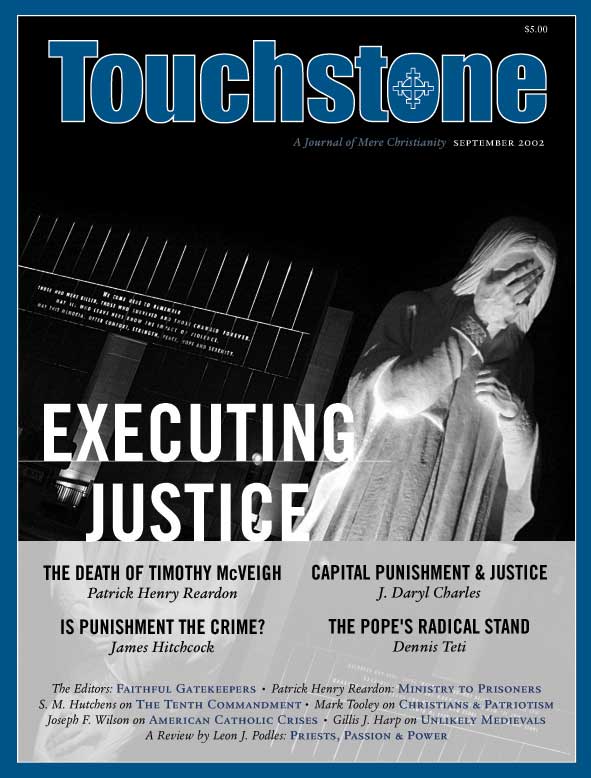
Capital Crime & Punishment by J. Daryl Charles
Capital Crime & Punishment
Reflections on Violating Human Sanctity
by J. Daryl Charles
Among Western nations there is a generally growing sentiment in favor of abolishing
the death penalty. This sentiment, it should be noted, is more disposed simply
to view the death penalty in unqualified terms as cruel, barbaric, and unsuited
to enlightened contemporary culture than it is to wrestle with the complexities
of public policy and the meaning of criminal justice—e.g., what is just,
what punishments are proportionate, which categories of criminals should be
permanently removed from civil society, what sorts of crimes are heinous and
worthy of ultimate sanctions, what obligation the governing authorities and
lawmakers have in protecting and preserving civil society, and what steps a
just society should take to ensure and facilitate restitution for victims.
It is noteworthy—when uncontroversial—that the abolitionist sentiment,
which would seem to be a coordinate of pacifism, is almost uniformly accepted
and propagated within the academy. Resistance to capital punishment is equally
strong among philosophers, theologians, ethicists, and social scientists (including
criminologists).
It is similarly noteworthy that commitment to the abolitionist position, particularly
as it finds expression in the academy, is equally strong among religious and
non-religious types. In their manner of argumentation, religious opponents of
the death penalty do not exhibit any major distinction from their non-religious
counterparts; both groups have recourse to and appropriate the identical arguments—e.g.,
the alleged inhumanity and barbarity of capital punishment, a lack of statistical
justification for its usage, the unpleasantness of executions, the deficiency
of the retributive motive, excessive legal costs, abrogation of the Mosaic legal
code, the criminal justice system’s arbitrariness and unevenness, potential
margin for error, racial disparity, and Jesus’ purported love ethic. The
last four of these are typically viewed as insuperable obstacles to the death
penalty’s implementation.
Mass murder—whether in the form of Oklahoma City or more recently in
New York City and Washington, D.C.—is only a more visible reminder not
only that the issue of the death penalty will not go away but also that debates
surrounding capital punishment—and the morality of punishment
in general—must press on beyond the standard byte-sized propagandizing
of the electronic and print media (both of which tend to discourage honest debate).
Such discussions, moreover, must move beyond the stereotyping that not infrequently
attends—indeed, stymies—criminal justice debates. Rarely does the
debate over capital punishment proceed with an honest consideration of the moral
merits of both sides of the issue. It will not suffice for us as a nation
or a society merely to say that Timothy McVeigh, or other murderers, should
or should not be executed. What matters is why people like McVeigh—whether
they kill one person or multiple hundreds—should or should not forfeit
their right to live. How we as a society understand and apply “justice,”
a significant part of which is reflected in our (in)ability to distinguish between
the criminal and the punitive act, will determine whether we are justified in
conceiving of ourselves as civilized or barbaric.
Moral Responsibility & Punishment
Although behavioral theorists are thought to agree on precious little, a substantial
majority would concur with B. F. Skinner that a person’s behavior
is determined by a genetic endowment traceable to the evolutionary history of
the species and by the environmental circumstances to which that person has
been exposed. Thus, at least at the level of “science,” determinism
tends to eclipse the concept of personal moral responsibility. It should be
noted that philosophers and mental-health professionals, as well as journalists
and pundits, are equally inclined to go along with this view.
It is therefore quite understandable, based on conventional wisdom, that the
basic notions of individual responsibility and punishment, having been delegitimized,
have fallen on hard times. The social-scientific consensus that punishment is
bad, it goes without saying, has had an extraordinary impact on the moral landscape
of American culture.
To speak of retribution is to dissent from prevailing social-scientific models
of human behavior. B. F. Skinner’s Beyond Freedom and Dignity1
contains what is perhaps the most forceful attack on the traditional understanding
of personal responsibility. Tellingly, many psychotherapists—be they behaviorist
or non-behaviorist—agree with at least the baseline of Skinner’s
message: Punishment is bad and personal moral responsibility is mythical.
Skinner’s opposition to punishment was rooted not so much in the belief
that it was wrong—to condemn it as morally objectionable, after all, is
to concede that there exists a fixed moral standard—as in the assumption
that it was ineffective, even producing counterattack. To be sure, social-scientific
evidence regarding reward and punishment can be made to say anything we wish.
For example, deterrence studies can be (and typically are) adduced by both sides
of the death penalty debate. But what is uncontroversial is the commonsense
notion that holding a man responsible for his actions means nothing less than
subjecting him to punishment2 if he breaks the law. This assumes that
people, from earliest childhood on, are sensitive to and motivated by reward
and punishment, which is to say, behavior is predictably subject to
causal influences. The implications of this thinking for criminal justice have
been patently stated by psychologist John Staddon:
If criminal behavior is predictably deterred by punishment, the justly punished
criminal is less likely to disobey the law again, and serves as an example
to other potential lawbreakers. . . . But if behavior were
unpredictable and unaffected by “reinforcement contingencies”—if
it were uncaused, in Skinner’s caricature of freedom—there would
be absolutely no point to punishment or any other form of behavioral control,
because it would have no predictable effect.3
If capital punishment in fact does not serve to deter the potential murderer,
the abolitionist will need to acknowledge the grim reality that neither
will any other form of punishment, whether in the private or the civil realm.
Accordingly, any punishment, including incarceration, is wholly arbitrary.
Does the fear of death deter? Hoodlums in Washington, D.C., and other major
cities intuit its reality. Given the growing dilemma of witness intimidation
in murder cases, law enforcement authorities note the refusal of witnesses to
testify. Witnesses’ fear of being eliminated themselves is making it exceedingly
difficult for authorities to prosecute murder suspects. “It’s undoubtedly
one of the biggest problems we face,” concedes the chief of the US attorney’s
office in the nation’s capital.4
In the end, anyone who promotes a punishment-free society is peddling not
science but social anarchy. The goal of the criminal justice system, remember,
is to raise the “costs” of criminal behavior to the place where
they outweigh the anticipated “benefits.” It is relatively uncontroversial,
except among some social and behavioral scientists, that people will commit
crimes only if they are willing to pay the “price” that society
“charges.” Tragically, as one cultural critic has observed, the
expected “prices” assigned to criminal activity in the United States
are shockingly low.5
Retribution or Revenge?
For several decades the concept of retribution has been called into question,
when it has not met outright rejection. Current penology tends to place emphasis
neither on retribution nor deterrence but on rehabilitation6 and prevention,
opting for probation, psychiatric treatment,7 and, increasingly, for
biomedical intervention.8 As it stands, the events of September 11,
2001, notwithstanding, neither the social nor the behavioral sciences possess
a vocabulary that is capable of explaining why murderers are doing wrong, beyond
mere utilitarianism.
Both religious and nonreligious opponents of the death penalty—indeed,
of punishment in general—base their opposition on several moral premises:
(1) punishment is retribution; (2) retribution is vengeance (revenge); and (3)
vengeance is morally repugnant. An evaluation of these premises, it goes without
saying, is of critical importance in assessing the moral merits of the death
penalty.
Punishment, it should be observed, has numerous roles in society: It isolates
individuals who endanger and threaten the common good; it expresses social outrage
at morally heinous acts; it controls and restricts victimization that would
be perpetrated through criminal acts; it rewards the perpetrator proportionately
with consequences befitting the crime; and it “rehabilitates” by
giving the offender time to reflect on the grievous nature of his crime. Each
of these trajectories represents a critically important component in the preservation
of the social order.
The act of punishment, properly understood, is not to be confused with the
act of revenge. Several activities and attitudes might be classified as revenge
or vengeance. One is “vigilante justice,” punishment carried out
by individuals based on their own authority. A second category qualifying as
revenge would be the attitude that delights in bringing evil upon the offender
rather than a greater social good to society. The avenger not only kills; he
also rapes, tortures, plunders, and burns what is left. By contrast, a higher
moral-social good must be aspired to if punishment is to be considered legitimate.
Yet another retaliatory category is the situation in which some political authority
takes the life of an innocent person to punish him—or punish a group (e.g.,
a village)—for particular political-ideological reasons. This practice
can be seen in the way that Communists treat political dissidents and religious
leaders. It also found widespread expression when the Nazis occupied France
during World War II. Whatever their respective distinctions, two important features
unite—and delegitimize—all of these categories: (1) intention, and
(2) the lack of legitimate authority. Capital punishment in and of itself,
however, is not an act of “revenge,” based on these definitions
and distinctions.
At this point, the term retribution requires similar qualification
and definition. While not all punishment can qualify as retribution, all punishment
has a retributive element. That is to say, justice—that cardinal virtue
and moral tissue by which a moral society coheres9—requires that
a crime be punishable, that future and proportionate consequences attend a criminal
act. Retribution as a justification for punishment is lodged in two unbending
ethical realities: the degree of wrongness of the criminal act, and the degree
of the individual’s criminal responsibility in committing such an act.
Retribution, then, requires that wrongdoers get no more and no less than what
is proportionate—or just—to their crime.
But isn’t retribution simply a pretext for vengeance or revenge? Is it
possible, in practice, to distinguish between the two? Our haunting doubts and
deep-seated cynicism notwithstanding, retribution distinguishes itself from
revenge in several important and unmistakable ways. First, retribution addresses
an objective wrong, while revenge may be enacted for an injury that is real
or perceived. Second, retribution has both upper and lower limits. It acknowledges
the moral repugnance of assigning ultimate sanctions to petty crime, as well
as of assigning light punishment to violent, heinous crime. It will protect
offenders from more punishment than they deserve, but it will exact punishment
precisely where it is deserved. Revenge, by contrast, is wild, “insatiable,”
retaliatory, and not subject to limitations. After killing his victims, for
example, the person carrying out revenge will mutilate them and burn their houses.
Vengeance has a thirst for injury, with no moral principles to limit penalties
and damage.
Third, retribution is impersonal. It demands impartiality (hence, the depiction
of Justice as blindfolded) and will not be subject to personal bias. The avenger,
on the other hand, will operate out of retaliation for something done to him
or to his particular group. Fourth, retribution takes no pleasure, unlike the
avenger, who derives pleasure or satisfaction from his victim’s suffering.
The moral outrage expressed through retributive justice is primarily rooted
in moral principle, not mere emotional outrage or hatred. Its outrage is the
expression of abiding moral markers—for example, “Thou shalt not
murder.” Fifth, retribution is aimed at the individual and not at groups
represented by the offender, whereas membership in an opposing or offending
group might be sufficient warrant for revenge.10
We are making a fundamental distinction, then, between retribution as a principle
of justice, without which a society cannot remain civilized, and “retributivism,”
which is frequently and mistakenly decried under the banner of “retribution.”
If we insist on driving a wedge between “justice” and “retribution,”
we end up reducing justice itself to incoherence, as Oliver O’Donovan
has correctly pointed out.11 For there cannot be two or more different
moral norms for governing social relationships.
Retributive justice is rooted, therefore, in an abiding standard of what is
morally good. When we express social outrage at morally heinous acts, we are
responding to moral intuitions; it is virtuous, not vicious, to feel anger at
moral evil. In truth, if we do not express anger and moral outrage
at evil, something is very wrong with us. To affirm retribution, which is integral
to the history of Judeo-Christian moral thinking as well as foundational to
any free and just society, is not to abandon one’s belief in mercy or
forgiveness; rather, it is to acknowledge the difference between private and
public spheres and to recognize that mercy does not release the demands that
justice imposes.12
Quite widespread is a mistaken notion of forgiveness that exists among both
nonreligious and religious abolitionists. Within a Judeo-Christian framework
of ethics, forgiveness is predicated upon a prior contrition and repentance
by the offender. In the Old and the New Testaments, forgiveness is never
understood as being required or granted apart from a thoroughgoing contrition
and deep-seated repentance for the evil act.13 Moreover, biblical teaching
on forgiveness occurs only in the context of personal relationships, not duties
of the state or magistrate. Where disobedience or evil is not repented of, judgment—which
is to say, justice—ensues, regardless of whether it applies to individuals
or to a nation.
What is often labeled “retributive justice” may be called “corrective
justice” or “adjudicative justice,” i.e., justice that expresses
itself in the correcting of ruptures or imbalances in society. And while individuals
and groups can work for “social justice,” only governments can practice
“corrective judgment,” which is to say, justice as judgment.
The distinction between vengeance and retribution, between the sphere of the
private and the sphere of the magistrate/governing authority, is precisely the
rationale behind St. Paul’s argument as contained in the Epistle to the
Romans. Whereas Romans 12:17 and following is devoted to a passionate proscribing
of private vengeance—with statements such as “Do not repay
anyone evil for evil”; “Do not take revenge, my friends, but leave
room for the wrath of God”; and “Vengeance is mine, says the Lord;
I will repay”—the apostle’s teaching as contained in 13:1–7
must be understood in context: It is a prescribing of government’s
ordained role to execute wrath on evildoers as an expression of maintaining
social order. Contextually, prescription follows directly on the heels of proscription.
Revenge is condemned, while retribution is condoned; indeed, the latter is authorized.14
In responding to moral evil, we direct our energies in several directions: We
respond to the victim who has been wronged; we respond to the wider society,
which is “scandalized” by the wrong done in its midst; we respond
to potential offenders who might be tempted to do the same wrong; and not last,
we respond directly to the offender himself. Understood rightly, then, retributive
justice performs a multifaceted moral good—a good that contributes to
the preservation of the social order.
To be sure, the question of how severely an offender should be punished remains
to be addressed. But that is a question that cannot be debated apart from normative
canons of virtue and vice, moral good and moral evil. Precisely what is a society
prepared to tolerate in the way of deviant behavior? What forms of behavior
are acceptable and unacceptable? Where will society draw the line? What forms
of criminal barbarity is it prepared to condemn as “evil,” and will
society have the moral wherewithal to sanction such forms proportionately and
consistently?
In the last two decades much abolitionist sentiment has been grounded in the
fear of the system’s “margin for error” as well as the common
perception of its arbitrariness. These perceptions, not illegitimate in themselves,
necessitate thoughtful and well-supported challenges. The fact that human beings
can err in their attempts to work for a just society, humbling as that prospect
is, is no grounds for abandoning justice; neither does it address the morality
of punishment per se. And while this fear produces a compelling argument against
use of the death penalty, it does not address the issue that retributive justice
raises, i.e., what is the proportionate response by society to the ultimate
social crime? If fear of the margin for error alone were to guide us in matters
of justice, then working for justice at any level would be futile and
a waste of time. Much easier would it be to embrace incivility and barbarism.
But what is required is that we work all the more for a just
society, refusing to bow to demagoguery, diatribe, racially charged cant, and
emotional manipulation—all of which tend to ignore responsible examination
of federal statistics15 as well as morally responsible debate.
Indeed, there will always be heard the cry of retaliationists who, in the name
of “justice,” demand that torture be meted out to the torturer.
But that outcry in itself does not cancel the fact that retributive justice
performs a necessary moral good. What we are arguing is that it is possible
to uphold retribution without collapsing into retributivism.
Retribution & Religious Sentiment
Comments by John Paul II in the 1995 encyclical Evangelium Vitae
(“The Gospel of Life”) have been interpreted by many—inside
and outside the religious community—as a condemnation of the death penalty.
John Paul indicated that capital punishment is rarely necessary, since “rare”
are the occasions that require it.16 This limitation must be contextualized
alongside other statements in the encyclical by which John Paul upholds the
church’s traditional teaching that the state possesses the right to exercise
capital punishment as a means of defense against the worst criminals.17
His observation that the death penalty is to be rare is a prescription of political
prudence and not of moral principle; thus, it cannot be construed as a rejection
or condemnation of the morality of capital punishment.18
The Catechism of the Catholic Church, in its clarification of the
commandment “Thou shalt not murder,”19 states: “The
covenant between God and mankind is interwoven with reminders of God’s
gift of human life and man’s murderous violence.” Among these “reminders”:
“For your lifeblood I will surely require a reckoning. . . .
Whoever sheds the blood of man, by man shall his blood be shed; for God made
man in his own image” (Gen. 9:5–6). Regarding this covenantal “promise,”
the Catechism is emphatic:
The Old Testament always considered blood a sacred sign of life. . . .
This teaching remains necessary for all time. . . .
The deliberate murder of an innocent is gravely contrary to the dignity of
the human being, to the golden rule, and to the holiness of the Creator. The
law forbidding it is universally valid: it obliges each and everyone,
always and everywhere.20
“Legitimate defense of persons and societies,” according to the
Catechism, is to be understood in this light. Legitimate defense can
be “not only a right but a grave duty for someone responsible for another’s
life, the common good of the family or of the state.”21 Preserving
the common good of society requires “rendering the aggressor unable to
inflict harm,” including the use of the death penalty:
For this reason the traditional teaching of the Church has acknowledged
as well-founded the right and duty of legitimate public authority
to punish malefactors by means of penalties commensurate with the gravity
of the crime, not excluding, in cases of extreme gravity, the death penalty.
For analogous reasons those holding authority have the right to repel by armed
force aggressors against the community in their charge.22
The Catechism understands theology to inform penology, acknowledging
three legitimate functions of punishment: it is expiatory, i.e., it pays a debt;
it is therapeutic, i.e., it contributes toward the offender’s correction;
and it is preservative, i.e., it safeguards personal safety and the social order:
The primary effect of punishment is to redress the disorder caused by the
offense. When his punishment is voluntarily accepted by the offender, it takes
on the value of expiation. Moreover, punishment has the effect of preserving
public order and the safety of persons. Finally punishment has a medicinal
value; as far as possible it should contribute to the correction of the offender.23
John Paul’s comments concerning the death penalty find further qualification
in his 1976 remarks on the relationship between temporal punishment and cleansing/purification
from sin. Still Archbishop Karol Wojtyla of Kraców at the time, he delivered
a series of homilies at the invitation of Pope Paul VI for a Lenten retreat.
In this remarkable series, collected and published under the title Sign
of Contradiction, sustained reflection was given to the question of man’s
purification from sin in the present life. Guilt incurred by sin, the future
pontiff noted, constitutes a debt in the present life that must be paid. Punitive
dealings, he maintained, provide the necessary atonement and restore the balance
of justice and moral order that has been disturbed. This “law of purification,”
as it was described, “reveals both the temporal and the eternal perspectives”
of human moral accountability, and purification comes “by way of suffering.”24
Lest John Paul’s remarks—past or present—be misconstrued to
oppose capital punishment in principle, he makes the following qualification
in his description of punishment as a means of “purification”:
We have all heard about terrible indictments—sometimes followed later
by rehabilitation—and sentences inflicted on people disgracefully liquidated
in the name, so it is said, of law and order. Nonetheless, these abuses cannot
change the basic truth about punishment. Unjust application of judicial systems
on the part of men only underlines the need for ultimate justice.25
Even for the pope, who has had intimate experience with totalitarian rule
and illegitimate political authority, the potential for abuse in the criminal
justice system does not allow us to set aside “the truth about
punishment” that is tethered to moral principle.
Thus, we find a harmony between John Paul’s views, the Catholic Catechism,
and what the Church has taught historically: “In extreme cases,”
legitimate authority has both “the right and duty” to “remove”
those who are vicious in character and undermine the common good. This view
concurs with that of Thomas Aquinas, for “although it be evil in itself
to kill a man so long as he preserve his integrity, yet it may be good to kill
a man who has sinned even as it is to kill a beast. For a man is worse than
a beast, and is more harmful, as the Philosopher states.”26 Aristotle,
the “philosopher” Thomas is citing, declares that “a bad man
can do ten thousand times as much harm as a beast.”27
The overwhelming testimony of Christian history—Catholic, Orthodox, and
Protestant—affirms the compatibility of supporting capital punishment
with orthodox belief and practice. While in recent decades questions have been
raised within religious circles regarding the death penalty, it is simply illegitimate
to contend that the doctrines of mercy and forgiveness cannot coexist with support
for capital punishment.
Sanctity & Civility
Does the death penalty for premeditated murder constitute an “uncivilized”
or “barbaric” response by society to crime, as many abolitionists
fervently maintain? The answer depends fundamentally on how a society perceives
the moral difference between crime and punishment. Those who contend that the
death penalty is barbaric and unsuited to convicted murder tend to conflate
the punitive and the criminal act. To abandon the criteria for capital justice
is to abandon all criteria for punishment that is just. If the standard of justice
is not universal and abiding, then no moral evil can be denounced. The Nuremberg
trials, therefore, were wrong-headed, since Nazi war crimes cannot by definition
be denounced. After all, one man’s torture is another man’s good
time. Might, in the end, makes right, and the Nazis simply came out on the wrong
side. In fact, thus seen, punishing the innocent can be tolerated, even justified,
since punishment has nothing at all to do with desert. In such a moral vacuum,
retribution is indistinguishable from revenge.
Much of the more recent objection to the death penalty is rooted in the seemingly
random way in which it is applied. Some critics might be willing to concede
that capital punishment, based on principle, might be reasonable, but the margin
for human error or the system’s unevenness, they claim, impels us to drop
its practice. But the fact that there is potential for error, real as that possibility
is, does not entitle us to give up working toward justice. Nor does it require
that we set aside the wisdom of the ages that holds people morally accountable
for their actions. At an existential level, we do not succumb to the power of
our emotions; we overcome them by commitment to moral principle. If we argue
for the ethical propriety of executing convicted murderers, it is not
because we delight in death. Quite the contrary, it is because we sense a need
to act out of moral obligation, based on a commitment to the sanctity of human
life and the preservation of the social order.
When a murder occurs, the community is obliged, regardless how unpleasant,
to clear its throat as it were and declare a communal response. Yale professor
of computer science David Gelernter, who was letter-bombed in June 1993 and
nearly lost his life, has put the matter clearly. We execute convicted murderers
in order to make a communal proclamation: namely, that murder, an evil so terrible
and so utterly defiling to a community, is intolerable. An execution forces
the community “to assume forever the burden of moral certainty; it is
a form of absolute speech that allows no waffling or equivocation. Deliberate
murder, the community announces, is absolutely evil and absolutely intolerable,
period.”28
But there is a fundamental problem here—a problem that eclipses the
deep and contentious philosophical debates surrounding the death penalty. The
problem is our culture’s unwillingness to pass moral judgments.
Morally speaking, we have grown accustomed to equivocating, and in so doing
we have cut ourselves off at the knees. American society’s moral evasiveness
begins with its indifference to the moral marker “Thou shalt not murder.”
The Torah, it must be remembered, does not forbid taking the life of a human
being; rather, it forbids murder. Indeed, Jewish and Christian moral traditions
concur in acknowledging justifiable forms of homicide, such as self-defense,
civilian protection, resisting insurrection, and just war. In a morally courageous
society, this list would be extended to include executing those who commit the
ultimate in human crime.
Harry Weller, Senior Assistant State’s Attorney for the state of Connecticut,
who represented the state’s interests in the appeal of Connecticut’s
first death sentence in 30 years, argues that “when society convicts someone
of murder it cannot ‘turn away its eyes’ but must impose the sentence
required by law.” In this regard he cites the contemporary relevance of
the eleventh-century Jewish commentator Rashi, who warns that one cannot act
in a cowardly manner by transforming the victimizer into a victim. For Rashi
and for Weller, it is morally inexcusable for society to say, “One citizen
is already dead. Why should we take the life of another?”29 Despite
the potential for error and the complexities surrounding capital punishment,
the state has not only the right but a duty to deter and punish violent criminals
while protecting its law-abiding citizenry. Any potential victim of a murderer
deserves nothing short of the highest protection, which only the existence of
the death penalty offers.
In observing the nature of contemporary abolitionist arguments, University
of Calgary classicist Barry Baldwin poses the following intriguing question:
“When capital punishment was abolished in Britain and Canada, one of the
main arguments raised against it was that it was not acceptable in a ‘civilized
society.’ But 30 years on, will anyone seriously maintain that either
British or Canadian society is more ‘civilized’ without the death
penalty than it was with capital punishment?” Baldwin is not much impressed
by abolitionist reasoning. With characteristic bluntness, he notes that the
impulse toward retribution is innate in humanity: “It is not enough to
reserve it for God. He may not exist, and if He does, if you take the Deist
approach from Epicurus to . . . Voltaire, He may not be concerned.”30
Punishment as a vehicle of retribution exists in society to express and affirm
the seriousness—and our consciousness—of criminal behavior. A view
of life that acknowledges proportionality for crimes is not predicated upon
“barbarity,” contrary to the rhetoric of impassioned abolitionists.
To be punished—however severely—because we in fact should have known
better is to be treated as human beings, endowed with dignity and moral agency.
A society unwilling to impose the death penalty upon those who murder in cold
blood is a society that has deserted its responsibility to uphold the unique
value of human life. In the end, civilized culture will not tolerate murder;
an uncivilized one, however, will.
Notes:
1. New York: Bantam, 1971.
2. Punishment may be understood as that action which entails any degree of deprivation,
loss of privilege, or loss of freedom.
3. John Staddon, “On Responsibility and Punishment,” The Atlantic
Monthly (February 1993), 93.
4. P. Duggan, “Witness Imprisoned by Fear: Man Goes to Jail Rather than
Risk Testifying at Murder Trial,” The Washington Post, 18 December
1993, A1.
5. Thus Ed Ruberstein, “The Economics of Crime,” Imprimis
(March 1995), 3.
6. The rehabilitation argument was little used before about 1800. With the
turn toward imprisonment as the chief form of punishment, the notion that prison
might “rehabilitate” the offender became more common. Hence, the
term penitentiary was coined to depict a place in which the prisoner
had time to reflect, repent, and resolve to change.
7. See, for example, Adrian Raine, The Psychopathology of Crime: Criminal
Behavior as a Clinical Disorder (San Diego: Academic Press, 1993).
8. This trend has been charted by W. Wayt Gibbs, “Seeking the Criminal
Element,” Scientific American (March 1995), 98–104. See,
for example, R. D. Masters and M. T. McGuire, eds., The Neurotransmitter
Revolution: Serotonin, Social Behavior, and the Law (Carbondale/Edwardsville:
Southern Illinois University Press, 1994).
9. Catechism of the Catholic Church, no. 1807. Thomas Aquinas, drawing
from Aristotle, St. Augustine, and St. Anselm, defines justice as that virtue
which is a constant and firm to render what is due to each man (Summa Theologiae
II-II, q. 58, a. 1).
10. I am particularly indebted to David A. Crocker of the Institute for
Philosophy and Public Policy in the University of Maryland School of Public
Affairs for his insights in drawing the necessary distinction between retribution
and “retributivism.” See in this regard “Retribution and Reconciliation,”
Philosophy & Public Policy 20/1 (2000), 1–6.
11. Oliver O’Donovan, “Payback: Thinking About Retribution,”
Books & Culture, (July/August 2000), 19.
12. A frequent error is to confuse forgiveness as a personal response
or reaction to injustice with the necessary strictures of public policy.
The private and the public are different spheres; a conflation of the two is
disastrous when applied to public policy, particularly in matters of justice.
Moreover, mercy does not remove the consequences for our actions. Whether we
are apprehended for speeding or strangulation, the consequences—i.e.,
the public debt—must be paid.
13. For an explanation of forgiveness that is both faithful to biblical revelation
and sensitive to the intrapsychological domain, see Avis Clendenen and Troy
Martin, Forgiveness: Finding Freedom through Reconciliation (New York:
Crossroad, 2002).
14. The commentary on Romans 13:4 by Pope Pius XII (whose pontificate extended
from the critical period of 1939 to 1958) reflects the consensual position of
the Christian Church’s position historically: The mandate of governing
authorities as “God’s deacon” to “bear the sword not
in vain” is “as little determined by time and culture as the nature
of man and the human society by nature itself.”
15. Statistics compiled by the federal government reflect most accurately
the true state of the criminal justice system. For example, in the sphere of
race-based capital sentences and executions of those on death row, Bureau of
Justice Statistics show that since 1976, contrary to conventional wisdom, the
death penalty does not discriminate on the basis of race. See, e.g.,
“Capital Punishment 1993,” December 1994, NCJ 150042, which contains
exhaustive documentation on the death penalty since 1976. See also the website
for exhaustive statistical analysis of racial trends up to the present at the
federal level as they apply to capital sentencing and executions.
16. Evangelium Vitae, no. 56.
17. Ibid., nos. 55–56.
18. Catholic philosopher Raphael Waters correctly makes this distinction (“Capital
Punishment: An Evil Act or an Act of Justice?” Social Justice Review
[January/February 1996], 6). A similar distinction is made by John Paul
himself in an earlier encyclical (Centesimus Annus 3).
19. Exod. 20:13; Deut. 5:17.
20. Catechism of the Catholic Church, nos. 2260–2261 (emphasis
added).
21. Ibid., no. 2266.
22. Ibid. (emphasis added).
23. Ibid.
24. Karol Wojtyla, Sign of Contradiction (New York: Seabury Press,
1979), 166–169. The former bishop of Kraców writes: “Although
punishment in itself causes suffering, humiliation, depravation of freedom—things
which grievously wound a man—it nevertheless serves a good purpose”
(166).
25. Ibid., 166.
26. Summa Theologiae II-II, q. 64, a. 2. This “removal,”
as Thomas knew, may extend to a forfeiting of one’s right to live. Such
removal, for Thomas, has a higher moral goal, i.e., safeguarding the common
good.
27. Nicomachean Ethics, Bk. VII, chap. 6, 1150a.
28. David Gelernter, “What Do Murderers Deserve?” Commentary
(April 1998), 22.
29. Cited in Weller’s Letter to the Editor, Commentary (August
1998), 10.
30. Barry Baldwin, “Crime, Punishment and Civility,” Chronicles
(August 1997), 25.
Some parts of this article were adapted from the author’s “The
Sword of Justice,” published in the December 2001 issue of Touchstone.
J. Daryl Charles is an associate professor of ethics and culture at Union University in Jackson, Tennessee. He is the author of Virtue Amidst Vice (Sheffield Academic), The Unformed Conscience of Evangelism (InterVarsity), and most recently, Between Pacifism and Jihad (InterVarsity, 2005). He is a contributing editor of Touchstone. |