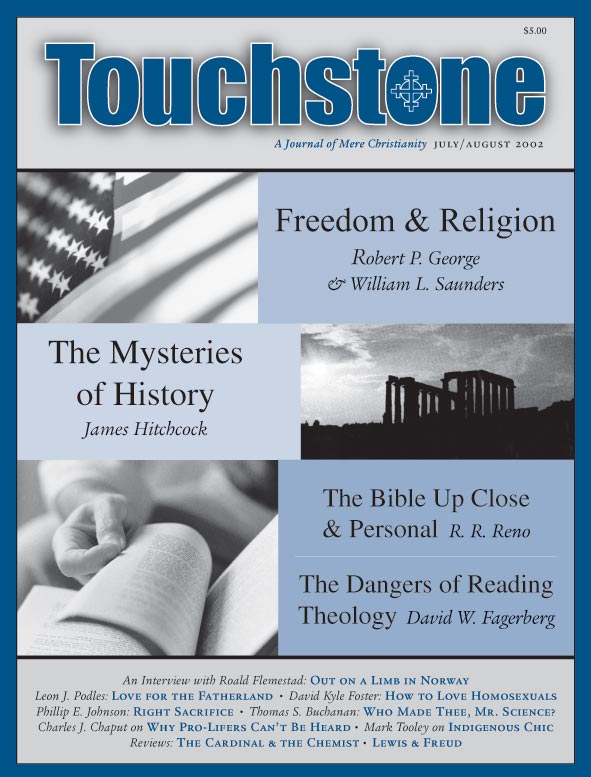
“You Have Been Brought Near ”
Reflections in the Aid of Theological Exegesis
by R. R. Reno
The challenge of theological exegesis is not altogether different from other situations of reading and listening. The difficulties of interpretation rest in the problem of hearing what is said. We are often very distant from what is spoken, and so it is difficult to hear. For example, my daughter is often in the basement reading a book, and she only vaguely hears me yell for her to go and clean her room. She hears, but does not hear. As parents know, one must be close to children in order to get them to pay attention.
When we read the Scriptures, of course, the text is not on one floor, yelling, while we are distracted on another. Yet, the situation is similar. The text has something to say, or more precisely, as a written artifact, it is forever saying what it has to say. We, on the other hand, often fail to hear. Even when the Scriptures are open before us, as near as the desktop, we remain at a distance. What is being said is not always clear. Like my daughter, we often respond to Scripture’s word with a pregnant “What?”—or worse, an indifferent “Whatever.”
Hermeneutics are the disciplines of attention that help us overcome this distance. After all, Hermes was a messenger. He bridged the chasm between the gods and human beings. He traveled the distance from the divine speakers to the human listeners. For this reason, no matter how much theoretical heavy machinery is brought to bear on the problems of interpretation, hermeneutical reflection is always practical. It involves acquiring the knowledge and skill necessary to reach the goal of listening: to hear what is being said. It is, in a sense, the knowledge and skill of a traveler, someone who can find a way to overcome the distance that often mutes, obscures, and even silences. Any biblical hermeneutic worth its salt, then, will provide guidance for negotiating what I call the “problems of distance.” It must inculcate the knowledge and skill necessary to get from where we are to what the Scriptures are saying.
The most important—and debilitating—distance that separates us from what the Scriptures are saying should be understood spiritually. For all our worries about history, as well as those about the limitations of finite language and culturally conditioned texts, our difficulties in relation to the biblical text are not historical or metaphysical. Those difficulties are but subsets of the fundamentally spiritual reason why paying attention to Scripture is such a challenge. The Word of God is near to us, but even as it is before our eyes and on our lips, we are far. Only the cure of our souls will bring us to hear the Word of God.
But what do I mean by “historical,” “metaphysical,” and “spiritual” distance?
Historical & Metaphysical Distances
The notion of historical distance is familiar to anyone who has taken a course in modern biblical criticism. The idea is simple. My difficulties in communicating with my daughter are not only a matter of trying to make my voice reach the basement family room. Sometimes, I will chastise her for failing to perform a certain task. She will respond, “Since when I am supposed to do that!” With exasperation I ask her why she cannot remember what I told her only yesterday. For a ten-year-old, one day seems sufficient to erase memory!
For the modern reader of the Bible, the challenges to memory are even more severe. The Scriptures were written a long time ago, and as a result, the context, semantic use, and the very languages of the texts stand at a distance. This makes it easy for us to confuse anachronistic readings with accurate readings as we substitute assumptions about the present for the realities of the past.
A great deal of the angst of modern Christian biblical scholarship rests in the historical distance created by the passage of time, and the challenges it poses. One of my colleagues is emphatic: The distance is nearly unbridgeable. The New Testament, he insists, was written in a “high context” social matrix of Mediterranean agrarian culture. It cannot be understood by students raised in a “low context” Northern European industrial culture.
R. R. Reno teaches theology and ethics at Creighton University in Omaha, Nebraska, and is author of In the Ruins of the Church: Sustaining Faith in an Age of Diminished Christianity (Brazos, 2002).
A Journal of Mere Christianity—Delivered to Your Door
- Essays on theology, culture, and the Church
- Contributors from across the Christian traditions

Six print issues (one year) of Touchstone, plus full online access and PDF downloads for only $39.95.

Get a one-year full-access subscription to the Touchstone online archives for only $19.95.
bulk subscriptions
Order Touchstone subscriptions in bulk and save $10 per sub! Each subscription includes 6 issues of Touchstone plus full online access to touchstonemag.com—including archives, videos, and pdf downloads of recent issues for only $29.95 each! Great for churches or study groups.
Transactions will be processed on a secure server.
more from the online archives

calling all readers
Please Donate
"There are magazines worth reading but few worth saving . . . Touchstone is just such a magazine."
—Alice von Hildebrand
"Here we do not concede one square millimeter of territory to falsehood, folly, contemporary sentimentality, or fashion. We speak the truth, and let God be our judge. . . . Touchstone is the one committedly Christian conservative journal."
—Anthony Esolen, Touchstone senior editor