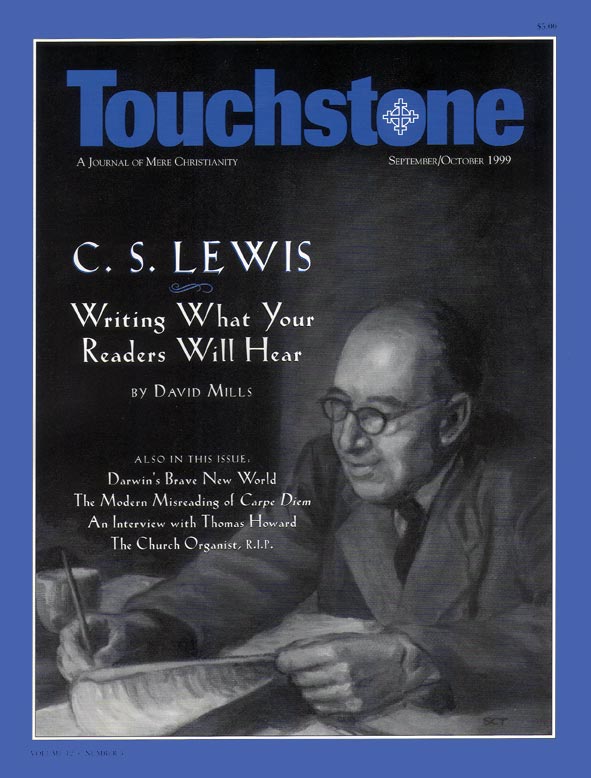
The Catholic Angler by Thomas Howard + Patrick Henry Reardon + David Mills
The Catholic Angler
An Interview with Thomas Howard
A longtime friend of Touchstone and himself a model
of the “ecumenical orthodoxy” and “mere Christianity”
we strive to represent, Professor Thomas Howard has brought many—Catholics
as well as Evangelicals—to a deeper understanding of the treasures of
the historic church through his writings and personal influence.
A graduate of Wheaton College and New York University, Professor
Howard taught for many years at an Evangelical college until he became a Roman
Catholic in 1985. From then on until his retirement he taught English at St.
John’s Seminary College, the seminary of the archdiocese of Boston.
He has written several books, on both religious and literary subjects,
beginning with Christ the Tiger, a sort of spiritual autobiography,
in 1967. Since then he has written seven more books, including Evangelical
Is Not Enough; Lead, Kindly Light, the story of his conversion to Catholicism;
and most recently On Being Catholic. He has also written studies of
the novels of Charles Williams and C. S. Lewis, notably The Achievement
of C. S. Lewis and C. S. Lewis, Man of Letters. Ignatius
Press, the publisher of On Being Catholic, also distributes a videotape
series of 13 lectures by Professor Howard on “The Treasures of Catholicism.”
Professor Howard was interviewed by senior editors Patrick Henry Reardon and
David Mills while at Trinity Episcopal School for Ministry to teach a weeklong
course on the novels of C. S. Lewis. The interview has been edited for
clarity and completeness, but the oral style has been retained.
Touchstone: One of the things C. S. Lewis is now notable for
is his intellectual dissent from, in a way his assault on, feminism. I mean
not the ordination of women as in his essay “Priestesses in the Church?”
but the feminist ideology in general.
Thomas Howard: That’s one of those questions that has
to be chased all the way through the corpus of Lewis’s works, because,
obviously, feminism as such was not then a major or articulate force. He wrote
the essay “Priestesses in the Church?” because the question had
surfaced in a mild Anglican sort of way, but there was nothing very imminent
about it.
Lewis presents a view of reality at a polar extreme from the frame of mind
that ends up demanding ordination of women as presbyters. Obviously, he believes
in hierarchy, but it’s not a hierarchy of power, which seems to be the
feminist understanding. The whole discussion of priestesses in the last thirty
years has run along sociological and political lines, with theology dragged
in, when necessary, from the sidelines and various attempts made to rewrite
the Bible to show that St. Paul said you should ordain women as presbyters.
In Lewis, you get a vision of things—of everything—in which the
whole question of masculine and feminine is a subdivision of tremendous, prior
considerations that he understands to characterize the universe. Lewis felt
that those categories are of the very stuff of the universe, prior to male and
female. Male is the way masculinity exhibits itself under biological species
or terms, and female is the way femininity manifests itself under biological
species.
For him, hierarchy is obviously the way the dance is choreographed, or the
way the map of the universe is drawn. He points out in one place that in a hierarchy
one has the duty of obedience to those above one in the hierarchy and the duty
of magnanimity and stewardship and noblesse oblige to those below one.
I seriously doubt that Lewis would use the words “above” and “below”
with respect to masculine and feminine, because they don’t apply. They’re
the terms of people who can only think of a dance in terms of power—which
makes for a pretty poor dance.
The locus classicus for his view of gender is, I think, the scene
toward the end of Perelandra when Ransom sees the two eldila: Perelandra,
who is feminine, and Malacandra, who is masculine. The feminine eldil, Perelandra,
participates in equal majesty, dignity, authority, and so on, with the masculine
figure, Malacandra, but she has a receptiveness, a nurturing side. All these
words have become buzzwords now, but they weren’t when Lewis wrote them
in the 1940s.
I think he would feel that it’s turning things upside down to try to
come at the mystery of femininity and masculinity with a power glint in one’s
eye, or with an egalitarian, calculating set of categories to try to even up
the slices of the pie.
You see this mind in That Hideous Strength.
TH: There’s a sense in which the entire book That
Hideous Strength is a document in the case. Jane Studdock is clearly deeply
confused at the beginning of the book in her effort to avoid being thought of
as “little wifey”—and who wants to be thought of as little
wifey? Fairy Hardcastle calls her that.
But she doesn’t want to be identified with what she would think of as
stereotypes, but which are actually archetypes, having to do with womanhood
and being wife or mother, etc. She is an intellectual, she is writing her dissertation
on John Donne’s “triumphant vindication of the body,” and
yet poor Jane is a Gnostic without knowing it. She hasn’t got a clue
about the vindication of the body. She doesn’t know that her body will
turn out to be virtually Mark’s salvation, not just because he remembers
her with lust or concupiscence in the toils of Belbury, but because it is her
womanhood that stands with clarity and truth and good sense and resilience and
toughness over against the bottomless deception and disintegration that is Belbury.
It is Jane embodied, not just the idea of Jane, not just Jane’s
intellect—far from it—but Jane as his spouse that saves
Mark. And, of course, the very last paragraph of the book is, in one sense,
the beginning. We have now come up to the real beginning of the marriage. Mark
is about to be saved. He has escaped hell, and Jane is to be his salvation.
You’ve spoken before about women being naturally religious,
having some natural intuition or instinct for the spiritual, and about men being
the activists who go dashing around trying to make up for a lack of spiritual
instinct.
TH: I cannot prove it but I deeply suspect that this is indeed
the case. I think Lewis felt this, too. His picture of Lucy, for example, would
sustain the following line of thought, namely, that there is a profound ontological
sense in which the woman is there, wherever we mean by “there.”
She is at home. Woman is the place, so to speak. She carries it in
her. She creates it around her. There’s something that women know in their
bones and marrow and lymph system and womb about being human. They are profoundly
at home in being human.
Men, on the other hand, are vexed and perplexed about life. It may be a form
of the wish for power. Obviously, women are susceptible to certain kinds of
vanity, but men are not only equally so, but also may be susceptible in more
serious ways. Take Mark Studdock: he will mortgage his soul to get into the
inner ring. And you see that sort of thing with men all the time.
It’s my hunch that this is the reason that trying, as some of the feminists
did early in the game, to dredge up names of women conquerors or women composers
or women painters, through the 10,000 years of myth and history that we have,
ends up being farcical. It’s a lost game. The list is short. There are
not that many good women composers. There are not that many good women philosophers
or mathematicians. There are not many good women painters.
I’m intrigued by the question of women novelists. A case could be made
that among the English novelists, they’re the best—George Eliot,
Jane Austen, and so on. None of the men ever quite equal them. One could go
off on a disquisition about that. It may spring from their profound understanding
of the immediate and familiar, and of domestic situations.
But anyway, back to the main point. This will sound fanciful and almost Jungian,
which I would hate to be thought to be, but nevertheless, I suspect that the
reason it has been the men who have been charging around—slaying woolly
mammoths, conquering kingdoms, furrowing their brows over mathematical formulae
and physics and astrophysics, writing symphonies, you name it—is that
men are aware of being in some sense on the periphery and they want to find
out: what is it? what is it? what is it? The woman is already there,
says my theory. They’re not hagridden with this need to know or to find
out.
This doesn’t mean a woman can’t be a physicist or a statesman.
In our own time, three of the toughest and most successful heads of state—Margaret
Thatcher, Indira Ghandi, and Golda Meir—certainly have shown no lack of
ability, but my guess is that your archetypal woman—woman qua
woman—doesn’t aspire to that. Even Margaret Thatcher is not a feminist
as such. She didn’t become prime minister to show that women could do
it, to score a point for the women. She liked politics. She liked running a
government. And she could do it. She was jolly good at it. She was better than
most of the men.
But anyway, there’s my theory. It gets right down to the sexual imagery,
you know. The man is seeking the place. He’s the aggressor; he’s
one who is probing, if you will, trying to find the place. The woman is already
there.
Relative to language, at St. Anne’s in That
Hideous Strength both the men and the women work in the kitchen, but the
Fisher King will not let them work there simultaneously because they do not
share the same vocabulary.
TH: Yes. That’s interesting. And this is one of the
things that scandalizes Jane. She thinks of herself as being a liberal with
all the right liberal attitudes, and she gets into St. Anne’s and finds
this simultaneous egalitarianism and hierarchy and she cannot
put it together. It scandalizes her and bothers her. She finds that Ivy Maggs,
who is lower class, is considered to be an equal member of the community, and
so on and so on.
I think the men and women do not work in the kitchen at the same time because
they do not have the same vocabulary, and obviously their vocabulary springs
from their inner substance and their way of coming at work and life. Lewis has
a marvelous aside somewhere where he speaks of a great “purgatorial kitchen . . .
with milk boiling over, toast burning, and crockery smashing.” The women
will have to learn to calm down about it, and the men will have to learn to
lend a hand.
There’s no notion in Lewis that something is proved by men giving the
baby the bottle or washing the dishes. Among a lot of couples nowadays, of course,
the woman is almost afraid to carry the baby and the man has to push
the stroller and change the diapers. I don’t think Lewis would have been
comfortable or happy with that notion, but it’s natural to him to picture
St. Anne’s as being such a place where there is this strange simultaneous
egalitarianism and hierarchy.
But when hierarchy is called upon, then it exercises itself. When the Fisher
King needs to be boss, he’s boss.
If I recall the differences in the way men and women speak, Lewis
says that a man says, “Put this on the third shelf on the north wall,”
whereas a woman says, “Put this over there.” The second is direct
and the first is quite specific by giving a grid, an outline.
TH: And for reasons incomprehensible to the men, it works
for the women! “Put it over there” doesn’t worry another woman.
The man wants to say, “Well, which shelf? Which end of the shelf?”
Yes, I had forgotten about that. That’s a good component, if you want
to try to put together a whole picture of Lewis’s ideas.
He had his tongue a little bit in his cheek sometimes about all this, but
I think one should. Lewis had a notion that there is probably a lot of drollery
in heaven, too, and it’s rather amusing, that sort of thing. And yet it
touches on an ontology. It’s profound.
You said that when the Fisher King needs to be boss, he’s
boss. But he’s never a fisher queen. What is it in headship that requires
masculinity? Why is the Fisher King a Fisher King?
TH: Well, there’s the question. Again, you have to keep
recalling the fact that you can have a queen, a Catherine the Great, a Maria
Teresa, a Victoria, an Elizabeth, who can jolly well run the show. But I think
this connection of headship and masculinity derives from God’s revelation
of himself as He. God is not male, of course, but certainly he is masculine
in the Judeo-Christian vision. And in most pantheons the head honcho is masculine.
There are not nearly as many matriarchal pantheons as the feminists would have
us believe, with the creator as the absolute sovereign being a female or a feminine
figure.
One of the reasons would be that in good medieval and renaissance fashion
we engage the doctrine of correspondences. We reflect in our circumstances the
nature of the Deity, and the head in the universe is king, not queen. I don’t
know any place where Lewis tries to itemize properties that add up to a better
crowned head.
On the other hand, back to Perelandra. The description of Malacandra
as opposed to Perelandra is certainly, if one buys Lewis’s ontology and
vision at all, magnificent. It is not only convincing, it is also a magnificent
unfurling of antiphonal dignity, antiphonal majesty. The whole story of Perelandra
is Tinidril being trained to be queen and mother. Tor, who is going through
lessons that we never see, is being trained to be king and father. We don’t
see his part. It’s interesting that Lewis picked the female, the feminine
figure, to pursue, to follow with great punctilio.
Why does one need to have a king? I think Lewis would finally demur a little
bit on that question. He would not retreat on it but he would appeal to mystery.
He would tick off the various items and say a woman can do this and that, and
that women are just as bright as men, and just as important as men . . .
and yet, and yet, and yet: There is something about the masculine mystery that
is asked to bear the yoke of authority, for whatever reason.
In “Priestesses in the Church?” Lewis says that a
child who prays to God the mother will have a radically different religious
life, spiritual life, from one who prays to God the Father, but he doesn’t
argue the point. He just drops it. One intuits the truth of his insight, but
how do you convey it? It is not a self-evident proposition anymore, even to
Christians. It may have been obvious when Lewis wrote, but not now. Is there
some way of making an argument for that, or do you have to do it imaginatively?
TH: I suspect that your last clause there may be the key.
It may have to be done narratively or imaginatively in a sense analogous to
the following: namely, it would be laborious, at best, to try to write a disquisition
on a state of affairs where absolute power is characterized by absolute love
and mercy and grace. When we think of absolute power, we immediately think of
Hitler and Mao and Stalin. It would be a laborious task to plot out how absolute
power could show itself as absolutely merciful as well. But all you need is
one page about Aslan and you’ve got it. You’ve got the whole picture:
absolute power with absolute mercy and grace and love and tenderness.
The paradox, the terrible good, would be a hard proposition to cope with in
a propositional disquisition, but you see it in a paragraph or two about Aslan.
By the same token, it would be laborious if not impossible to show why masculinity
is asked to bear the yoke of authority, and why a feminine deity leads to confusion
and chaos. To describe a child who prays to goddesses, I think you’d just
have to get down to specifics and talk about Isis and Diana, or Ungit in Glome.
There’s a lot of truth in the religion of Glome, by the way. They certainly
know about shed blood and propitiation and liturgy and so on.
There’s a non-answer. I don’t know. I wouldn’t
be able to argue it. Lewis never does argue it in so many words.
If I can change subjects: Since the book of Acts, there’s
been a separation of ministries between the ministry of the Word and the ministry
of social service to the needy. Since then, it appears to me that there has
been a certain juxtaposition rather than an integration between these two ministries,
and that when we get them together in individuals, as in Antoine Frederick Ozenam
and Ernesto Cardenal, they become political.
One of the things that has distressed me about our ministry in
Touchstone is that we haven’t shown very much social concern
for the needy. We have dealt with the ministry of the Word, we have dealt with
ideas, we have dealt with the intellectual dimension, the literary dimension
of the culture. Somehow we have got to get interested in the poor and the service
of the needy. And I’m not sure how that is done, although I can think
of a good number of literary figures who have done it—preeminently the
current pope.
TH: Yes. And, of course, he would himself refer back to the
encyclical of 100 years ago, Rerum Novarum, that gave a new impetus
to Catholic consciousness of social questions. And in country after country
after country, of course, you’ve got monasteries with hospitals. All the
Benedictine monasteries have to receive every man as Christ, the poor at the
gate.
I don’t know whether you’d include as a negative quantity—or
as something that shows how difficult it is to integrate it—the liberation
theology in Latin America. People like Gustavo Gutierrez and Leonardo Boff.
By the time they get galloping on social justice, they’ve pretty well
excised the Scriptures. You’re down to Amos, Micah, and not much else.
And Exodus.
TH: And Exodus. Parts of Exodus. Not the bells and
pomegranates and holiness to the Lord. It always has been a difficulty. The
Evangelical wing of Protestantism with which we’re all familiar handed
it over to the “modernists” and really downplayed the notion of
social justice and good works, although the Salvation Army was sort of the paradigm
for us. They seemed to be doing it right, somehow or other. They would come
around your house and collect clothes. They would run rescue missions.
I think a word does need to be said about the fundamentalists. Their foreign
mission work was very visionary and had to be very explicitly evangelistic,
but they did start schools and hospitals back before it was fashionable. But
they almost had to do it off in Africa, not here. Some of the fundamentalists
did have rescue missions, but social action really didn’t take root.
I don’t know why there is a disjuncture. John Stott—who is, of
course, Mr. Evangelical Preacher, almost the John Chrysostom of this epoch for
the Evangelicals—a good twenty years ago began pumping for consciousness
of this. It does seem to be sort of a tertium quid that has to be dragged
in by main force to get a lot of Christians involved—maybe the Orthodox,
certainly the Evangelicals. Not liberal Protestants, of course. They’ve
always been in it in a way, and yet they seemed to have dropped most of the
mysteries of the faith.
Which explains why the Evangelicals are afraid of it.
TH: I think the Evangelicals are afraid, not altogether unjustly,
because of “Rauschenbuschianism.” The social gospel crowd of the
twenties and thirties really did seem to ignore the next world in order to work
in this one.
Here I’m afraid we may have to lay something at the feet of our friend
Martin Luther. He actually did maintain that Romans and Galatians and the other
Epistles—that is what you want to read. The Gospels are distinctly
marginal, because there are no verses in Matthew, Mark, and Luke to get somebody
saved on the spot. If you have to have a Gospel, okay, you can drag in John,
because it’s got John 3:16 in it. But do your preaching out of Romans.
When I read that I saw where all of the Evangelical tradition of preaching
came from. I wonder whether the tradition, which ended up in the hermetically
sealed little entity of Evangelicalism, didn’t come from that. Of course,
if people really paid attention to the last couple of chapters of Romans, they
would get some astonishing texts.
That was true in my background. To all intents and purposes we expunged Matthew,
Mark, and Luke. I have absolutely no recollection for the first twenty years
of my life of ever hearing a sermon at a Bible conference or at my church on
Matthew, Mark, and Luke. Those were the liberals’ books.
Relative to the juxtaposition and integration of the literary
and social concerns, what would Chesterton say?
TH: Ah! Wouldn’t you say that maybe there’s a
case in point of integration? I think Chesterton did integrate these things,
but his “distributism” gave a lot of people the vapors. They loved
his robust, orthodox, articulate, swashbuckling Catholicism, but his politics
gave them the vapors, I think for good reason.
Chesterton’s praise of the French Revolution, for example.
TH: Yes. Of course, as examples of integration we can all
bring up Mother Teresa or Brother Charles Foucault in Africa, but then some
people criticize Mother Teresa for not whispering Scripture verses into the
ears of the dying. She truly believed herself to be washing the wounds of Jesus
in caring for the dying, and people say, “Yes, but she didn’t get
them saved.” Well, I don’t know what she did. I suspect we’ll
find she did more of that than we thought.
With respect to Chesterton, one thinks of his love for the common
man, his radically democratic sympathy. It was this, surely, that made him uncomfortable
with Burke, in spite of his native affinity with Burke’s adherence to
tradition.
TH: Yes, I think that’s probably why. The following
is speculation, but take the huge, ragged, somewhat moldy Churches like Orthodoxy
and Rome. Those are peasant Churches. In them you’ve got all these mumbling
Sicilian or Greek peasant crones with no teeth. Their clientele is the poor,
in most places. Protestantism tends to be a Northern European, educated, middle
class, literate, verbalist, propositionalist phenomenon. This, obviously, is
a bit unjust, because you’ve got lots of wonderful Protestants digging
ditches.
I think this is one of the reasons why Anglicanism finds itself doing an interesting
balancing act, because it does in some profound sense participate in the Catholic,
and yet its manifestation in the British Empire and in this country put it on
the top of the social pile. Of course very often you’ll find Anglo-Catholic
churches in the slums—I suppose we ought to say inner city now.
But being a peasant church is not something that sits easily with “the
gospel” in northern European Protestantism, although, the more you think
about it, the more complex the question gets. In fundamentalist Protestantism
there’s a component that doesn’t cotton to social justice, and yet
it was the arch-fundamentalists who had the rescue missions and so on, and it’s
the Assemblies of God and other Holiness Pentecostal groups who have always
dealt with the sociological “lower echelon” of society.
The Orthodox had no choice. It wasn’t just the Romanovs they had to
take care of, it was the kulaks and the peasants. And Rome has had no choice
either.
I [PHR] remember back when I was an Anglican pastor, particularly
among the English more than Americans, I did hear that a lot: “Well, you
know, Roman Catholicism is a religion for peasants. People who join it are just
Irish and Italian riffraff.”
TH: When I was Anglican, I asked the priest in our church
in New York City, which was as Catholic as you can get, “Why aren’t
you a Roman Catholic?” And he said, “Because I’m a snob.”
To switch subjects sharply, who are your heroes and why?
TH: Well, Enoch, who walked with God—that’s all
we know about him. I like Simeon and Anna because there they were, waiting for
the salvation of Israel with no trumpets and drums. St. Joseph is a major figure
in my martyrology. Then, moving along, and skipping lots of the Fathers and
saints down through the centuries, I am always intrigued by St. Vladimir. And
St. Michael the Archangel.
Among the literary figures who have had the most impact on the shape of my
imagination would be T. S. Eliot, most notably in The Four Quartets.
Obviously, Lewis and Tolkien and Charles Williams, no question about that. Flannery
O’Connor because of the toughness and sinewiness and ebullience of her
Catholic orthodoxy.
Then of Catholic and Orthodox writers, I’d list Romano Guardini, Dietrich
von Hildebrand, Karl Adam, Alexander Schmemann, and Georges Florovsky, although
I have only read one small book of his. Is that a long enough list of heroes?
Dante?
TH: Oh, heavens, yes. Dante. He’s got the whole thing.
And Samuel Johnson, of course, and Newman.
Why St. Joseph?
TH: Because he’s almost a patron of the obscure and
of the anonymous—of all those whose walk in life is simply to put one
foot in front of the other, with no limelight, no flashbulbs, no headlines.
Obscurity and anonymity: that is something that I have wrestled a lot with myself.
Obviously, I have written a few books and a few articles, but they are in a
very tiny, almost invisible, corner of the cotton patch.
I think a man is bugged or has his metaphorical elbow plucked now and again
with the desire to move and shake, to be listened to, to be read, to be heard.
And that has passed me by. That has eluded me, and I need to take Joseph seriously
as a patron who is outside the carbon arc lamps on the stage. And yet, and yet:
he’s right up there with half a dozen saints.
Who are your models as a writer?
TH: T. S. Eliot’s prose is wonderful. And C. S.
Lewis, of course. Two English writers, Anthony Powell and Evelyn Waugh, have
had a major, major effect on my prose in the books I have written in the last
eight or ten years. Everybody—including my wife—says my style is
more irenic, less pugilistic now than it used to be. That is to be attributed,
I think, to my reading of Anthony Powell and Evelyn Waugh.
What is it in their prose style that you’ve picked up? They
are all my [DPM’s] models, as well, with Orwell and a few writers like
that.
TH: There is a—how shall I put it?—there is a
delicate tact and a circumlocution in the interest of directness—which
sounds like a paradox, which it is—that somehow began to appeal to me
and get under my skin.
I’ll give you one example from my own writing. In the little book called
Lead, Kindly Light, which was about my odyssey from Anglicanism to
Rome, I give a page or two of description of fundamentalism, mentioning some
of the stereotypes that Hollywood likes to indulge. Then I had a sentence starting
another paragraph saying, “I myself am not disposed to scoff in this connection.”
Whoppo! There go all the people who were thinking, “Yippee, he hates
the fundamentalists and he’s really going after them.” And I say:
“I myself am not disposed to scoff in this connection.” That would
be an example of a sentence that I think I would have to attribute to those
writers.
What is it in this prose style? I don’t like to say self-effacement.
One doesn’t want to accuse oneself of self-effacement.
He said self-effacingly.
TH: Yes! (Laughs.) Well, you tell me.
We’re interviewing you.
TH: Touché. I think it has to do with a lowering of
the decibel level and a dependence on courtesy and tact in prose, and a certain
circuitousness that angles around the topic. Here’s another example: Christopher
Hollis, who was nobody in particular himself, but was a friend of all those
people in England we’ve been talking about. He’s referring to what
he believes and what he doesn’t believe. He says, Purgatory, that’s
fine. As to Hell, I’m a little more skittish, but “Whoever it is
that has the arrangements for the Last Judgment, it will not be me, so it makes
very little difference what I think about it.” That’s the sort of
thing that appeals to me.
That’s very helpful. Lewis and even more so Chesterton argued
by analogy in a way that makes a point that, if you just laid out the argument
in logical form for people, it would escape them. When you say, “This
that you don’t believe is exactly the same thing as this other thing that
you already believe,” that is when the light goes on.
TH: Absolutely. Probably anybody who has moved into Anglicanism
or Orthodoxy or the Roman Church from free-church Evangelicalism would agree
that by far the real zinger for them was the argument that shows by analogy
that they had already bought into the principle of incense, kneeling, vestments,
things like that. If they say they don’t like read prayers or anything
“canned,” they had better quit singing hymns. “Amazing grace,
how sweet the sound”—John Newton wrote that 250 years ago. It’s
canned; it’s shopworn; it’s warmed over; you’re not expressing
yourself ad hoc, off the cuff; it’s not spontaneous. Forget it.
So you’re exactly right. Even with questions about the Mother of God,
you can angle them into Catholic belief step by step by step with things that
they already know. They’ve never thought of it, but there is no other
creature in the universe who has been so privileged—no seraph bore any
offspring to God, no seraph suckled the Son of God, the second Person of the
Trinity. And so on. You’re off and running. If you proceed by non-controversial
steps you can lead them right into the Catholic lobster trap.
(PHR): Back when you were talking about characteristics of the
particular writers you followed, of angling things instead of hitting them directly,
I was thinking that what you were describing is very, very Anglican. When you
used the word “angled” it brought back Gregory the Great’s
“not Angles but angels.” All of us who write for Touchstone
share a store of writers from whom all of us borrow. With a few exceptions like
S. M. Hutchens, who doesn’t like Flannery O’Connor and most
of Dostoyevski.
(DPM): And Jim Hitchcock doesn’t like Chesterton.
TH: And I don’t like Belloc.
One other thing I’d like you to comment on. Lewis is not
afraid to be obvious. Look at Mere Christianity, for
example. He’ll say, “There are four arguments for this. First, . . .
Second, . . . Third, . . . Fourth, . . .
Therefore, we’ve seen there are four arguments for this. And there are
two arguments against it. First, . . .” It’s all
very clear.
TH: Of course, he had a ferociously rigorous training
from the Great Knock, Kirkpatrick. Lucky Lewis, he had the training. I can’t
do it. Peter Kreeft writes that way. He got up at one conference and said, “I
have 21 points.” My heart sank into my boots. But he got through them
in 45 minutes. He has that kind of training and discipline. I don’t.
You are heuristic in finding divisions that are already there.
In your book on Charles Williams, the divisions were already there: he wrote
this number of novels, this is how many chapters we will have in the book. These
are the subjects he covered, this is what I’m going to cover. But I think
that’s part of your genius. You can find the divisions in which the subject
naturally falls; you don’t have to impose your own categories on it. It’s
one of your values as a writer.
TH: Yes, I suppose I do try to stick to the obvious.
That’s not what I meant.
TH: Well, let’s say that I try to pluck people’s
sleeves and make them see what’s right there in front of them. I dedicated
Chance or the Dance, which was then called An Antique Drum,
to my professor Clyde Kilby, “who took my arm and said ‘Look.’”
He made us look at what was there.
If one were to analyze the effort at persuasion in my sequence of books—I
never have, until now—I think I’d urge that I try to keep it on
the level of “This is right there, chaps.” It isn’t as though
I’m trying to introduce Protestants to monstrosities or grotesqueries
from somewhere off in the universe. I’m telling them, it’s here,
you already count on highly similar notions.
Do you have sort of a mere Christianity reading list, I mean mere
Christianity in Lewis’s sense, the sort of thing
Touchstone is about? If someone said that he has a year and wants to read
ten or fifteen books to get the general outline of mere Christianity, what would
you recommend to him? Besides Mere Christianity.
TH: Well, of course, my list would be loaded in the Roman
Catholic direction. But on mere Christianity, obviously Chesterton’s The
Everlasting Man and Orthodoxy I would certainly recommend. Romano
Guardini’s book, The Lord, which is his magnum opus, has very,
very little that is explicitly or polemically Roman, so I would tell people
to drop everything and read that.
Dietrich von Hildebrand’s magnum opus, Transformation in Christ,
I would loudly recommend that. Alexander Schmemann’s For the Life
of the World opens up the sacramental vision of the world.
You earlier mentioned Karl Adam.
TH: Yes. Karl Adam wrote a book called The Spirit of Catholicism.
I think it is probably the best single book that a person can give to a thinking
person who is looking at the Church and specifically the Roman Church.
Then, I think, with a certain amount of indirection, of Walker Percy and Flannery
O’Connor’s essays: Percy’s The Message in the Bottle
and Flannery O’Connor’s Mystery and Manners. And her letters,
The Habit of Being. There are lots of others that I’m not as
familiar with now as I used to be: people like Eric Mascall and Austin Farrer.
And there’s that whole French Catholic intellectual movement that is bone-crushingly
difficult but very good: Peguy, Claudel, Maritain, and Bernanos.
Of course, I’ve left out T. S. Eliot, if only his Selected Essays.
And The Idea of a Christian Society and Christianity and Culture.
What about imaginative works? Almost everything you mentioned
is discursive. What about someone who wanted to form a Christian mind or imagination
through imaginative literature? What books would you recommend he read?
TH: Well, strange as it may seem, I would start at a place
that would appear to be way out in the hinterland, having nothing to do with
Christianity, but I maintain that it participates in the same pattern. I would
tell them to get the whole set of Beatrix Potter’s books and read them.
Mrs. Tiggly-Winkle, Squirrel Nutkin, Jeremy Fisher. You have to read
those. I was brought up on them. And Lewis loved them. He said Squirrel
Nutkin opened up to him the idea of autumn in the sense of Sehnsucht.
Anyway, Beatrix Potter. And the Christopher Robin books. These are good things.
But after that, it’s embarrassingly predictable what I would say: Tolkien,
Lewis, and Charles Williams. What else am I going to say?
There are all these other efforts to come up with new three-volume sagas.
God bless them. I have friends who tried to make the effort. But it’s
no good. Mozart has done it, you can’t write Mozart symphonies. Haydn
has done it, you can’t write Haydn symphonies.
Tolkien has done it. And even if little John Jones loves elves and fairyland
and all that kind of thing, he doesn’t have the philology at his disposal.
Tolkien came at it with a titanic grasp of and love for and immersion in English
and mythology, and the Greek and Roman classics, and “northernness.”
It can’t be done again.
By imagination, I didn’t just mean fantasy, though. For
example, I was thinking of the Norwegian writer, Sigrid Undset.
TH: Well, yes, of course her Kristin Lavransdatter
is a wonderful book. And then I would say Evelyn Waugh, most particularly Brideshead
Revisited, which I think is the most successful piece of fiction from the
Christian point of view in the twentieth century. It is a magnificent story
of a conversion. And he never misses a step. There are a thousand places where
he could have slipped into the mire of sentimentalism and he didn’t. It’s
flawless.
I would say Waugh’s military trilogy, The Sword of Honor, if
only for the two or three pages in the second volume that give the funeral of
Guy Crouchback’s old father. It is a portrait of a Christian gentleman
the likes of which has never been drawn before.
And then, of course, Flannery O’Connor and Walker Percy. I happen to
like both of them. I know it’s easier to get your toe into O’Connor
through her essays and her letters, and that people are often stumped by her
stories. But if one can get the skeleton key to Flannery O’Connor and
what she’s on about, it’s tremendous, particularly The Violent
Bear It Away.
Of Walker Percy’s novels, I think The Moviegoer and Love
in the Ruins are my favorites. I actually do bog down eventually in Walker
Percy. I’ve never been able to get through The Last Gentleman.
I don’t think I’ve ever been able to quite get through The Second
Coming. But certainly The Moviegoer and Love in the Ruins
are major works.
What about Anthony Powell?
TH: Only from the standpoint of honing one’s prose style.
And, if you will, maybe honing one’s sensibilities. There’s an urbanity,
and a reserve, and a rather droll, dry self-deprecation in him that’s
very, very salutary. It saves one from being sanctimonious or too solemn about
oneself. I think there’s an awful lot of trumpery in Christian journalism
and speechifying by people who are just too impressed with themselves and too
pontifical. In reading Tony Powell you are taken into a world where understatement
or the oblique statement or the allusion is the zinger.
I was thinking that Powell’s A Dance
to the Music of Time gives such an extraordinary portrait, in Widmerpool,
of the archetypal modern man who is simply pure will, and of the eventual chaos
and destruction that this enslavement to the will leads to. It’s a horrifying
image of modern man.
TH: Oh yes. I mean there isn’t much religion in Tony
Powell, but he certainly gives an acute, and exquisite, portrait of modernity,
and almost post-modernity. If you want a portrait of modernity, A Dance
to the Music of Time would be it.
One more question along this same line: What would you give for
a C. S. Lewis reading list? If someone had a year to read five or ten books
of Lewis’s and wanted to know which ones to start with, what would you
tell him, to get an overview of his prose and fiction?
TH: There would be an obvious case for telling someone to
start with Mere Christianity. I wouldn’t quarrel with that, but
I, myself, might say start with the Narnia Chronicles. Reading the
Narnia Chronicles has the advantage of almost inevitably drawing a
reader in, head over heels, to a world—the world, the world of
truth, of reality—that is Lewis’s whole world. So I would say the
Narnia Chronicles, The Abolition of Man, The Great Divorce, “The
Weight of Glory” and “Transpositions”—which last two
appear in a book of essays called The Weight of Glory—The Space Trilogy,
Till We Have Faces.
Then, of his apologetic books, Miracles I think in one
sense is a special-interest book. I think Mere Christianity does that
job well for general readers. Of his scholarly books, the books on Edmund Spenser
and his English Literature in the Sixteenth Century from the Oxford
History of English Literature—the “OHEL”—are wonderful.
They’re glorious reading. Other works like Studies in Words and
Experiment in Criticism are good but they’re not center
stage.
I think I would include Preface to Paradise Lost, interestingly enough,
even if the reader has never read and will never read Milton. Lewis touches
on some very, very fundamental things there.
The Problem of Pain?
TH: Yes, I would certainly include that.
Last night in your lecture you told everyone to drop everything
and read The Discarded Image.
TH: Ah! Yes! You see, the list gets longer. That’s a
glorious book. And he pursued an absolutely faultless course. He never drops
into the error of nostalgia for the Middle Ages or of complaining that “Oh,
we’ve gone down the tubes since then.” He describes the mind of
the Middle Ages, and at the very end of the book he says, “It will be
obvious to the reader where my sympathies lie,” but he doesn’t argue
it.
Yes, I think one could even make The Discarded Image number one because
it will lead you in a sober, classroom way or a Lewis tutorial way into the
world that you are going to encounter one fine morning at the Last Trump.
|