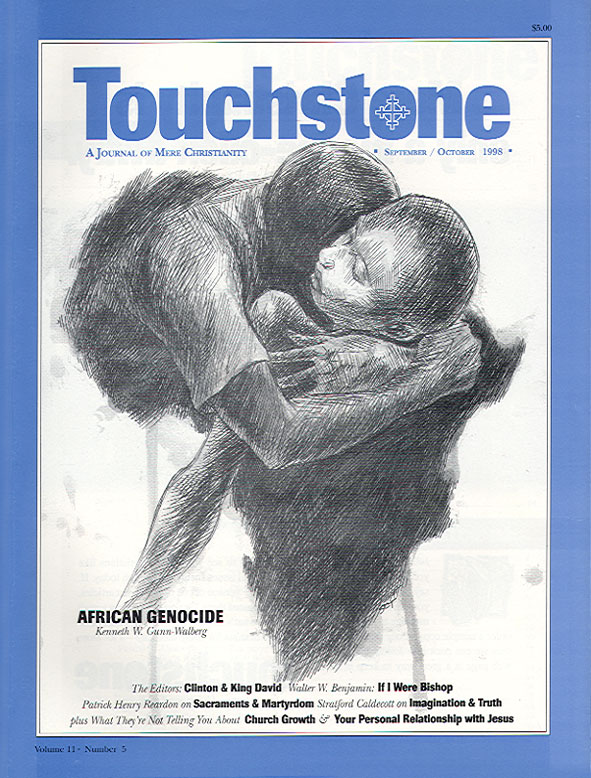
If I Were the Bishop . . . by Walter W. Benjamin

If I Were the Bishop . . .

A Ten-Point Epistle to the Bishops of the Methodist Church

by Walter W. Benjamin

“If I were the bishop . . . !” How many times have you heard this comment from a fellow clergy or church member? In more tranquil times, of course, our bishops might slough off the gratuitous advice that usually follows. But our church is, to use a medical term, in extremis, and new and strong medicine and new consultants may need to be used and heard.

I have been an ordained Methodist elder for 40 years and, while I have rarely attended annual conferences because of the conflict of summer-school teaching, I have tried to practice Yale’s Halford Luccock’s admonition—“Always have a lover’s quarrel with your Church.” It is out of this “creative estrangement” that I offer these ten principles for consideration by our bishops.

1. Restore Theological Boundaries

Since the patristic era the role of the bishop was as the teacher and defender of classical doctrine. Pastors historically have looked to bishops for doctrinal orthodoxy and pastoral norms. But today relativism, subjectivism, and false irenicism are rampant, and we are paying a high price for doctrinal promiscuity. While pastors can still be punished for disciplinary infractions, doctrinal boundaries have all but been erased. The result: we are all sail and no anchor. You must give greater attention to doctrinal centrism or Methodism will self-destruct.

An observer at the 1997 spring meeting of the Bishop’s Council found an inordinate amount of time devoted to racism, multiculturalism, and children. Evidently you were to envisage yourselves as little children since the back of the meeting room was filled with toys, kiddie books, and little tea cups and saucers. Do you eschew doctrine because pluralism is our only credo; because politics is more important than theological belief? Could you envisage Bishops Athanasius and Eusebius—or our own Asbury and Coke—engaged in such activity? “The collapse of theological integrity,” the reporter mused, “seems inevitably to foster the collapse of dignity.” Have we forgotten the warning of Origin in Against Celsus, that keeping the boundaries of faith undefined is a “demonic temptation”?

When Harvey Cox was a student minister in Berlin in 1962, a year after the erection of the Berlin Wall, he was able to travel back and forth between East and West because he held an American passport. He became a courier for pastors and Christian laypeople on both sides of that divide and was able to smuggle theological books into the East. What the people wanted most were copies of Karl Barth’s Church Dogmatics. “To carry in something by Bultmann [I wonder whether those enamored of the ‘Jesus Seminar’ are listening?] would have been a wasted risk,” Cox said. “Let the bourgeois preachers in West Germany agonize about the disappearance of the three-decker universe and existentialism. We had weightier matters to confront” (Christianity Today, 2/9/98).

This is a parable for us today. A theology more enamored with novelty than fidelity is not worthy of smuggling, nor will it reinvigorate the people of God. G. K. Chesterton reputedly warned against liberal distortions of Christian truth by saying that if one wishes to draw a giraffe one can draw it many ways, but it has to have a long neck!

It is time to draw lines against our flirtation with neo-gnosticisms, neo-paganisms, heresies, and other heterodoxies of our era. Methodism should be a fundamentalist church in the classic, not post-Darwinism sense. “If there is no immune system to resist heresy,” states Dr. Thomas Oden of Drew Theological Seminary, “there will soon be nothing but the teeming infestation of heresy” (Christianity Today, 2/9/98). Historically understood, according to Vincent of Lerins, bishops by definition are the defenders of Christian truth—“What has always been believed by all Christians everywhere.”

2. Widen Your Perspective


A Journal of Mere Christianity—Delivered to Your Door

  • Essays on theology, culture, and the Church
  • Contributors from across the Christian traditions
Subscribe (Print + Online)

Six print issues (one year) of Touchstone, plus full online access and PDF downloads for only $39.95.

Subscribe (Online Only)

Get a one-year full-access subscription to the Touchstone online archives for only $19.95.


bulk subscriptions

Order Touchstone subscriptions in bulk and save $10 per sub! Each subscription includes 6 issues of Touchstone plus full online access to touchstonemag.com—including archives, videos, and pdf downloads of recent issues for only $29.95 each! Great for churches or study groups.

Transactions will be processed on a secure server.


more from the online archives

31.6—November/December 2018

Virtue Gone Mad

Victimhood Culture Scapegoats Its Very Source by Michael P. Foley

31.1—January/February 2018

Ivy League Advice Worth Repeating

by Robert P. George

35.6—Nov/Dec 2022

The Prince’s Peace

on the Divine Promise Fulfilled by the Child of Bethlehem by James M. Kushiner

calling all readers

Please Donate

"There are magazines worth reading but few worth saving . . . Touchstone is just such a magazine."
—Alice von Hildebrand

"Here we do not concede one square millimeter of territory to falsehood, folly, contemporary sentimentality, or fashion. We speak the truth, and let God be our judge. . . . Touchstone is the one committedly Christian conservative journal."
—Anthony Esolen, Touchstone senior editor

Support Touchstone

00