




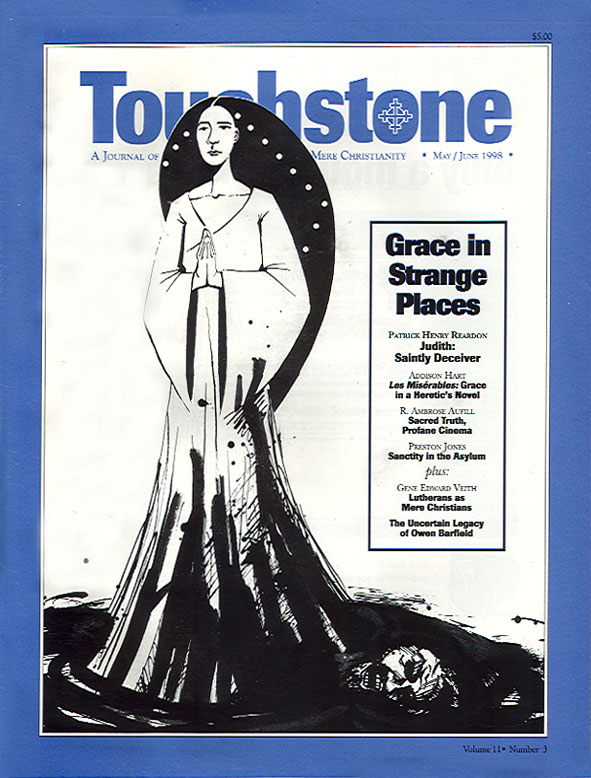
Prayer & the Work of God
Reflections on the Daily Office & the Prayer of the Heart
by Robert Louis Wilken
This article, originally titled “Opus Dei,” was originally given as an address by the author, June 2, 1997, for the Sixth Annual Banquet of the Center for Catholic and Evangelical Theology.
I spent last spring living at Sant’ Anselmo, a Benedictine house of studies and monastery in Rome. It was not, as some of the younger monks from contemplative houses elsewhere reminded me, un vero monastero, a genuine monastery, because monks came from all over the world and would return to their home communities, and they were not under the discipline of the local abbot. But for this visitor from the United States it had enough of the rhythms of the monastic life and its practices (breakfast in silence, reading at the evening meal, praying the office in choir) to give me a feel for un vero monastero.
My reason for going was that I wanted to spend some time living, to use current sociological jargon, in a thicker Catholic culture than central Virginia. One thinks that in being received into full communion with the Catholic church one is being received into a large international fellowship extending to every corner of the earth. But what I discovered was that I had taken up residence in the diocese of Richmond—what a friend once called a missionary diocese. So you can perhaps appreciate why I felt a strong urge to spend some time in Rome. Though I am embarrassed to say that the second Sunday after I arrived I visited the local parish church in Testaccio, the neighborhood down the hill from Sant’ Anselmo, and the first thing I heard on entering the church was the dispiriting sound of guitars warming up for the liturgy.
The chapel at Sant’ Anselmo is a late nineteenth-century Byzantine revival building with a spacious choir for singing the office and a large semicircular domed apse. The monks allowed me to participate fully in their daily prayer and on cold winter mornings—there was no heat in the church, fortunately I had the prescience to pack long underwear—as I took my place in the choir stall I would look up at the apse mosaic. Christ was in the center and to the right stood Saint Anselm and to the left St. Benedict, both bowing in adoration of the Risen Lord. Next to St. Benedict were written the words, “Nihil operi Dei praeponatur,” that is, “Let nothing take precedence over God’s work.”
The words come from Benedict’s Rule and the work (opus) that is at the center of the monastic life is praying the divine office, the daily recitation of the psalms. It is this phrase, “Nihil operi Dei praeponatur,” that I would like to speak about for a few minutes this evening.
Work is not a term we are accustomed to use in referring to prayer, at least not in the nonmonastic context. Perhaps obligation, responsibility, or from another perspective, “play.” Liturgy is something we do for its own sake, for ends that are within the action itself, as in playing a game; liturgy is not instrumental. But the term work carries other connotations that are appropriate to the monastic context, and to daily prayer in the lives of the faithful outside the monastery. As the months passed and I contemplated Benedict’s saying each day, I realized that here, as in many other things, St. Benedict had a profound insight into the Christian life.
One image can illustrate what I mean. Morning prayer was at 6:20 a.m. and a bell rang in the halls at 5:50. By 6:10 as I made my way to the church I would meet or pass monks scurrying to find their place in the choir or in one of the chapels in the cavernous building.
But before getting to my point perhaps I should say a bit about the daily schedule at Sant’ Anselmo. The language of prayer in the house was Latin and the offices were sung in plainchant except for morning prayer. Pope Paul VI had charged the Benedictines with keeping alive the Latin office in Gregorian chant and Sant’ Anselmo has taken on that responsibility as its own. But because the community of 120 monks is an international group, a few years back they decided to have daily morning prayer and weekday Mass in language groups (on Sundays they are in Latin). So each morning there is a Latin group, an Italian group, and French, German, and English groups for morning prayer and Mass.
The other offices are in Latin: midday prayer, which took place at 12:50 in the chapter room immediately before pranzo (which always began with pasta or risotto, meat or fish course, fruit—all accompanied by local white wine followed of course by a riposo); full sung vespers in the main chapel at 7:15, then cena, the evening meal with readings from the Rule and other books; and compline at 8:30 in the main church. I attended the Italian morning prayer and Mass in the church.
A Journal of Mere Christianity—Delivered to Your Door
- Essays on theology, culture, and the Church
- Contributors from across the Christian traditions

Six print issues (one year) of Touchstone, plus full online access and PDF downloads for only $39.95.

Get a one-year full-access subscription to the Touchstone online archives for only $19.95.
bulk subscriptions
Order Touchstone subscriptions in bulk and save $10 per sub! Each subscription includes 6 issues of Touchstone plus full online access to touchstonemag.com—including archives, videos, and pdf downloads of recent issues for only $29.95 each! Great for churches or study groups.
Transactions will be processed on a secure server.
more from the online archives
24.5—Sept/Oct 2011
on Wondering or Wandering Through College Education by Anthony Esolen
calling all readers
Please Donate
"There are magazines worth reading but few worth saving . . . Touchstone is just such a magazine."
—Alice von Hildebrand
"Here we do not concede one square millimeter of territory to falsehood, folly, contemporary sentimentality, or fashion. We speak the truth, and let God be our judge. . . . Touchstone is the one committedly Christian conservative journal."
—Anthony Esolen, Touchstone senior editor
