




1054 & All That
Dating the Orthodox/Catholic Schism
The year is 1273, and the Byzantine emperor, Michael VIII Palaiologos (ruled 1258–1282), exasperated with an obstinate synod of bishops, has turned to violence. The bishops had withstood his ecclesiastical plans of a reunion with the church of Rome, designs necessary to spare the empire the certain invasion and probable conquest of the city at the hands of papal champion Charles of Anjou, king of the two Sicilies. In his frustration Michael decided to make an example of Manuel Holobolus, one of the leading opponents of the union, an orator and the former head of the patriarchal school. Michael had already mutilated and imprisoned the monk for his opinions, but now the emperor had him taken from prison, flogged, and chained to nine other poor souls (including Holobolus’s niece), whom he then paraded through Constantinople. Holobolus’s neck was wrapped with a sheep’s intestines, and an “executioner” beat his head with the animal’s liver as the convicts walked through the streets, going around the quarters of the great church, Hagia Sophia.
When Michael VIII recaptured Constantinople in 1261, he opened probably the most bitter episode of the several attempts at healing the schism between the Catholics and the Orthodox, the Latins and the Greeks. Michael hoped that a union of the churches would spare his weak and feeble empire, and, under the sympathetic eye of Pope Gregory X, he agreed to such a union. Rome accepted that the emperor was able to control the Byzantine church, at least on some level, and expected Michael to enforce the union. But, as Michael informed Pope Gregory, the union enjoyed no popularity among the clergy or the people of Constantinople. The main defender of Michael’s position was the former cartophylax John Bekkos, who had been imprisoned at one point for his obstreperous resistance to the idea of the union. But fed a steady diet of Latin polemics, Bekkos eventually came to the Latin position on the key question of the procession of the Holy Spirit. However brilliant Bekkos was, the Synod of Constantinople dug in its heels.
Many, including Holobolus, had given an ear to Michael VIII’s scheme, aimed at stopping Anjou, by removing the casus belli of Charles’s League of Viterbo, i.e., that the Byzantines were schismatics. Yet the years of exile from their city remained within the memory of most Byzantines. Michael, however, knew that many in the synod had entertained a union with Rome in the time of his predecessor, John IV Vatatzes, a union with conditions almost identical to those now offered by Rome: commemoration of the pope during the Divine Liturgy, the recognition of the pope’s judicial supremacy, and the placement of his name in the diptychs.
Ultimately, the synod weakly bowed to the pressure of Michael VIII, though the patriarch did not assent. Yet even with the submission of the synod, Michael could find no one to go to the reunion council, to be held in Lyon in 1274. Eventually only diplomats and the deposed former patriarch Germanos made it to the council. Upon the Declaration of Union, Patriarch Joseph resigned, Bekkos became the new patriarch, and Michael turned brutal, even executing people who withstood his policy. For all his troubles, in the end, Michael VIII was excommunicated by Pope Martin IV, the creature of Charles of Anjou, in 1281. But owing to a revolt on the island of Sicily against their French lords (the War of the Sicilian Vespers), the feared invasion by Charles of Anjou never occurred, a revolt that Michael VIII most certainly had a hand in planning.
Michael VIII died on December 12, 1282, and his son, Andronikos II, refused to give his father a Christian burial but instead placed his body in a cave. Andronikos then removed Bekkos as patriarch and installed Gregory of Cyprus in his place, who would oversee a council that met at the Blachernae palace in 1285 and formally repudiated the union of Lyons (materially dead with the death of Michael VIII). For the next 150 years, communications between Rome and Constantinople barely existed.
Material versus Formal Schism
The above episode clearly shows a distinction to keep in mind in thinking about the relationship of the Latins and the Greeks. Michael VIII’s union was largely a formality without substance, a form without matter. In other words, the union formally existed, but materially it did not. To illustrate: In the fall of 1998 I had finished writing my dissertation. Once all the members of my committee had agreed to its satisfactory status, the date of my defense was set, and in the spring of 1999 I defended it. The whole affair went as expected. Dismissed, the committee discussed my fate for all of five minutes, and then Prof. Donald R. Kelly came out and shook my hand, followed by the rest of the committee.
Materially, I had finished my dissertation and my graduate studies in 1998. But formally they were not finished until my dissertation committee said so, and indeed not until I received my doctoral diploma in the spring graduation of 1999. No one really called me Dr. Jenkins before that. The distinction of material and formal should be kept in mind when discussing the schism that arose in the latter middle ages between the Catholic West and the Orthodox East.
There were times before the high Middle Ages (beginning about the year 1000) when the two were both formally and materially in schism, such as during the Acacian Schism from the late fifth to the mid-sixth centuries, when the Latin West saw the Orthodox East wavering and compromising on the teaching of the councils (the material aspect of the problem), and thus formally broke communion.
But at other times formal schism existed, though without anyone having declared it, and with no seeming material reason for this to be, such as when the pope’s name disappeared from the list of those bishops commemorated during the Liturgy at Constantinople, sometime around 1009, something the Synod of Constantinople would later assert was done through carelessness.
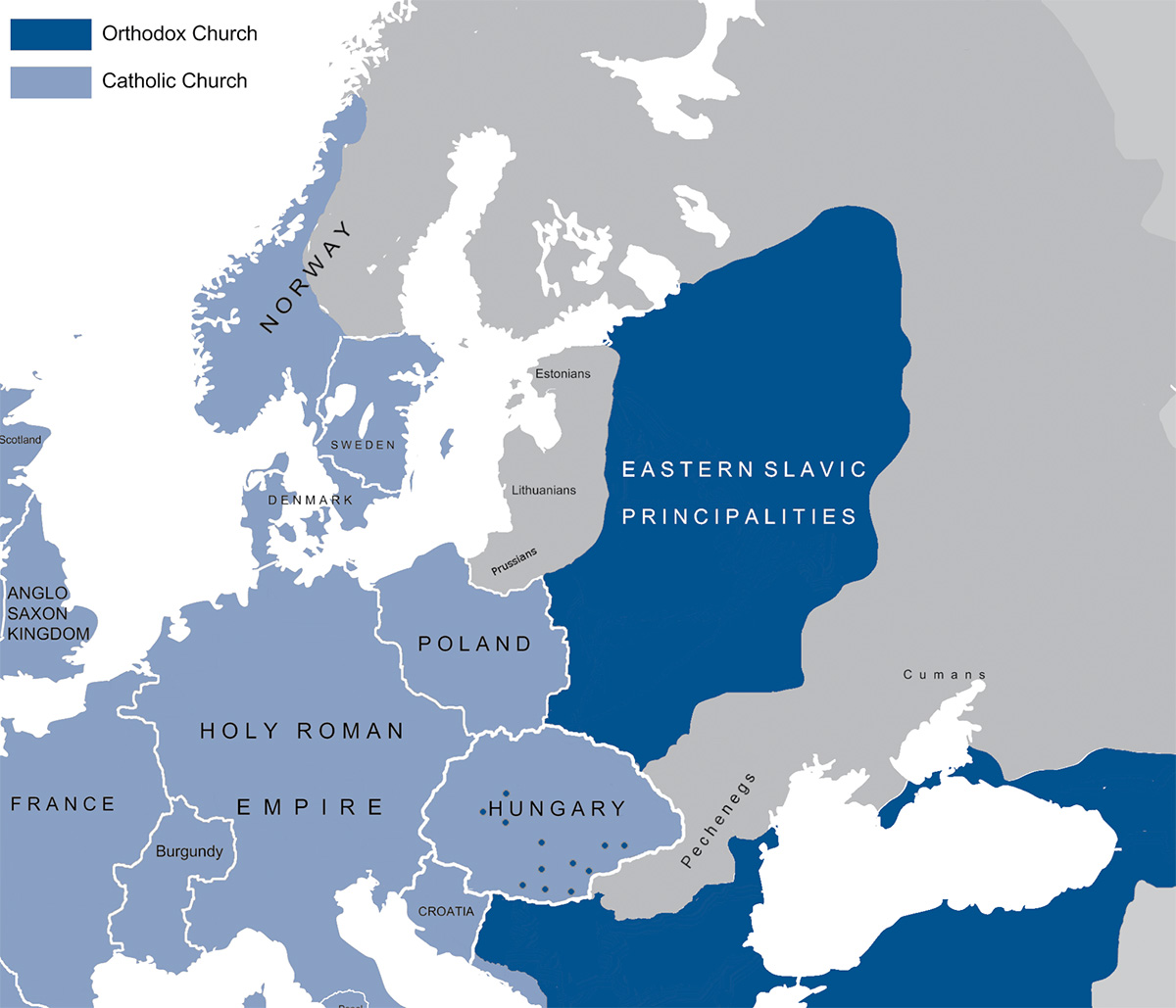
This said, many a writer will throw out the year 1054 as the beginning date of the schism (materially and formally), which has lasted till this present day. But neither materially nor formally can this be considered the case. The year 1054 is an important date, but the events of that summer were not the efficient causes of the schism in the Church. First and formally, the actors involved did not speak for the entirety of their respective churches, as we shall see. And second, even if this were the case, the excommunication issued by the Latin cleric, Humbert, cardinal bishop of Silva Candida, named only Michael Kerularius, the patriarch of Constantinople (along with all who would agree with him), Leo the archbishop of Ochrid, and the imperial chancellor as under the ban, not the Synod of Constantinople, let alone the entire Orthodox world. As regards Michael Kerularius, the Patriarch of Constantinople, the excommunication issued by him and the Synod of Constantinople took aim only at the three legates, the aforementioned Humbert, Frederick of Lorraine, and Mark, the archbishop of Amalfi, but most definitely not at the pope, let alone the entire Western church.
Gary Jenkins Ph.D., is the Van Gordon Professor in History (retired) at Eastern University in Pennsylvania, and the current director of the St. Basil Center for Orthodox Thought and Culture (also at EU).
Share this article with non-subscribers:
https://www.touchstonemag.com/archives/article.php?id=38-04-036-f&readcode=11254
A Journal of Mere Christianity—Delivered to Your Door
- Essays on theology, culture, and the Church
- Contributors from across the Christian traditions

Six print issues (one year) of Touchstone, plus full online access and PDF downloads for only $39.95.

Get a one-year full-access subscription to the Touchstone online archives for only $19.95.
bulk subscriptions
Order Touchstone subscriptions in bulk and save $10 per sub! Each subscription includes 6 issues of Touchstone plus full online access to touchstonemag.com—including archives, videos, and pdf downloads of recent issues for only $29.95 each! Great for churches or study groups.
Transactions will be processed on a secure server.
more on Catholic from the online archives
29.3—May/June 2016
A Deathbed Reflection on Catholic Social Teaching & Our Future Prospects by Karl D. Stephan
24.5—Sept/Oct 2011
A Critical Memoir of Thomas Merton at Gethsemani Abbey by Patrick Henry Reardon
35.4—Jul/Aug 2022
The Death Rattle of a Tradition
Contemporary Catholic Thinking on the Question of War by Andrew Latham
more from the online archives

32.2—March/April 2019
Finding Him Again Through the Patriarchal Group by Anthony Esolen
19.1—January/February 2006
on Death & Seven of the Last Words of Socrates by Graeme Hunter

19.6—July/August 2006
The Three-Fold Cord of Imagination, Reason & Will in C. S. Lewis by Michael Ward
calling all readers
Please Donate
"There are magazines worth reading but few worth saving . . . Touchstone is just such a magazine."
—Alice von Hildebrand
"Here we do not concede one square millimeter of territory to falsehood, folly, contemporary sentimentality, or fashion. We speak the truth, and let God be our judge. . . . Touchstone is the one committedly Christian conservative journal."
—Anthony Esolen, Touchstone senior editor
