




1054 & All That
Dating the Orthodox/Catholic Schism
The year is 1273, and the Byzantine emperor, Michael VIII Palaiologos (ruled 1258–1282), exasperated with an obstinate synod of bishops, has turned to violence. The bishops had withstood his ecclesiastical plans of a reunion with the church of Rome, designs necessary to spare the empire the certain invasion and probable conquest of the city at the hands of papal champion Charles of Anjou, king of the two Sicilies. In his frustration Michael decided to make an example of Manuel Holobolus, one of the leading opponents of the union, an orator and the former head of the patriarchal school. Michael had already mutilated and imprisoned the monk for his opinions, but now the emperor had him taken from prison, flogged, and chained to nine other poor souls (including Holobolus’s niece), whom he then paraded through Constantinople. Holobolus’s neck was wrapped with a sheep’s intestines, and an “executioner” beat his head with the animal’s liver as the convicts walked through the streets, going around the quarters of the great church, Hagia Sophia.
When Michael VIII recaptured Constantinople in 1261, he opened probably the most bitter episode of the several attempts at healing the schism between the Catholics and the Orthodox, the Latins and the Greeks. Michael hoped that a union of the churches would spare his weak and feeble empire, and, under the sympathetic eye of Pope Gregory X, he agreed to such a union. Rome accepted that the emperor was able to control the Byzantine church, at least on some level, and expected Michael to enforce the union. But, as Michael informed Pope Gregory, the union enjoyed no popularity among the clergy or the people of Constantinople. The main defender of Michael’s position was the former cartophylax John Bekkos, who had been imprisoned at one point for his obstreperous resistance to the idea of the union. But fed a steady diet of Latin polemics, Bekkos eventually came to the Latin position on the key question of the procession of the Holy Spirit. However brilliant Bekkos was, the Synod of Constantinople dug in its heels.
Many, including Holobolus, had given an ear to Michael VIII’s scheme, aimed at stopping Anjou, by removing the casus belli of Charles’s League of Viterbo, i.e., that the Byzantines were schismatics. Yet the years of exile from their city remained within the memory of most Byzantines. Michael, however, knew that many in the synod had entertained a union with Rome in the time of his predecessor, John IV Vatatzes, a union with conditions almost identical to those now offered by Rome: commemoration of the pope during the Divine Liturgy, the recognition of the pope’s judicial supremacy, and the placement of his name in the diptychs.
Ultimately, the synod weakly bowed to the pressure of Michael VIII, though the patriarch did not assent. Yet even with the submission of the synod, Michael could find no one to go to the reunion council, to be held in Lyon in 1274. Eventually only diplomats and the deposed former patriarch Germanos made it to the council. Upon the Declaration of Union, Patriarch Joseph resigned, Bekkos became the new patriarch, and Michael turned brutal, even executing people who withstood his policy. For all his troubles, in the end, Michael VIII was excommunicated by Pope Martin IV, the creature of Charles of Anjou, in 1281. But owing to a revolt on the island of Sicily against their French lords (the War of the Sicilian Vespers), the feared invasion by Charles of Anjou never occurred, a revolt that Michael VIII most certainly had a hand in planning.
Michael VIII died on December 12, 1282, and his son, Andronikos II, refused to give his father a Christian burial but instead placed his body in a cave. Andronikos then removed Bekkos as patriarch and installed Gregory of Cyprus in his place, who would oversee a council that met at the Blachernae palace in 1285 and formally repudiated the union of Lyons (materially dead with the death of Michael VIII). For the next 150 years, communications between Rome and Constantinople barely existed.
Material versus Formal Schism
The above episode clearly shows a distinction to keep in mind in thinking about the relationship of the Latins and the Greeks. Michael VIII’s union was largely a formality without substance, a form without matter. In other words, the union formally existed, but materially it did not. To illustrate: In the fall of 1998 I had finished writing my dissertation. Once all the members of my committee had agreed to its satisfactory status, the date of my defense was set, and in the spring of 1999 I defended it. The whole affair went as expected. Dismissed, the committee discussed my fate for all of five minutes, and then Prof. Donald R. Kelly came out and shook my hand, followed by the rest of the committee.
Materially, I had finished my dissertation and my graduate studies in 1998. But formally they were not finished until my dissertation committee said so, and indeed not until I received my doctoral diploma in the spring graduation of 1999. No one really called me Dr. Jenkins before that. The distinction of material and formal should be kept in mind when discussing the schism that arose in the latter middle ages between the Catholic West and the Orthodox East.
There were times before the high Middle Ages (beginning about the year 1000) when the two were both formally and materially in schism, such as during the Acacian Schism from the late fifth to the mid-sixth centuries, when the Latin West saw the Orthodox East wavering and compromising on the teaching of the councils (the material aspect of the problem), and thus formally broke communion.
But at other times formal schism existed, though without anyone having declared it, and with no seeming material reason for this to be, such as when the pope’s name disappeared from the list of those bishops commemorated during the Liturgy at Constantinople, sometime around 1009, something the Synod of Constantinople would later assert was done through carelessness.
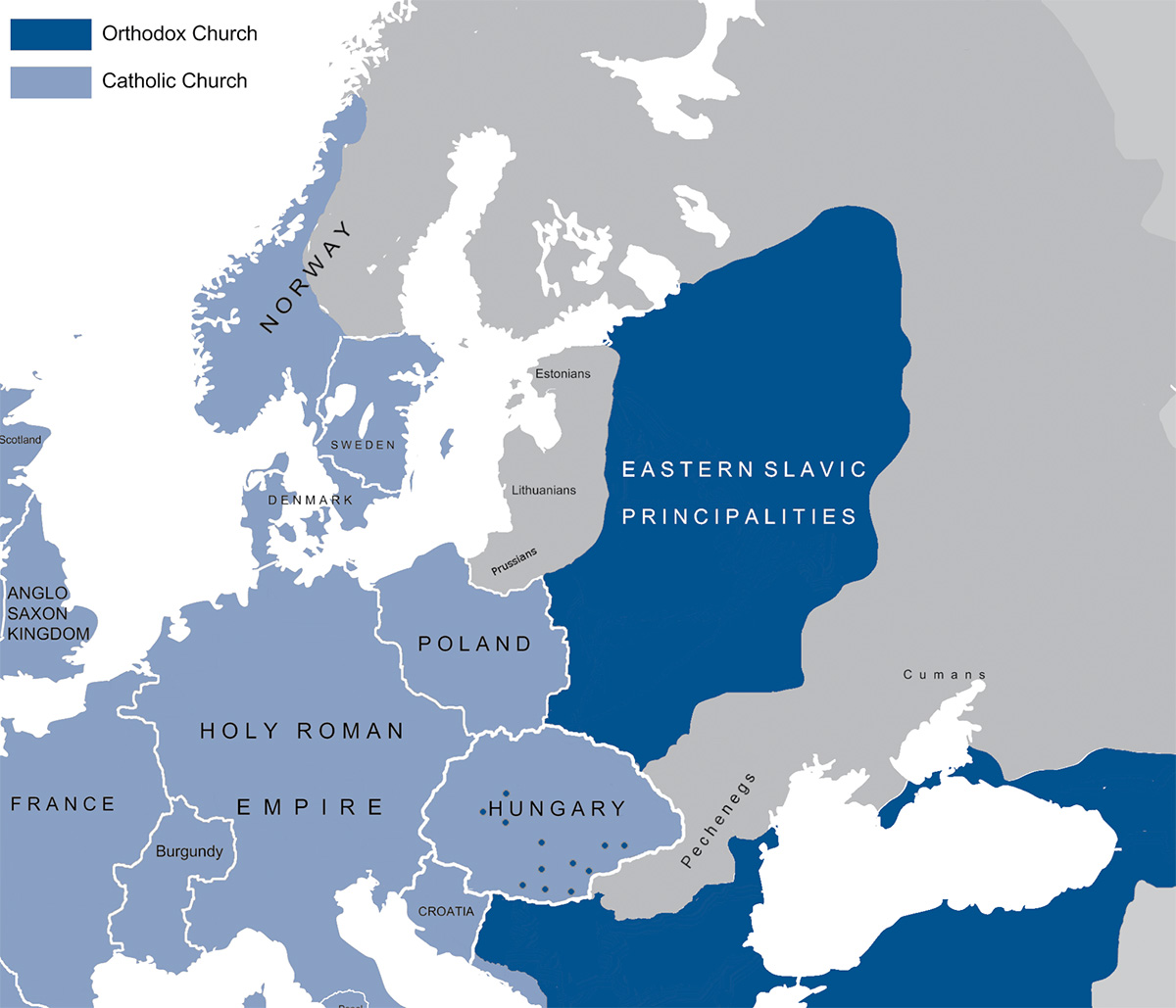
This said, many a writer will throw out the year 1054 as the beginning date of the schism (materially and formally), which has lasted till this present day. But neither materially nor formally can this be considered the case. The year 1054 is an important date, but the events of that summer were not the efficient causes of the schism in the Church. First and formally, the actors involved did not speak for the entirety of their respective churches, as we shall see. And second, even if this were the case, the excommunication issued by the Latin cleric, Humbert, cardinal bishop of Silva Candida, named only Michael Kerularius, the patriarch of Constantinople (along with all who would agree with him), Leo the archbishop of Ochrid, and the imperial chancellor as under the ban, not the Synod of Constantinople, let alone the entire Orthodox world. As regards Michael Kerularius, the Patriarch of Constantinople, the excommunication issued by him and the Synod of Constantinople took aim only at the three legates, the aforementioned Humbert, Frederick of Lorraine, and Mark, the archbishop of Amalfi, but most definitely not at the pope, let alone the entire Western church.
So, though materially strained, this situation hardly rose to a formal schism between the two bodies. That relationships following 1054 were strained none denied. The West certainly put store by what had happened, even though canonically what Humbert had done was invalid, since Pope Leo IX, who had granted him his legatine powers, had died before the fateful act, thus nullifying everything Humbert and the other legates did in his name. Nonetheless, because of Humbert’s stature among the clergy of Rome, said clergy accepted that the Greeks stood in some way outside full communion with Rome.
Given the reform movement then dominating Rome and Humbert’s leadership in it (the Gregorian reforms), and the great struggle between the reformers and the imperial and royal powers of the West, it would be wondrous did the clergy of Rome not give Humbert’s actions some form of legitimacy. Humbert, further, wrote a stinging tract, Against the Calumnies of the Greeks. The incident played a significant part in the mind of a significant cleric and shouldn’t be minimized.
Political Amity
That being said, by the end of the century, with the Orthodox world reeling under the sudden collapse of the empire, a collapse brought on by the corruption and decadence that had infested both the imperial court and Constantinople following the death of Basil II in 1025, the rhetoric coming out of Rome addressing the plight of the Byzantine East and its status as a Christian realm assumed a wholly different character than one would expect were Humbert the putative measure of the Orthodox faith. One can see this new perspective best in the rhetoric describing the plight of the Greeks in the sermons summoning the First Crusade.
Pope Urban II (1088–1099) overtly spoke of the Greek East in fraternal terms. In his sermon at Clermont in France calling for what would be the First Crusade (the word, or any of its cognates, yet to be used), Urban spoke of the Christian duty his audience at Clermont had to defend the weak, to be their brother’s keeper, to aid the Christian churches under the yoke of the infidel, and to liberate their fellow Christians from bondage to unbelievers. Who were the brethren and Christians Urban asked the French chivalry to defend? It was the Greeks.
We can find this same amity on the part of the Latins several decades later in 1136, when Anselm, bishop of Havelberg, being in Constantinople as an emissary for the German emperor, debated the Orthodox archbishop, Niketas of Nicomedia. Anselm left a detailed record of his debate, which touched on the questions then seemingly dividing the two churches (and similarly debated in 1054) of the azymites (the unleavened bread used in the Eucharist by the Latins), the filioque (the word the Latin West had added to the Creed to proclaim that the Holy Spirit proceeded from both the Father “and the Son”), and the papal primacy. From Anselm’s account, the debate proceeded along the most charitable of lines, even if both sides pulled no theological punches.
At this debate we see the Orthodox address directly for the first time the explicit claims of primacy by the bishops of Rome, which probably equally with the question of the filioque drove the division between the churches. In Niketas’s telling, the transfer of the empire (translatio imperii) from Rome to Constantinople brought with it the transfer of ecclesiastical primacy. For him, the Petrine ministry was universal, as was the ministry of all the apostles, and to confine it to one place was to do a disservice to that ministry. Further, that the popes of Rome sat in Peter’s seat was true, but so, too, did the bishops of Antioch. Further, if apostolic preeminence should rest anywhere, it should be with Jerusalem, whose first bishop, James, was the brother of the Lord.
As regards the Orthodox and their rhetoric, Michael Kerularius certainly employed trenchant and abusive language with respect to the Latin church in his letters to the other patriarchs of the East when describing the events of 1054. This language would be echoed by others, including the notable late-twelfth-century lawyer Theodore Balsamon, for whom, as he expressed to the patriarch of Alexandria, the Latins as a whole were guilty of heresy and usurpation, and no Latin should be admitted to communion unless willing to denounce Western enormities.
But however much Kerularius and others denounced the Latin West, others of equal stature held the Latins, if not in a sympathetic light, at least in a charitable one. First and perhaps foremost among these would be Peter, patriarch of Antioch, Kerularius’s senior contemporary, who could speak from long experience about the relationships of the Latins and the Greeks.
Peter saw in Kerularius’s correspondence describing the events of 1054 and his assessment of the Latins little more than a brief of personal animosity, littered with inaccuracies and errors on points of doctrine, and saturated with a spirit hardly worthy of a patriarch of Christ’s Church. Kerularius had asserted that the pope’s name had not been observed in diptychs for centuries. Peter countered, however, that in the year 1009 he had been in Constantinople and had there heard the pope’s name commemorated during the Liturgy. Further, argued Peter, charity should be exercised, in that the Latins and the Latin language lacked the subtlety to make the theological points that the Greek language allowed. In the mind of Peter, perhaps with a more subtle take than other Orthodox writers would employ on the same topic, the Latins, Latin culture, and Latin theology all suffered a rustic innocence of sophistication.
To Peter of Antioch, differences between the Latin and Greek churches existed, but he did not see the Latins as schismatics, let alone that the Greeks and Latins comprised two distinct communions. Peter’s stance is backed up by the actions and statements of the future patriarch of Jerusalem, Euthymius, who had enjoyed good relations with Latin pilgrims in Jerusalem. Euthymius had been driven from his bishopric by the Seljuq conquest in 1071, and the emperor Alexius I used him as his emissary when treating with the Normans, knowing their regard for him. An undulating amity between Latins and Greeks in Antioch, Jerusalem, and Alexandria in the following years persisted.
Further, Kerularius’s campaign against the Latins came to nothing, ending with his deposition at the hands of the emperor Isaac I Comnenus in 1058. While the actions of Isaac I and those emperors who followed reveal a strained relationship between the churches, they do not show that the Byzantine court held itself estranged from the Roman church. The cordial relations can best be seen in that Michael VII had reached out to Pope Gregory VII in 1073 asking the pope to thwart the planned invasion of the empire by the Norman prince Robert Guiscard, the pope’s vassal. This was done, and Guiscard sent his daughter Helena to Constantinople to be wed to Michael’s son and heir.
But when the rebel Nicephorus Boteniates overthrew Michael VII in 1078, he sent Helena packing. Gregory VII responded with the new emperor’s excommunication, and for the first time the Byzantine imperial court itself felt the weight of Rome’s understanding of its authority, embodied in Gregory VII, though certainly preached by the aforementioned Humbert, Gregory VII’s friend, that the kings of the earth stood in relation to the papacy as the moon stood in relation to the sun.
Despite this, by the reign of Alexius I Comnenus (1081–1118) the Byzantine church sought to heal whatever rift divided the two great churches. In 1089, as referenced above, a synod of the city of Constantinople admitted that the pope’s name had not been commemorated for decades, but also stated that it knew not why this was, and that the removal of the pope’s name from the list of bishops declared to be in communion with the archbishop of Constantinople was due to negligence.
Further, just two decades removed from 1089, we find St. Theophylact of Ochrid echoing Peter of Antioch in his sympathy for the Latin church. He expands on Peter’s assessment of Latin doctrine, Latin motives, and Latin abilities. Theophylact, the first of the Orthodox to leave a complete commentary on the entire New Testament, went out of his way to pour oil on the ecclesiastical waters, saying he had little sympathy for those condemning the Latins, since they objected to trivialities in matters of custom. Among these, he noted the practice of kneeling before the altar as opposed to bowing, the use of silk in vestments, the wearing of gold rings, and the practice of priestly celibacy. All these, he wrote, came from devotion, and not as a conscious affront to the tradition of the Church.
Those who faulted the Latins for their use of azymites in the communion, objecting that it was Apollinarian since leavened bread spoke of the consubstantiality of Christ with our human nature, were faulting the Latins for a heresy (Apollinarianism) they had never partaken of. (The heretic Apollinaris denied that Christ Incarnate fully assumed our human nature.) It is right, argued Theophylact, that the Greeks should use leavened bread (artos) since it was among the Greeks that Apollinarianism had arisen. Lastly, he noted that the Latin tongue was rustic and inelegant, and that while the Orthodox cannot tolerate the addition of the filioque to the Creed, it must be remembered that Greek had four different words to handle the subtle nuances of theology in respect to the spiration and mission of the Holy Spirit, the Latins but one.
It can be reasonably held that at the beginning of the twelfth century, the communion of the Church was strained, and that differences were seen, weighed, and adjudicated, with some Orthodox holding the Latins at more than arm’s length, while others took a far less drastic approach. On the side of the Latins, this same may be assumed. However much the filioque was and would be an issue, for the Latins, the chief concern seemed clearly the Roman pope’s supremacy.
Cracks, Crusade & Collapse
The twelfth century, however, saw whatever goodwill existed fade in the light of the ever-increasing failures of the Crusades. The First Crusade affected the relationship of the churches, but constituted little more than a contributing cause, and not in any way a material or efficient cause, of the schism. While the Latin crusader lords often set up their own ecclesiastical structures in certain places, such as Antioch, at other places, the Greek clergy persisted in their normal functions, with their normal duties, and almost without regard to their Latin overlords.
But throughout the twelfth century real animus increased between the Catholic West and the Orthodox East. It was not uniform, by any means, but in the nearly 110 years from the First to the Fourth Crusade (1095–1204), fraternal relations became increasingly strained, so that even by the Second Crusade (1147–1149), elements of the crusading host called for the French, under their king, Louis VII, to seize Constantinople. While Louis VII wanted no part of this, it should be noted that his chaplain, Odo of Deuil, a monk of the abbey of St. Denis, and Godfrey de la Roche, the bishop of Langres and the leading cleric among the crusaders, were at the forefront in encouraging it. The crusade’s failure left Louis VII bitter towards the Byzantines, and he planned to join the Normans of southern Italy in an assault on the empire. The German king, Conrad III, whose army suffered much more during the crusade, joined with the Byzantines in opposition to the Norman designs. The pope, Eugenius III, refused to back the French-Norman alliance, and nothing came of the matter.
The fall of the kingdom of Jerusalem to Saladin in 1187 launched the calamitous Third Crusade (1189–1192), soon followed by the calling of the Fourth (1199–1204). Under the leadership of Boniface of Monteferrat and the doge of Venice, Enrico Dandalo, the crusade detoured to Constantinople as part of a bargain with the pretender, the young Alexius Angelus (son of the deposed emperor, Isaac), to take the throne from his uncle, Alexius III. The crusaders hoped to reap the benefits promised by Alexius IV: a payment of the crusaders’ debt to Venice, a Byzantine part in the expedition to retake Jerusalem, and the promise of a permanent Byzantine garrison in Jerusalem, once conquered.
But Alexius IV was unable to keep his promises, and upon his murder by those hostile to the Latins’ presence in the city, the crusaders and Venetians, dividing the spoils ahead of time, attacked and sacked the city. Constantinople had withstood larger and better-equipped armies for centuries, but the crusaders and their co-religionists had enjoyed the run of the city before hostilities broke out, and once the fighting started, the defenders along the walls where the attack came, the low sea-walls facing the harbor of the Golden Horn, suddenly found themselves fighting crusaders in front of them, and fires being lit behind them. They abandoned the defense of the city, and the government, along with the patriarch, John Camaterus, fled across the Bosphorus to the city of Nicaea.
If any date can be given for the start of the schism, 1204 can easily claim precedence. From this time, neither the people of the Orthodox East nor almost any of their clergy had any real stomach either for treating with the Latins or considering doing so. But more importantly, from this point on, all sides openly admitted that the two communions were clearly in schism from each other, with recriminations flying from all directions.
Blunders & Closed Doors
Ironically, prior to the fall of the city, Patriarch John had been in correspondence with Innocent III, calling for a general council to discuss the differences that obviously existed. At such a council, the presence of the Holy Spirit would guide the Church as it had done in the past. Innocent III replied welcoming the idea of such a council, but, lawyer that he was, he insisted first that the churches of the East recognize the supremacy of Rome as Rome understood it. The negotiations came to nothing, and following the crusader sack of the city, Innocent made two political blunders that only hardened respective opinions.
First, he sent a letter of commendation to the crusaders that the great city was at last united to Rome. His rejoicing turned to grief when he learned of the crusader enormities following the city’s fall, and Innocent’s listing of the crimes is quite the bill of indictment. Nonetheless, those Greeks who learned of his congratulation could only entertain it with horror.
Second, and perhaps more importantly, with the death of John Camaterus in 1206, the Greek bishops who had not fled their charges in the wake of the Latin conquest appealed to Innocent III for a Greek patriarch who would sit astride the Latin patriarch, Thomas Morosini, but subject to the pope. Innocent rejected this plea as a slight to his own patriarch. The Greek bishops promptly decamped to the most prominent of the continuator Greek kingdoms, Nicaea, to take part in the election of a new Greek patriarch. How much Innocent’s refusal affected the future of Orthodox and Catholic relations is impossible to gauge, but it is obvious that from this time the Orthodox clergy were united in their opposition to a union with the Latins.
For all of the disaster that the Latin conquest brought the Greeks, Demetrius Chometianus, archbishop of Ochrid (1216–1234), writing about 20 years after the aforementioned Balsamon’s death, and living in the Latin kingdom of Constantinople (1204–1261), criticized Balsamon’s anti-Latin views. Chometianus protested that Balsamon had been too severe, for no synod had condemned Latin doctrine or uses, and further, concelebrations of the Liturgy still occurred.
Despite Chometianus’s assertions, both sides clearly saw the division and its causes. The two chief among these, the question of the procession of the Holy Spirit and papal primacy, were actually quite interwoven. For the Orthodox, the Latin doctrine of the procession of the Holy Spirit was erroneous, and even if true, the Creed could not be changed unilaterally as the Latins had done. For the Catholics, not only was the doctrine true, but the bishop of Rome possessed the authority to alter the Creed, from which arose the question of the nature of the pope’s magisterial and judicial authority. These respective claims dominated the attempts to heal the schism from 1204 onward. Other doctrines entered the lists, such as purgatory, but these two overshadowed everything else.
The first of these attempts came during the reign of the Nicene emperor John Vatatzes, who in 1251, realizing the diminishing power of the Latin kingdom and its weakening hold on Constantinople, addressed himself to Pope Innocent IV. Negotiations stretched over four years (1251–1254), but the Greeks were never willing to concede the definition of papal primacy that Innocent sought, nor were they willing to admit the filioque unless it was confirmed by a divine utterance (a general council?). In 1254 the main parties, emperor, pope, and patriarch, all died, and the matter came to nothing.
The sad episode of the reign of Michael VIII soon followed, and the Blachernae Council of 1285 and its statement (tomos) on the question of the Holy Spirit seemed to close all future doors. The schism now both materially (the unresolved and divisive questions of the papacy and the filioque) and formally (the Latin excommunication of Michael VIII and the Orthodox repudiation of the union in 1285) existed.
Material & Formal Dates
Over the next 150 years, communications were not nonexistent, but certainly meager. Throughout this period, the empire withered, owing to civil wars and the advance of the Ottoman Turks, who took advantage of these wars to expand into Europe. The emperors of this period seemed to agree with the mind of Manuel II (ruled 1391–1425), who had warned his son and heir, John VIII, never to seek union with the Latins, for it would only embitter his Greek subjects against him and, further, would arouse the suspicions of the Turks, and doubtlessly incite them to hostilities (by this time the empire was little more than a client of the Ottomans).
By 1425, the empire had contracted to Constantinople, Thessalonica, and the regions south of Corinth called the Morea (the Peloponnesus). Even these last two were constantly contested with the Ottoman Turks, who were now closing in. Manuel II had spent years in the West seeking military aid apart from any union but obtained nothing for his efforts. Finally, John VIII, despite his father’s warnings, in the early 1430s appealed both to Rome and to the council then sitting at Basle, hoping for a reunion council which would bring with it a crusade against the Ottomans.
As it happened, the Council of Basle and Pope Eugenius IV were at an impasse, and the council fathers actually had the pope on his heels. The arrival of the Greek envoys allowed Eugenius to summon a council and, for the sake of the Greeks, to hold it in Italy. The council at Basle ended up splitting, with a minority decamping south, declaring that the unity of the Church was more important than the reforms the council at Basle was seeking.
The council met first in Ferrara in 1438, but then, because of the plague and because of the munificence of Cosmo the Medici, who wanted to meet certain members of the Greek delegation, the council transferred itself to Florence. This was the occasion for the well-known painting in the Medici chapel, The Procession of the Magi, in which Emperor John VIII figures prominently. At Florence the open debate, which had not happened at Lyons and which the Greeks certainly sought, finally materialized. By the council’s end, all of the Greek bishops signed the document of union, with the exception of their most prominent member, Mark of Ephesus (his failure to sign elicited the comment from Eugenius IV that “without Mark we are nothing”).
Many of the Greeks agreed to the union based upon the final wishes of the patriarch, Joseph II. He had left a written confession of adherence to all that the church of Rome taught. Ironically, in the Formula of Union, Pope Eugenius IV had added a thanksgiving to God that the schism of 437 years had ended (dating back to 1002, though why this date was alluded to is not clear).
Despite the hopes of Eugenius IV and John VIII, Florence fell short of uniting the Orthodox with the Catholics, as the patriarchates of Antioch, Jerusalem, and Alexandria unanimously rejected the council at a meeting in Jerusalem in 1443.
Further, with the fall of Constantinople in 1453, the union materially, such as it was, fell apart. To return to the distinction between material and formal, we can see that the churches were in both material and formal schism between 1285 and 1439, whereas after 1439 there may have been a formal union between Rome and Constantinople, one that lasted at least till the fall of the city. But even following the Council of Florence and the signing of the Formula of Union at the council, it would stretch the facts to say that materially the churches could be considered one. Just before the fall of the city, the union was proclaimed at Constantinople, but even then, prominent Orthodox, including several signatories from Florence, i.e., Macarius of Nikomedia, Ignatius of Trnovo, and Sylvester Syropoulos, were already seeking a union with the Hussites of Moravia, who had been declared heretics and excommunicated from the communion of Rome by the Council of Constance (1414–1418).
Among those seeking this latter agreement was George Gennadius Scholaris, a onetime supporter of the union of Florence, but who had been convinced to renounce his stance by Mark of Ephesus. At the fall of the city, Scholaris was known even among the Turks as an opponent of the union and, owing to this, was bought out of slavery by the sultan Mehmet II and elevated to the patriarchal throne. Not until 1484 did a council of Orthodox hierarchy, including representatives of the four Eastern patriarchs, formally renounce the union. Materially, it would be hard to say it had ever existed since 1204.
Indeed, even before 1204, materially the matter is tenuous. But it would be stretching this observation, in the face of so many witnesses, to say that 1054 had created for the Orthodox and Catholics both a formal and material schism. For my own humble part, I agree with my former professor, Aristeides Papadakis, on 1204 as the material date and 1285 as the formal one. Though never overtly explicit on this in his writings, he was certainly so in -conversations.
Gary Jenkins Ph.D., is the Van Gordon Professor in History (retired) at Eastern University in Pennsylvania, and the current director of the St. Basil Center for Orthodox Thought and Culture (also at EU).
Share this article with non-subscribers:
https://www.touchstonemag.com/archives/article.php?id=38-04-036-f&readcode=11254
A Journal of Mere Christianity—Delivered to Your Door
- Essays on theology, culture, and the Church
- Contributors from across the Christian traditions

Six print issues (one year) of Touchstone, plus full online access and PDF downloads for only $39.95.

Get a one-year full-access subscription to the Touchstone online archives for only $19.95.
bulk subscriptions
Order Touchstone subscriptions in bulk and save $10 per sub! Each subscription includes 6 issues of Touchstone plus full online access to touchstonemag.com—including archives, videos, and pdf downloads of recent issues for only $29.95 each! Great for churches or study groups.
Transactions will be processed on a secure server.
more on Catholic from the online archives
32.6—November/December 2019
on Taking Heed of the Parallels Between the Crises of Yesterday & Today by Korey D. Maas
35.4—Jul/Aug 2022
The Death Rattle of a Tradition
Contemporary Catholic Thinking on the Question of War by Andrew Latham
24.5—Sept/Oct 2011
A Critical Memoir of Thomas Merton at Gethsemani Abbey by Patrick Henry Reardon
more from the online archives

14.1—January/February 2001
A Sociologist Looks at Fatherlessness & Its Causes by David Blankenhorn
calling all readers
Please Donate
"There are magazines worth reading but few worth saving . . . Touchstone is just such a magazine."
—Alice von Hildebrand
"Here we do not concede one square millimeter of territory to falsehood, folly, contemporary sentimentality, or fashion. We speak the truth, and let God be our judge. . . . Touchstone is the one committedly Christian conservative journal."
—Anthony Esolen, Touchstone senior editor
