Michelangelo’s Delphic Sybil
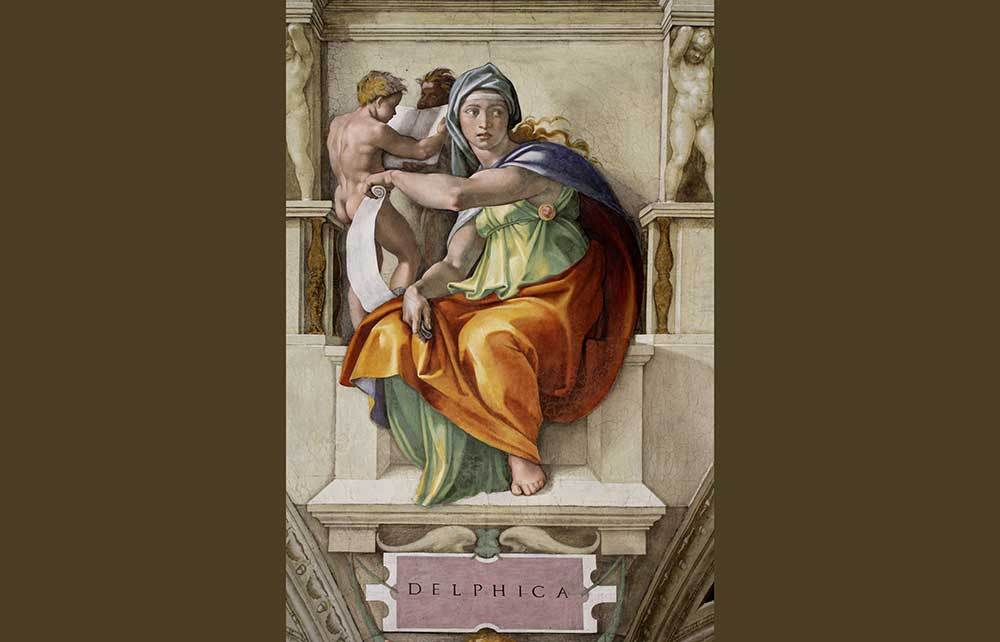
Michelangelo’s Delphic Sybil is one of the most familiar figures from the Sistine Chapel ceiling. For one thing, she is one of the largest figures, seated among the seven prophets and five sybils in the spandrels that punctuate the outside edge of the ceiling’s decorative scheme. The prophets are well-known to us from the Hebrew Scriptures, foretelling the need for and coming of the Savior, which is the central theme articulated in the ceiling. Less well understood are the sybils, the female prophetesses of the Classical world; they, too, were thought to have foreseen the advent of the Messiah. How Michelangelo imagined them, and why, bears a closer look.
Color Revelation
Michelangelo envisions the Delphic sybil as a young woman seated on a throne, holding an unfurled scroll and giving a startled look to the side as her golden hair flies out behind her. She wears a blue headscarf and vibrant yellow-green and orange clothing. Traditionally, the Delphic sybil’s cult was the most ancient one of the Classical world. In the origin myth, the original sybil was a sister of Apollo and her sanctuary lay at the center of the world, at Delphi. According to tradition, her cult predated the Trojan War, and it continued in operation until it was shut down by the Christian emperor Theodosius in the fourth century A.D.
As historically the most ancient sybil, Michelangelo sets her at the entrance to the chapel, but he depicts her as a young woman since successive priestesses at Delphi were chosen as young girls, who went on to lead chaste and virginal lives. The artist’s choice of colors emphasizes her youthfulness: her blue headdress connects her with the celestial, but the green of her drapery is the color of youth and growth, and the bright yellow-orange stands for her warmth.
The colors as they appear today caused something of a furor at the close of the last century. The Vatican, bankrolled by a Japanese film company, undertook an ambitious cleaning of the ceiling that eventually took fourteen years. The results were drastic, and to some, shocking. Brilliant contrasts of unexpected colors came to light, upsetting scholars accustomed to the previous subdued color chords. They protested that the cleaning had gone too far, removing Michelangelo’s overlaid modulations of color. Not so, said the conservators; they had only removed five hundred years of dirt and candle soot to reveal the original bright pigments bonded to the plaster. The ceiling, they argued, had to be seen from sixty feet away, so Michelangelo deliberately chose contrasting colors verging on the garish to carry across such an awkward architectural space.
Sculptural & Dynamic
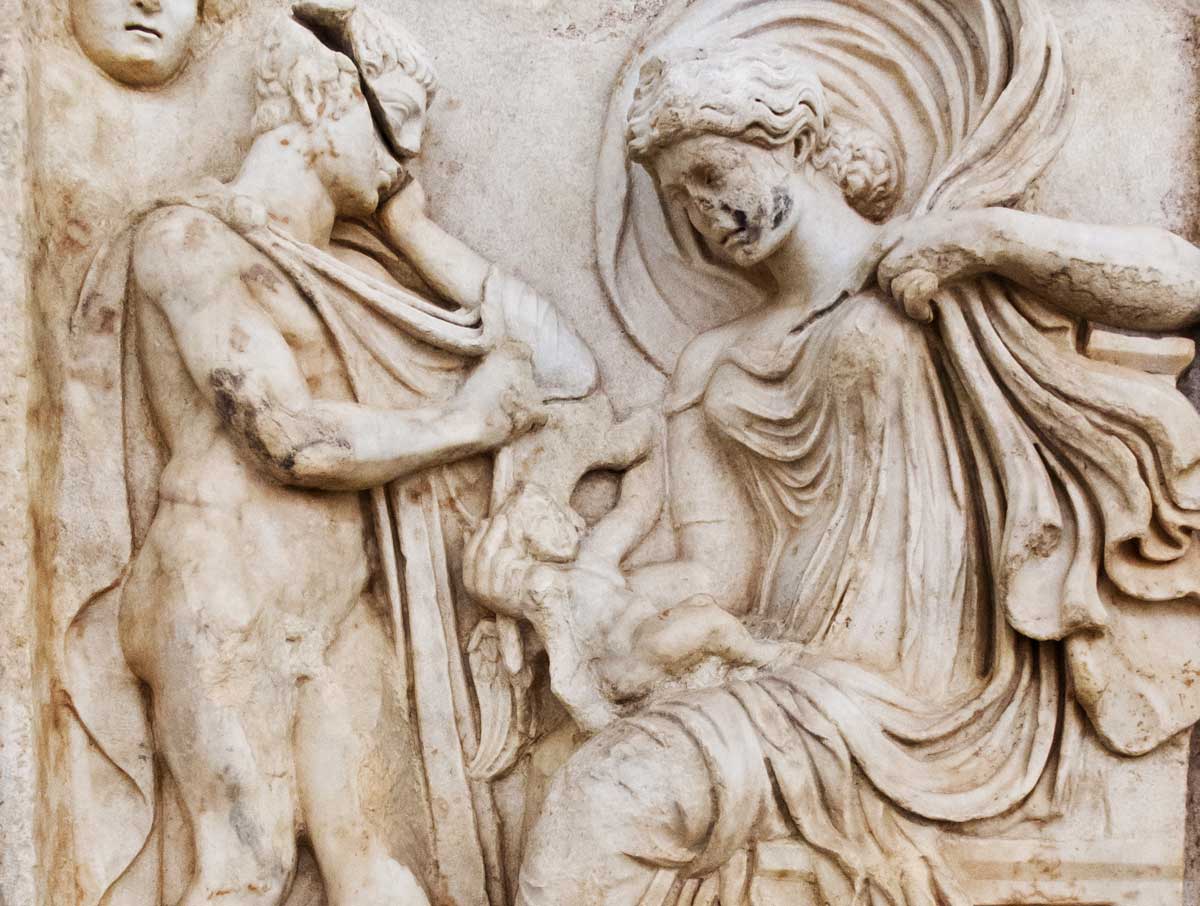
Another result of the cleaning was to heighten the contrasts between light and dark that had been muted by the smoky residues, resulting in a renewed sculptural solidity of the figures on the ceiling. The Delphic sybil may be young, but she is also powerful and sculptural. The rebirth of Classical ideals and canons of proportion in the Renaissance had been fueled by the rediscovery of ancient sculptures and their idealization of the human figure. One such sculpture was the Belvedere Torso, known at least since the fifteenth century and in the Vatican in Michelangelo’s time (Figure 1).
The statue is a partial figure, seated with its knees apart, its torso twisting in a pose of dynamic tension. Just so sits the Delphic sybil under her colorful drapery. In two dimensions, the strong simple lines of her drapery form a harmonious pointed oval balanced within her niche, but her knee, like the Belvedere Torso’s, breaks forward into our space, as does her left elbow, creating a sculptural illusion of three dimensions.
Meanwhile, she turns her head in the opposite direction from her body. We have caught her in a moment of motion critical to our understanding of the figure. Her head, another pointed oval, turns to her left. Her eyes are round, glancing sideways, and her lips are parted as if she were startled and distressed. To her right stand two little putti: one reads from a book while the other, darker skinned, holds it up and frowns over the top. Are they the genii who convey the prophecy to her? And have we caught her in that moment of inspiration?
Traditionally, the sybil prophesied while breathing in sweet-smelling fumes that issued from a crevice in Apollo’s shrine at Delphi; under their mind-altering influence, she uttered words conveyed by the god. In Michelangelo’s rendering, the sybil’s hair is blown, as if by the volcanic fumes of the movement of the spirit of revelation.
Foretelling the Savior
But what precisely might that revelation have been? Augustine and a number of early church fathers recorded the supposed predictions of the ancient sybils, interpreting them in ways that confirmed that the prophetesses of the ancient world had also foretold the coming of the Savior. That notion continued throughout the commentaries of the Middle Ages, and would have been known to Michelangelo and whatever consultant, if any, worked with him on the ceiling’s iconological program.
According to tradition, then, the Delphic sybil foretold the coming of a savior of mankind, who would be born, falsely judged, shamed by unbelievers, and ultimately crowned with thorns. Fifteenth-century depictions of the sybil show her holding the crown of thorns, but Michelangelo has chosen to show her at the moment of her terrifying insight.
Also, he places her beside the central panel depicting the Drunkenness of Noah, in which his own sons strip and mock him. This Old Testament scene is often interpreted as foreshadowing the mocking of Christ, as Noah was a type of the Savior of mankind. So, to Michelangelo the humanist, the Classical world was in accord with his central theme: that mankind, in need of redemption, would find salvation in the Christ, that his salvation was known within the pagan world as well, and that it was open also to the Gentiles.
Mary Elizabeth Podles is the retired curator of Renaissance and Baroque art at the Walters Art Museum in Baltimore, Maryland. She is the author of A Thousand Words: Reflections on Art and Christianity (St. James Press, 2023). She and her husband Leon, a Touchstone senior editor, have six children and live in Baltimore, Maryland. She is a contributing editor for Touchstone.
A Journal of Mere Christianity—Delivered to Your Door
- Essays on theology, culture, and the Church
- Contributors from across the Christian traditions

Six print issues (one year) of Touchstone, plus full online access and PDF downloads for only $39.95.

Get a one-year full-access subscription to the Touchstone online archives for only $19.95.
bulk subscriptions
Order Touchstone subscriptions in bulk and save $10 per sub! Each subscription includes 6 issues of Touchstone plus full online access to touchstonemag.com—including archives, videos, and pdf downloads of recent issues for only $29.95 each! Great for churches or study groups.
Transactions will be processed on a secure server.
more from the online archives

calling all readers
Please Donate
"There are magazines worth reading but few worth saving . . . Touchstone is just such a magazine."
—Alice von Hildebrand
"Here we do not concede one square millimeter of territory to falsehood, folly, contemporary sentimentality, or fashion. We speak the truth, and let God be our judge. . . . Touchstone is the one committedly Christian conservative journal."
—Anthony Esolen, Touchstone senior editor