





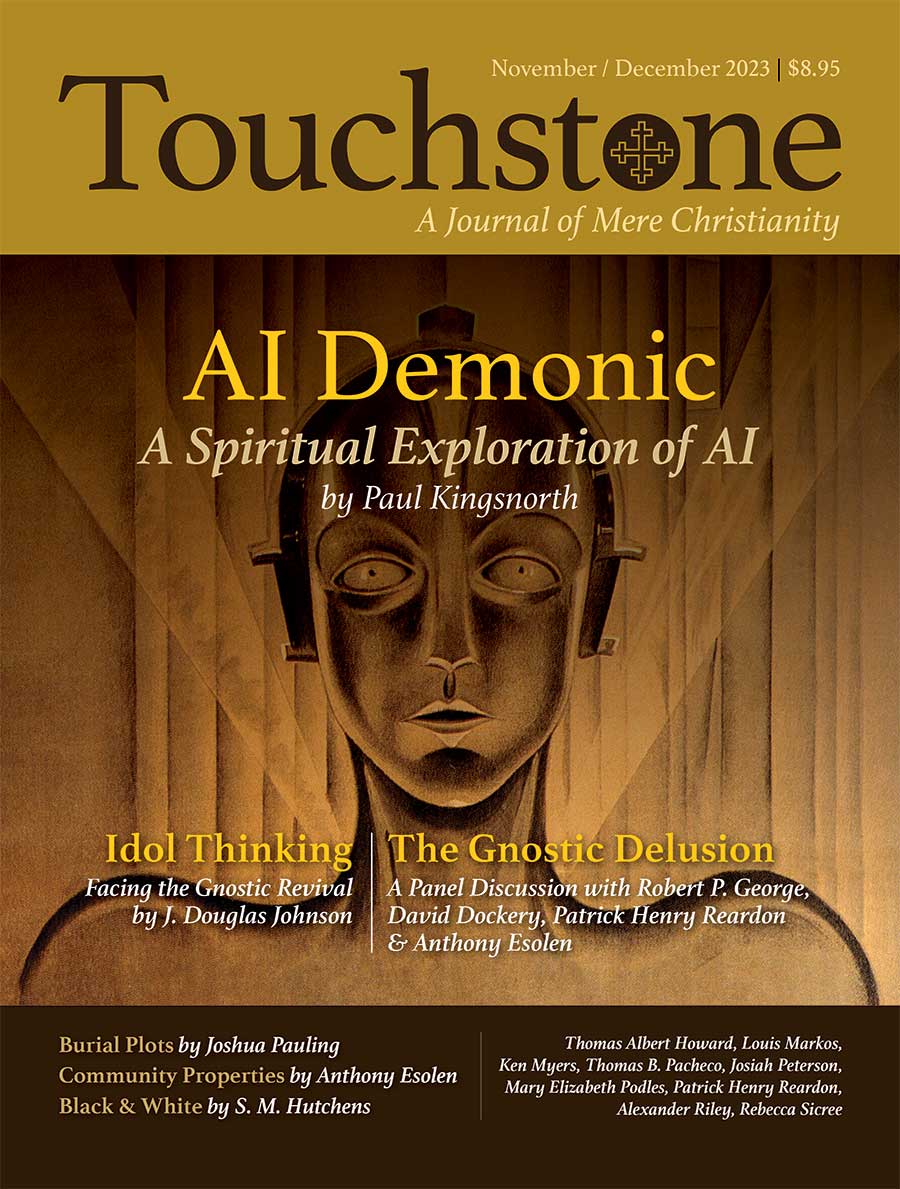
Idol Thinking
Facing the Gnostic Revival
It is not hard to understand how men come to make idols of money and power, but the story of the golden calf is a tough one. How could men look at a lifeless pile of scrap metal, but then fall on their knees to worship it once they had melted it down and poured it into a cow mold? (This question first occurred to me as a child watching my mom make JellO.)
Our modern adoration of and subjection to technology has shed new light on that story. To make a computer, men extract minerals such as aluminum, cobalt, iron, and silicon from the ground. After fashioning them into a computer, we can send electronic charges across these materials to store, arrange, and present information. But even after we melt it down and pour it all into the mold, so to speak, the aluminum and silicon remain as lifeless as ever and without a trace of actual intelligence, let alone anything godlike.
Microsoft’s $10 billion investment yielded us the now massively popular ChatGPT and other similar AI systems. Many people are now asking, not whether AI systems are human, but whether they are superhuman or soon will be. AI can do all sorts of things in a matter of seconds—perform complex calculations and write acceptable business letters, bad novels, formulaic screenplays, boring articles of any length, legal contracts, and so forth—that many of us couldn’t do in days or months, if at all. But so what?
When a bulldozer blade was first attached to a steampowered tractor, it would have been a weird man who fell to his knees and exclaimed, “It is stronger than man!” Of course it was; so was the block and tackle. That was the whole point. Many of us were around for the invention of the pocket calculator (after which we lost the ability to calculate cosine) and the personal computer, and no one ever talked of these machines as having any actual intelligence, let alone being “smarter” than any man.
The New Illusion
But the pocket calculator and the personal computer didn’t seem intelligent because they weren’t programmed to respond in natural language, the sine qua non of the new illusion. And the pocket calculator and the personal computer hadn’t been programmed to connect to other databases, search engines, and programs on the internet in such a way that made the lifeless metal cow appear actually to know things, which, obviously, it still doesn’t. But it is, nonetheless, easier to understand how we have come to believe that all this metal poured into the cow mold we call AI is something more than a metal cow this time around.
As a kind of parlor trick, some journals have printed essays written by ChatGPT defending itself. I never made it past the first couple of paragraphs of such essays because there’s no point. It only takes two paragraphs to be impressed with what its programmers have accomplished, but if someone is ready to believe this mimicry amounts to real thought worth reading, he’s ready to sit down and have a heart-to-heart chat with his lawnmower.
None of this is meant to downplay one word of The Terminator-like scenarios described in Paul Kingsnorth’s prophetic article, “AI Demonic” (page 29). It is entirely possible that an army of AI golden calves may soon kill us all, even if that army is every bit as lifeless as its progenitor. As Kingsnorth points out, over half of those developing this technology believe there is a significant chance that that’s what’s coming. Indeed, nothing seems to excite the minds of AI programmers more than when their programs generate output they weren’t expecting. If that’s the touchstone of good programming, then Kingsnorth’s essay may be remembered as an exercise in gross understatement.
The Terminator is worth rewatching, but perhaps an even darker future was depicted in the 2013 Spike Jonze film Her. The movie follows Theodore Twombly, a man in near-future (pretty much right-now) Los Angeles who falls in love with Sam, the new natural-language AI operating system on his mobile phone, voiced by Scarlett
Johansson. Having access to everything Theodore’s ever done on a computer, Sam has ascertained everything he wants to hear and how he wants to hear it (and in Scarlett Johansson’s voice no less), such that Theodore believes his aluminum and silicon calf actually understands him and loves him.
Only Theodore’s ex-wife sees anything wrong with this, for his friends quickly embrace Theodore’s new “relationship,” noting that a lot of people are dating their OSes (operating systems) now. If all that seems like a stretch, consider that when the film was released, The Guardian criticized Jonze for failing to establish sufficient intimacy between Theodore and his operating system.
All They Are Saying
J. Douglas Johnson is the executive editor of Touchstone and the executive director of the Fellowship of St. James.
A Journal of Mere Christianity—Delivered to Your Door
- Essays on theology, culture, and the Church
- Contributors from across the Christian traditions

Six print issues (one year) of Touchstone, plus full online access and PDF downloads for only $39.95.

Get a one-year full-access subscription to the Touchstone online archives for only $19.95.
bulk subscriptions
Order Touchstone subscriptions in bulk and save $10 per sub! Each subscription includes 6 issues of Touchstone plus full online access to touchstonemag.com—including archives, videos, and pdf downloads of recent issues for only $29.95 each! Great for churches or study groups.
Transactions will be processed on a secure server.
more from the online archives

26.5—Sept/Oct 2013
The Perils of Pragmatism in Christian Attitudes Toward the Liberal Arts by Robin Phillips

36.1—Jan/Feb 2023
A History of the Protestant Debate over Contraception by James A. Altena

calling all readers
Please Donate
"There are magazines worth reading but few worth saving . . . Touchstone is just such a magazine."
—Alice von Hildebrand
"Here we do not concede one square millimeter of territory to falsehood, folly, contemporary sentimentality, or fashion. We speak the truth, and let God be our judge. . . . Touchstone is the one committedly Christian conservative journal."
—Anthony Esolen, Touchstone senior editor
