




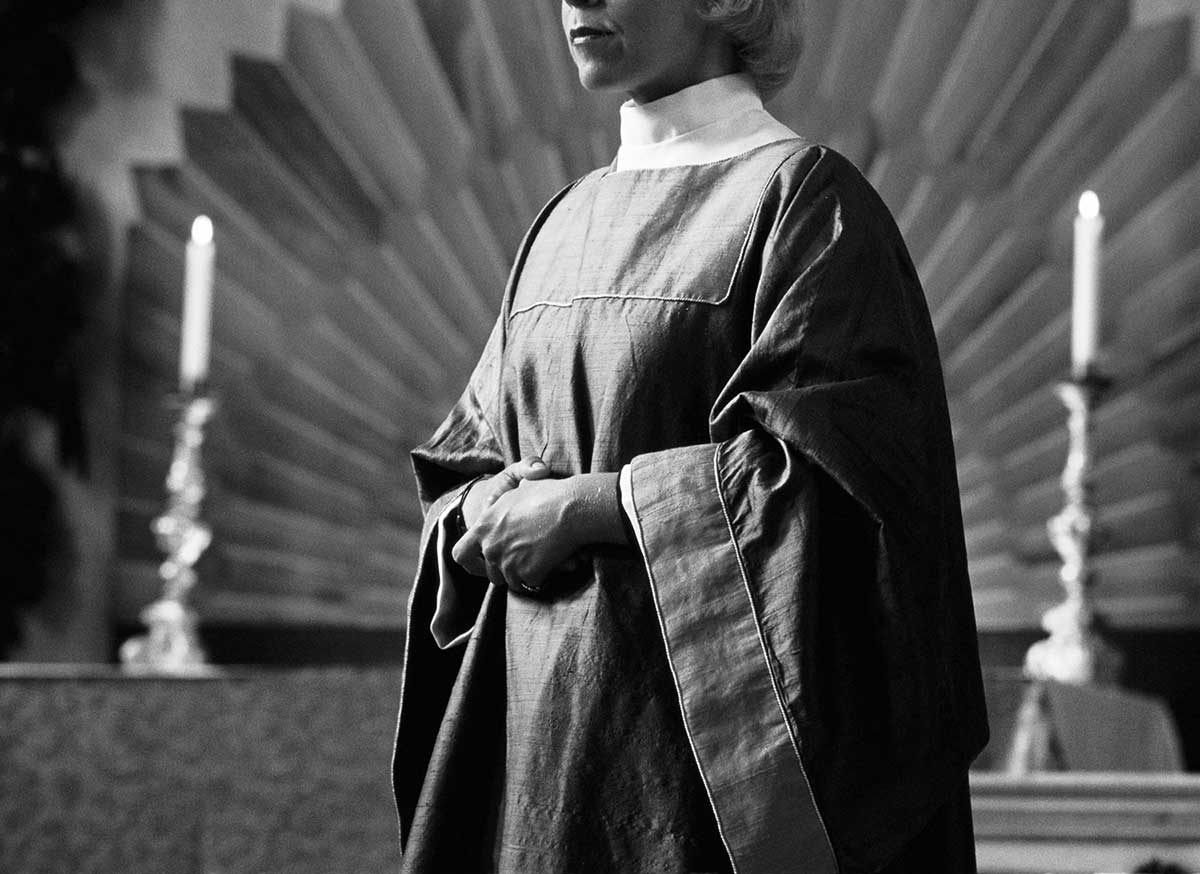
The Redefinition of Priest
on Catholic Priestesses & the Loss of Catholicity
Over a half-century ago, C. S. Lewis wrote an essay on the impossibility of the Church of England ordaining women to holy orders (“Priestesses in the Church?”, 1948). He argued that if the church did such a thing, it would cease to be part of the one, holy, catholic, and apostolic church of Jesus Christ. In that essay, he noted that although the proposal to open holy orders to women had been raised, it was most unlikely that the Church of England would take such a dramatic and irreversible step, which would cut it off from other Christian churches and from the consistent teaching of the whole church from its founding by Jesus Christ. Though the Church of England did not break from that teaching during Lewis’s lifetime, it and other branches of the Anglican Communion subsequently did so, thus aligning themselves with Protestant denominations that do not treat the priestly office the way Catholic, Orthodox, and Oriental Orthodox churches do.
Within the Catholic Church, the matter was settled definitively in 1994 by Pope John Paul II in his Apostolic Letter, Ordinatio Sacerdotalis, which built on the earlier declaration, Inter Insigniores, issued in 1976 by the Congregation for the Doctrine of the Faith (CDF) with the approval of Pope Paul VI. It would be foolish to ascribe clairvoyance to Lewis, but a close reading of “Priestesses in the Church?” shows his prescience in predicting that if the Church of England ordained women to holy orders, it would result in serious division within the Anglican Communion as well as cut off the Church of England from the Orthodox, Oriental Orthodox, and Catholic churches.
Lewis’s arguments against the possibility of the church ordaining women to the priesthood anticipated the arguments of Avery Cardinal Dulles, S.J., in his 1996 lecture, “Priesthood and Gender.” Dulles went further than Lewis, however, as his lecture included a detailed explanation of why the Vatican pronouncements cited above should be considered a “definitive teaching” that requires a firm assent from the Catholic faithful. He also noted that the question whether “definitively held” equaled “infallible” as regards this teaching had been settled in the affirmative by the CDF’s response to a dubium concerning Ordinatio Sacerdotalis.
Voices Raised Anew
Yet voices are again being raised in the Catholic Church asking whether women can be ordained to the sacramental priesthood. Most Catholic proponents of priestesses start their arguments by denying the infallibility of the teaching against women’s ordination, ignoring or refusing to engage with the pronouncements of Paul VI, John Paul II, and Benedict XVI (when he was Joseph Cardinal Ratzinger, prefect of the CDF). Much like postmodernist philosophers, the proponents of Catholic priestesses seek to redefine the terms that render the ordination of women impossible, claiming that they mean something else. This is a necessary tactic, for as long as the impossibility of ordaining women is recognized as a definitive teaching requiring the firm assent of all Catholics, no progress towards the ultimate goal of ordaining women is possible.
Once the definitive teaching is relegated to nothing more than the assertion of men who are unwilling to relinquish their domination of the church by allowing women to exercise as much power as the men do through the priesthood, the game is up, for then we are no longer dealing with the mystery of the Incarnation and the paschal sacrifice of Jesus, but are moving in the realm of progressivism’s principalities and powers. One can foresee the chain of progression envisioned by self-styled progressive Catholics: first open all non-clerical ministries to women, then ordain them as deacons, then as priestesses, then as female bishops, and then—why not?—elect a woman as the Vicar of Christ, just as has occurred, save for the last step, in the Church of England and other parts of the Anglican Communion.
Which brings us back to C. S. Lewis; for though he did not recognize the pope in Rome as the Vicar of Christ, he did recognize that every priest is in fact a vicar of Christ. At certain times, every Christian priest stands in persona Christi, in the place of Jesus Christ. Lewis recognized this “standing in” as the fundamental issue related to women’s ordination. Dulles picked up on it, too, as did Sister Sara Butler, MSBT, in her book The Catholic Priesthood and Women (2007). Jesus of Nazareth was a man; thus, only a man, even a not very good man, can take the place of Jesus when his sacrifice is re-presented at the Liturgy of the Eucharist. Only a man can stand in the place of the Son of God, the Son of Man, the Son of David, the Bridegroom of the Church.
Not Like a Ball
Lewis began his essay with a quotation from Pride and Prejudice, in which Caroline Bingley tells her brother that balls would be better if carried on differently—specifically, that they would be more rational if conversation instead of dancing were the dominant activity. Her brother counters that by saying that substituting conversation for dancing at a ball might make it more rational, but would also make it much less like a ball.
Anticipating the postmodernist rhetoric of gender ideology, Lewis rejects the notion that men and women are as interchangeable for the purpose of representing Christ in the liturgy as they are for most public functions in post-industrial, secular society. Being a fallen and sinful man himself, he acknowledges his discomfort in defending the necessity for a priest standing in persona Christi to be male, for indeed no merely human man can approach the full masculinity of Jesus, true God and true man. But substituting a woman, that is, a feminine person, for a not perfectly masculine person, is no solution. Returning to the image of the ball, he writes:
Edward G. Stafford is a retired U.S. Foreign Service officer who often focused on church-state relations in his diplomatic assignments. He now serves in the Roman Catholic diocese of Camden as a lector, catechist, and ESL teacher. He is married with three adult sons and five grandchildren.
A Journal of Mere Christianity—Delivered to Your Door
- Essays on theology, culture, and the Church
- Contributors from across the Christian traditions
Subscribe (Print + Online) 
Six print issues (one year) of Touchstone, plus full online access and PDF downloads for only $39.95.
Subscribe (Online Only) 
Get a one-year full-access subscription to the Touchstone online archives for only $19.95.
bulk subscriptions
Order Touchstone subscriptions in bulk and save $10 per sub! Each subscription includes 6 issues of Touchstone plus full online access to touchstonemag.com—including archives, videos, and pdf downloads of recent issues for only $29.95 each! Great for churches or study groups.
Transactions will be processed on a secure server.
more on Feminism from the online archives

14.6—July/August 2001
Three Bad Ideas for Women & What to Do About Them by Frederica Mathewes-Green
33.1—January/February 2020
on the Consequences of One Birth Before Roe v. Wade by Craig Kellogg Galer
more from the online archives
17.4—May 2004
The Unhappy & Abusive Marriage of Liberalism & Modernism by James Hitchcock

31.6—November/December 2018
Victimhood Culture Scapegoats Its Very Source by Michael P. Foley
23.6—November/December 2010
Darwin, Design & Thomas Aquinas
The Mythical Conflict Between Thomism & Intelligent Design by Logan Paul Gage
calling all readers
Please Donate
"There are magazines worth reading but few worth saving . . . Touchstone is just such a magazine."
—Alice von Hildebrand"Here we do not concede one square millimeter of territory to falsehood, folly, contemporary sentimentality, or fashion. We speak the truth, and let God be our judge. . . . Touchstone is the one committedly Christian conservative journal."
Support Touchstone
—Anthony Esolen, Touchstone senior editor
