





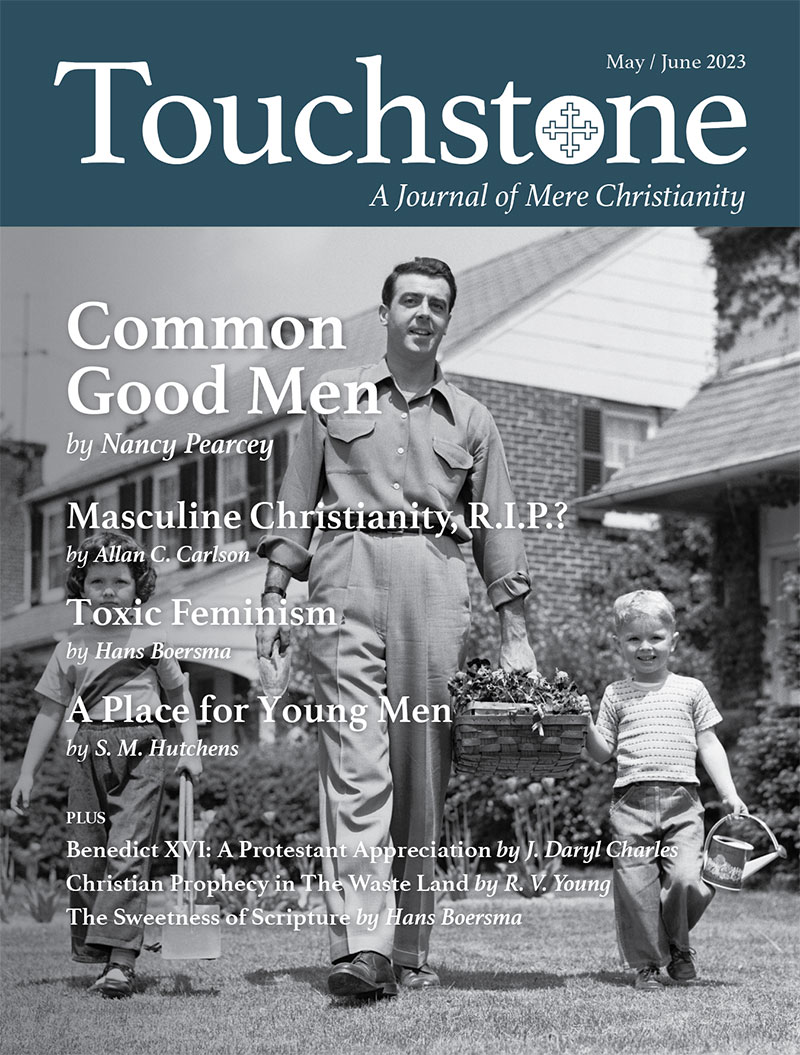
Feminism’s Orphan
Elizabeth Fox-Genovese: Paternalism’s Daughter by Deborah A. Symonds
University of Virginia Press, 2021
(339 pages, $39.50, hardcover)
The biographer’s task is to find patterns in, bring meaning to, and highlight the significance of a human life. Drake University historian Deborah Symonds so engages the legacy of her teacher and subsequent editorial colleague, the woman-of-letters Elizabeth (“Betsey”) Fox-Genovese. The challenge here is relatively daunting, for Symonds finds her subject to be both “noted and notorious, kind and cutting,” a “lightning rod” in the American culture wars of the last sixty years.
Indeed, Fox-Genovese defies easy categorization. Born in 1941 to a father of old Puritan stock and a secular Jewish mother, and educated at prominent prep schools, Bryn Mawr, and Harvard, she fell under the spell of Sigmund Freud, twice entered extended periods of Freudian analysis, kept astonishingly frank journals describing her dreams, and at times hoped to become a psychiatrist. In graduate school she embraced Marxist historical analysis, which emphasized how the material world and socio-economic class relationships drove cultural and historical change. In 1969 she married the outspoken Marxist scholar Eugene Genovese. As a self-described Marxist-Feminist, Fox-Genovese went on to found “Women’s Studies” programs at the State University of New York at Binghamton and Emory University. In a 1994 article for Vanity Fair, Christopher Hitchens called the two academics America’s “royal couple of radicalism.”
And yet, from the very start of her adult life, she was different; as Fox-Genovese herself explained, “I am not . . . a proper child of my time.” She refused to join other young feminists for their late-night sessions featuring “grubby suppers” and “cheap wine drinking.” She always dressed smartly and well and was known for her expensive four-inch heels. She collected prints of French fashions from the late eighteenth and early nineteenth centuries. When she turned to write on the lives of American women, white and black, under slavery, she exulted in the diaries left by Southern belles such as Mary Chesnut and Sarah Gayle.
I first met her at an event supporting the presidential run of Pat Buchanan. In 1995 she entered the Roman Catholic Church, drawn by the meditations of Edith Stein (a.k.a. St. Teresa Benedicta of the Cross) and St. Teresa of Avila. In 1999 Betsey accepted my invitation to give the keynote address to the World Congress of Families II in Geneva, Switzerland. Her subject? “On the Equal but Complementary Roles of Men and Women.” And she began to write for strange publications, such as Touchstone: “Deadly Choice: Abortion as a War Against Women” in 2003, and “Liberté! Egalité! Académie! On the Recovery of Academic Freedom” in 2004.
The Feminist Blames the Men
How might the biographer explain these seemingly massive contradictions? On the one hand, author Deborah Symonds has an advantage. She writes as a feminist and lesbian (see her book dedication to “my wife”), and all feminist biographies have the same overriding theme: the female subject’s struggle against The Patriarchy. That is certainly present here, visible even in the book’s subtitle: “Paternalism’s Daughter.”
The chief villain in this story is Edward Whiting Fox, Sr., Betsey’s father. A substantial share of this book focuses on his patriarchal flaws. Though a scholar of modern French history, a professor at Cornell University, and a part-time officer in the Central Intelligence Agency, he was admittedly not a model husband or father. Symonds blames him for the decision by Betsey’s mother to forego her own promising academic career to care instead for their children. He traveled frequently, with long spells away from home and family.
“Well born” but not wealthy, he and wife Elizabeth (“Betty”) scraped together the money to send their children to the best private schools: in Betsey’s case, the Waldorf-oriented North Country School, which featured a classical canon focused on Latin; the College Cevenol, of Huguenot descent in the Auvergne region of France; Concord Academy (“one of the best . . . in the country”); and finally Bryn Mawr (“the most intellectually demanding of the Seven Sisters colleges”). However, father required that his children keep a strict record of their expenses, including the purchase of food. Symonds argues that Betsey was “pummeled by her father’s demands and his fear of expense,” which led to the anorexia which troubled her throughout her twenties.
More darkly, Symonds suggests that Betsey exhibited the Electra complex, a Freudian concept involving a young girl’s competition with her mother for the affection of her father. The biographer lifts passages from Betsey’s “dream” journals said to hint at forbidden, sublimated desires. Symonds also focuses on Betsey’s purchase of a new pen upon her arrival in London for having “phallic implications” involving “Daddy and the typewriter.”
Allan C. Carlson is the author of numerous books, including Family Questions: Reflections on the American Social Crisis and The American Way: Family and Community in the Shaping of the American Identity. He attends St. Paul Lutheran Church in Rockford, Illinois. He is a senior editor of Touchstone.
A Journal of Mere Christianity—Delivered to Your Door
- Essays on theology, culture, and the Church
- Contributors from across the Christian traditions

Six print issues (one year) of Touchstone, plus full online access and PDF downloads for only $39.95.

Get a one-year full-access subscription to the Touchstone online archives for only $19.95.
bulk subscriptions
Order Touchstone subscriptions in bulk and save $10 per sub! Each subscription includes 6 issues of Touchstone plus full online access to touchstonemag.com—including archives, videos, and pdf downloads of recent issues for only $29.95 each! Great for churches or study groups.
Transactions will be processed on a secure server.
more on feminism from the online archives

33.1—January/February 2020
on the Consequences of One Birth Before Roe v. Wade by Craig Kellogg Galer

14.6—July/August 2001
Three Bad Ideas for Women & What to Do About Them by Frederica Mathewes-Green
more from the online archives
19.4—May 2006
The Culture War Is Between Religious Believers on Both Sides by Howard P. Kainz

33.3—May/June 2020
on the Wisdom of the Good Doctor Edmund Pellegrino by Allen H. Roberts II
33.4—July/August 2020
on Boethius's Consolation in a Time of Plague by Thomas Albert Howard
calling all readers
Please Donate
"There are magazines worth reading but few worth saving . . . Touchstone is just such a magazine."
—Alice von Hildebrand
"Here we do not concede one square millimeter of territory to falsehood, folly, contemporary sentimentality, or fashion. We speak the truth, and let God be our judge. . . . Touchstone is the one committedly Christian conservative journal."
—Anthony Esolen, Touchstone senior editor
