The Angel Asiel, the Fear of God

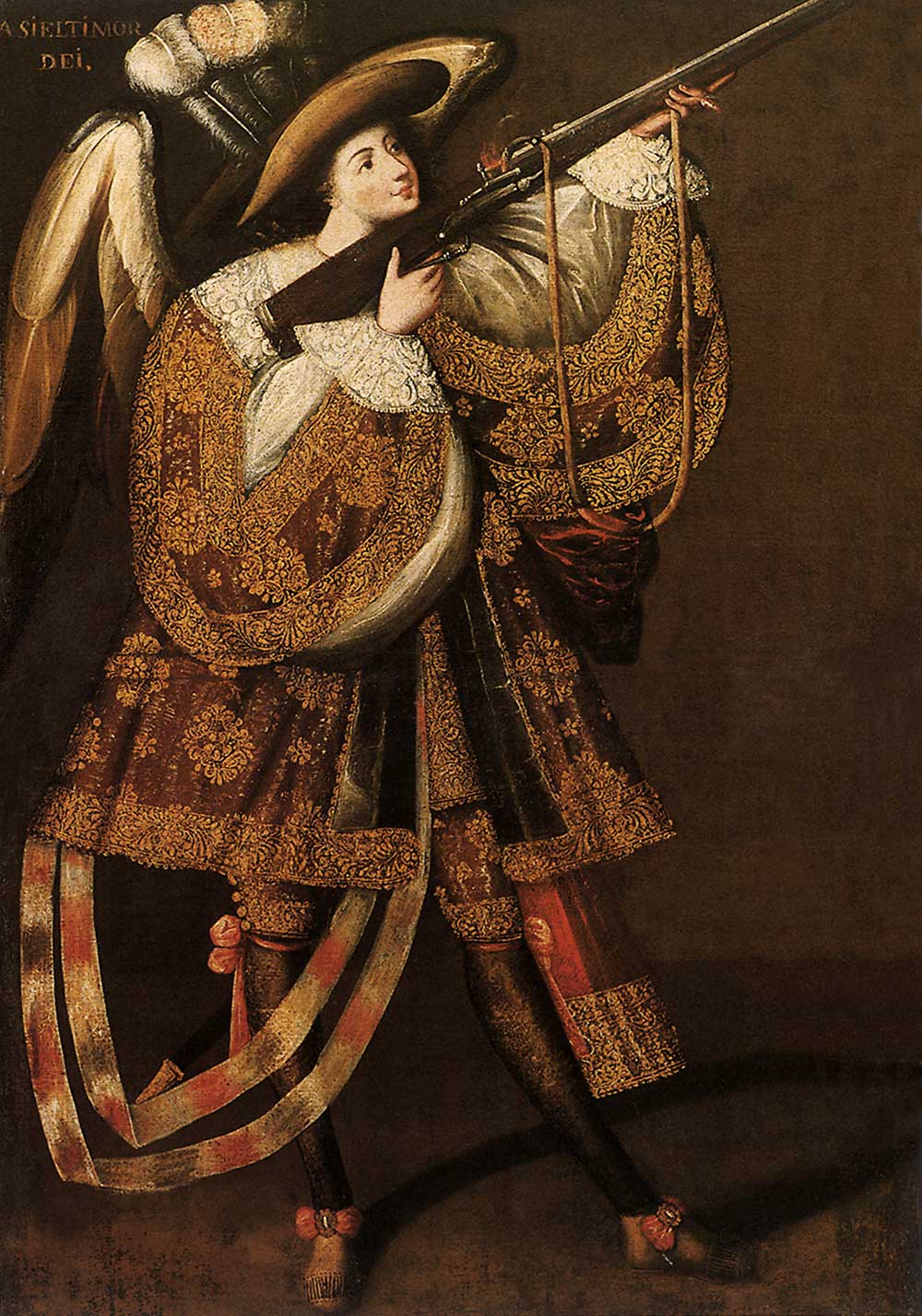
A young friend once happened onto an illustration of this painting bearing the simple label “Angel.” He said to me, “At first, I thought it was a portrait of someone named Angel. Then I saw the wings. So, what is it really?”

Clearly, this is not the white-nightied angel of the conventional Christmas card world. Instead, it is one of many examples of the militant angels of the Peruvian School of Cuzco, dating from the sixteenth to the eighteenth centuries. This one, labeled “Asiel, the Fear of God,” is an elegant winged figure in exaggerated European dress: court trousers and ballooning sleeves, a plumed hat, ribbons, and an elaborate overlay of gold lace. And he is flourishing what was then the most advanced of high-tech weaponry, the arquebus or matchlock musket. He stands close to the picture plane and fills the whole of the canvas against a dark, empty background. How are we to explain him?

A Fusion of European & Indigenous Elements

The School of Cuzco, of which he is a late exemplar, was a Jesuit experiment in evangelization. When Peru and Bolivia were opened to the Jesuit missionaries, they set out to establish settlements that were to depend on cooperation with, rather than coercion of, the indigenous Incas they found there. These communities were intended to be not only physically and economically self-sustaining, but also to sustain a culture that combined the Christian mission with the existing artistic milieu. So, for example, Jesuit musicians composed Baroque music that combined European-style instruments with the rattles, pipes, and drums of the Incas in a wonderfully hybrid style. It is still played today in South America.

Similarly, the Jesuits sent artists like Bernardo Bitti to Peru to create a painting style that was a fusion of European and indigenous elements. Bitti, who apprenticed as an artist in his teens, joined the Society of Jesus and was sent from Italy to Spain, and thence to Peru and what is now Bolivia. There, he traveled from mission to mission, decorating churches and training artists, many of them Incas, in the European style we now think of as Late Renaissance or Mannerist, adding to it elements of a strong indigenous artistic heritage. The result was paintings like the angel that we examine here.

Obviously, this angel has European antecedents, is painted three-dimensionally, and is wearing the extreme of current courtly fashion. His artistic antecedents probably lie in the illustrations for the Dutch artist Jacques de Gheyn’s Exercise of Arms (see figure below). Ostensibly a manual for military training in new firearms weaponry, de Gheyn’s work is also an exercise in the posturing and costuming of elegant mannered figures, soldiers outfitted more for the parade ground than the battlefield.

Every artist collected prints like these as a toolbox for design ideas, much as we might consult “Images” in our browser searches. Prints were inexpensive and portable, and artists like Bitti would no doubt have traveled with their collections in hand. The placement of the figure, the swaggering gesture, the fanciful uniform, even the matchlock, all point to de Gheyn’s soldiers as the direct ancestors of the Cuzco angels.

Figures of Power & Protection

What is new to the angels, however, is the intricate overlay of lace, which is essentially two-dimensional, and which springs from the Incan vocabulary of elaborate linear patterning. The Jesuit artist has co-opted the indigenous linear forms into his image of the militant angel. To the Inca, clothing defined one’s status, and the gold of the Andes implied not only status and wealth, but also power.

For all their elegance and grace, then, these angels were meant to personify power. According to the mythology of the Incas, winged warriors moved the stars through the heavens and provided protection for the indigenous peoples below. It was a short reach for the missionaries, in keeping with their policy of cooperation, to co-opt the warrior gods and accord them the status of angels in the Christian cosmology.

To aid with this incorporation, the Jesuits probably drew upon the apocryphal Book of Enoch, which describes Enoch’s vision of the archangel Michael’s war with the rebel angels. This apocalyptic work, known to the church fathers but lost for centuries, was mentioned in the sixteenth century by no less than Sir Walter Raleigh, and was known for sure in the eighteenth century, when this angel was painted.


Mary Elizabeth Podles is the retired curator of Renaissance and Baroque art at the Walters Art Museum in Baltimore, Maryland. She is the author of A Thousand Words: Reflections on Art and Christianity (St. James Press, 2023). She and her husband Leon, a Touchstone senior editor, have six children and live in Baltimore, Maryland. She is a contributing editor for Touchstone.

A Journal of Mere Christianity—Delivered to Your Door

  • Essays on theology, culture, and the Church
  • Contributors from across the Christian traditions

Subscribe (Print + Online)

Six print issues (one year) of Touchstone, plus full online access and PDF downloads for only $39.95.

Subscribe (Online Only)

Get a one-year full-access subscription to the Touchstone online archives for only $19.95.


bulk subscriptions

Order Touchstone subscriptions in bulk and save $10 per sub! Each subscription includes 6 issues of Touchstone plus full online access to touchstonemag.com—including archives, videos, and pdf downloads of recent issues for only $29.95 each! Great for churches or study groups.

Transactions will be processed on a secure server.


more from the online archives
35.4—Jul/Aug 2022

The Death Rattle of a Tradition

Contemporary Catholic Thinking on the Question of War by Andrew Latham

32.1—January/February 2019

Schools of Impiety

The Diabolical Failure of Leaders in the Present Crises by James M. Kushiner

29.5—Sept/Oct 2016

Dying of Despair

on the Loss of True Community & Rising Political Desperation by Karl D. Stephan

calling all readers

Please Donate

"There are magazines worth reading but few worth saving . . . Touchstone is just such a magazine."
—Alice von Hildebrand

"Here we do not concede one square millimeter of territory to falsehood, folly, contemporary sentimentality, or fashion. We speak the truth, and let God be our judge. . . . Touchstone is the one committedly Christian conservative journal."
—Anthony Esolen, Touchstone senior editor

Support Touchstone

00