





Even the Sparrow
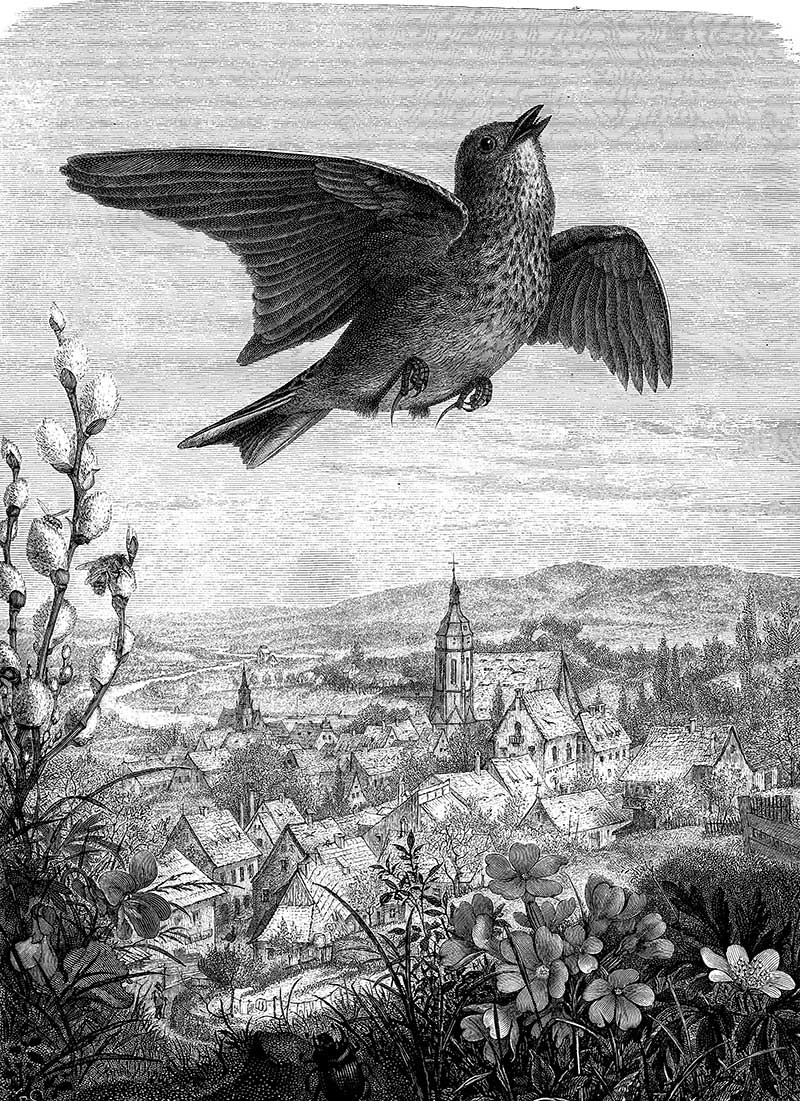
Every year in the spring my husband Jim and I move from our dining room to sit in our improvised breakfast room on the back porch—a smaller, sunnier, and more intimate setting where we can enjoy a view of our backyard. Though there is much to enjoy in a new spring garden, I have especially enjoyed watching the birds. Among them are noisy blue jays, red-breasted robins, large and aggressive grackles, cooing mourning doves, and even an impressive hawk. The sparrows, this year, though, have been my favorite.
Based on the informative bird cards that I gave Jim for his birthday, and the use of a pair of binoculars to see the birds up close, I think we have house sparrows, the most common and widespread bird in our country. They are small, the female especially drab, and they have a monotonous chirp. They are sociable and like to beg for food in parks and parking lots. I have happily been able to observe the domestic life of some of these common house sparrows, seemingly so appropriately named.
The sparrows lead an active and generally quiet life in our little garden. The previous spring, an enterprising and industrious pair of robins had built a nest atop a small lamp fixture attached to the side of the garage. We left it up to see if another bird would repurpose it, and sure enough, the practical sparrow saw an opportunity to build an upward addition to the nest to suit its needs. It took many days to add on to the nest, and they added so much foraged material that the end result was more like a cave with a very small opening at the top. Jim reminded me of the beautiful verse in Psalm 84: “Even the sparrow finds a home, and the swallow a nest for herself, where she may lay her young, at your altars, O Lord of hosts, my King and my God” (v. 3).
THIS ARTICLE ONLY AVAILABLE TO SUBSCRIBERS.
FOR QUICK ACCESS:
Patricia Kushiner is a retired long-time staff member of the Fellowship of St. James. She and her husband, Jim, have six children and sixteen grandchildren. They attend All Saints Antiochian Orthodox Church in Chicago, Illinois.
A Journal of Mere Christianity—Delivered to Your Door
- Essays on theology, culture, and the Church
- Contributors from across the Christian traditions

Six print issues (one year) of Touchstone, plus full online access and PDF downloads for only $39.95.

Get a one-year full-access subscription to the Touchstone online archives for only $19.95.
bulk subscriptions
Order Touchstone subscriptions in bulk and save $10 per sub! Each subscription includes 6 issues of Touchstone plus full online access to touchstonemag.com—including archives, videos, and pdf downloads of recent issues for only $29.95 each! Great for churches or study groups.
Transactions will be processed on a secure server.
more on family from the online archives

33.2—March/April 2020
Christian Pro-Family Governments?
Old & New Lessons from Europe by Allan C. Carlson
36.1—Jan/Feb 2023
A History of the Protestant Debate over Contraception by James A. Altena

33.2—March/April 2020
Encounters with Faith & Forgiveness in Communities of Faith by Nicole M. King
more from the online archives
31.4—July/August 2018
Labels & the Ecumenism of Discipleship by James M. Kushiner
30.6—Nov/Dec 2017
on Benedict XVI on the Fairest of the Sons of Men by Michael Martin De Sapio
calling all readers
Please Donate
"There are magazines worth reading but few worth saving . . . Touchstone is just such a magazine."
—Alice von Hildebrand
"Here we do not concede one square millimeter of territory to falsehood, folly, contemporary sentimentality, or fashion. We speak the truth, and let God be our judge. . . . Touchstone is the one committedly Christian conservative journal."
—Anthony Esolen, Touchstone senior editor
