The Last Cavalier Poet

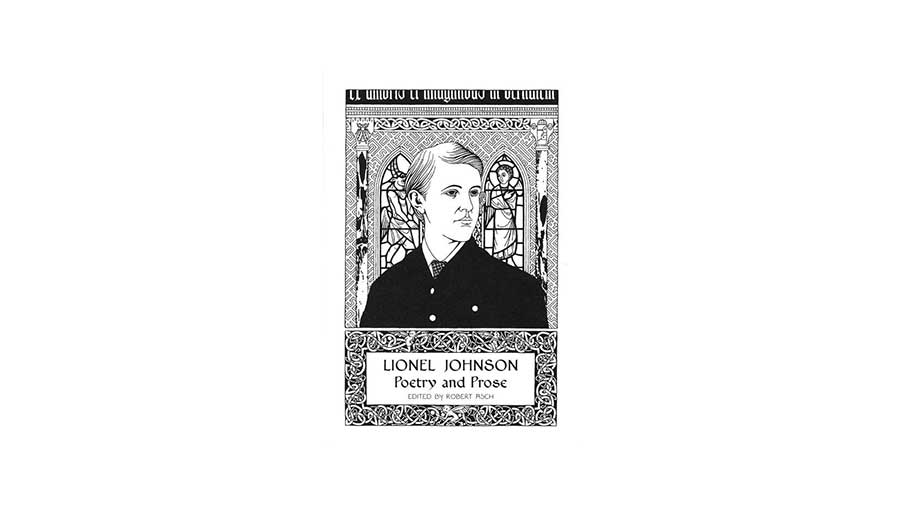
Lionel Johnson: Poetry and Prose edited by Robert Asch

If Lionel Johnson is remembered today, it is likely to be in a footnote to Yeats, or Wilde, or even T. S. Eliot. He was highly valued by all of them, both as poet and critic. But the shadow of fin de siècle morbidity hangs over him, as over other writers of the 1890s, whose sense of an ending, full of sin and death, was soon left behind by the imaginative energy of the new century. The ebullience of the Edwardians, and the youthful pastoral of the Georgians before the deluge, even the ever avant-garde appeal of the Modernists, all provide a more vigorous appeal to sensibility than the palely loitering Decadents, doomed since to haunt a recondite and submerged period of English letters.

Johnson has lived on, to some extent, in collections (e.g., Yeats’s Oxford Modern Poetry, Palgrave, and the Wain Oxford anthologies), where “The Dark Angel” typically gives a flavor of both poet and period. But since the attention paid to him by Eliot (and also by Pound), he has largely faded from view, like The Yellow Book, absinthe, and artificial flowers. Robert Asch, however, has now restored Johnson to his rightful place of significance, and in superb fashion.

Sustained by Art & Religion

A comprehensive overview of Lionel Johnson’s life and work is given in Asch’s accomplished and substantial introductory essay. Johnson spent his formative years at Winchester College, and then New College, Oxford, both foundations of the medieval English bishop William of Wykeham. Familiarity with the Greek and Latin classics, and those of late antiquity, was early imbued in him, along with the beginnings of what quickly became a deep scholarship. It was in this rarefied world, compounded by the afflictions of insomnia, alcoholism, and homosexuality, that Johnson seems early to have acquired the habit of distance from life and a preoccupation with death. Art and religion were both to sustain him, until a fall from a barstool hastened his end at the age of thirty-five.

After Oxford, he lived alone in various sets of rooms in the London Inns of Court or Chancery, maintaining a pattern of existence, and even similar residential circumstances, to the one he began at Winchester, aged thirteen. His shortness of stature and slight, pale features suggested one who had not developed beyond adolescence, but his learning was profound, always beyond his years. His productivity as a poet and critic, published in a number of leading journals, was, between about 1888 and 1894, prolific. The poems, in particular, arose from a mind stimulated by narratives of time and place, both seen through the lens of the past, and dreams and visions came to him at night, through an intense subjectivity.

The claims of intense subjective experience, a keynote of the Decadent movement, were affirmed in its adherents by Walter Pater in his book The Renaissance and in the famous imperative to “burn always with this hard, gem-like flame.” However, as Asch persuasively argues, “No recollection of the fin de siècle is complete without Lionel Johnson—but he was not, by any deliberate intellectual, moral, aesthetic, or spiritual conviction, a Decadent.” The Oxford influence of Pater is certainly present in Johnson, but rather the subsequent, overlooked Pater, whose aesthetic subjectivism had been transformed by another Oxfordian. John Henry Newman’s Grammar of Assent is at work in Marius the Epicurean, and Pater’s early paganism was to give way to a sceptical mysticism of Anglo-Catholic character.

At Oxford, Johnson had also come to know Oscar Wilde, Lord Alfred Douglas, Robbie Ross, and Ernest Dowson, with all their attendant religion of art for art’s sake. But it was Newman’s influence that was to be the definitive one: “Newman brought three gifts of understanding which few others could give: he was the oracle of conscience and the reality of sin; he proclaimed and reclaimed Patristics; and he formulated the theory of the illative sense.”

Catholic & Cavalier Poet

Johnson’s conversion to Catholicism, in 1891, came at the peak of his literary output. As Asch shows, Johnson was one of the most significant English Christian poets since the seventeenth century: “Of the two-hundred and thirty-odd surviving poems in the Johnson corpus, some 36% involve strong Christian or Catholic themes.” His style is learned and austere, his form both lapidary and exquisite. Very interesting, given the intensity of his interior experience, is the

frequency of second-person pronouns. . . . These are by far the most used words and vastly outnumber his use of first or third person pronouns, in contradistinction to poets he is often compared with, like Francis Thompson or Ernest Dowson. This poetry of encounter—of I-Thou—is consonant with the heteronomy implicit in the order of his poetry and thought.


André Gushurst-Moore is a graduate of Oxford University and a former Senior Fellow of the Russell Kirk Center for Cultural Renewal. Currently, he is Second Master at Worth School in Sussex, UK. His work has appeared in a number of periodicals in the UK and the US, and he is the author of two books: The Common Mind: Politics, Society and Christian Humanism, from Thomas More to Russell Kirk (Angelico Press, 2013) and Glory in All Things: St Benedict and Catholic Education Today (Angelico Press, 2020).

A Journal of Mere Christianity—Delivered to Your Door

  • Essays on theology, culture, and the Church
  • Contributors from across the Christian traditions

Subscribe (Print + Online)

Six print issues (one year) of Touchstone, plus full online access and PDF downloads for only $39.95.

Subscribe (Online Only)

Get a one-year full-access subscription to the Touchstone online archives for only $19.95.


bulk subscriptions

Order Touchstone subscriptions in bulk and save $10 per sub! Each subscription includes 6 issues of Touchstone plus full online access to touchstonemag.com—including archives, videos, and pdf downloads of recent issues for only $29.95 each! Great for churches or study groups.

Transactions will be processed on a secure server.


more on poetry from the online archives
37.5—Sept/Oct 2024

Young Folly & Elder Hope

A Battle Plan for Peace While Growing Old by Anthony Esolen


more from the online archives

31.2—March/April 2018

Reason Takes Up Arms

How Best to Face the Total War of the Anti-Culture by R. J. Snell

24.2—March/April 2011

Our Numbered Days

Certain Death & the Last Lectures of Socrates & Jesus by Randall B. Smith

19.4—May 2006

The Relatively Good Book

on the Liberal Protestant Bible Translation by B. J. Hutto

calling all readers

Please Donate

"There are magazines worth reading but few worth saving . . . Touchstone is just such a magazine."
—Alice von Hildebrand

"Here we do not concede one square millimeter of territory to falsehood, folly, contemporary sentimentality, or fashion. We speak the truth, and let God be our judge. . . . Touchstone is the one committedly Christian conservative journal."
—Anthony Esolen, Touchstone senior editor

Support Touchstone

00