




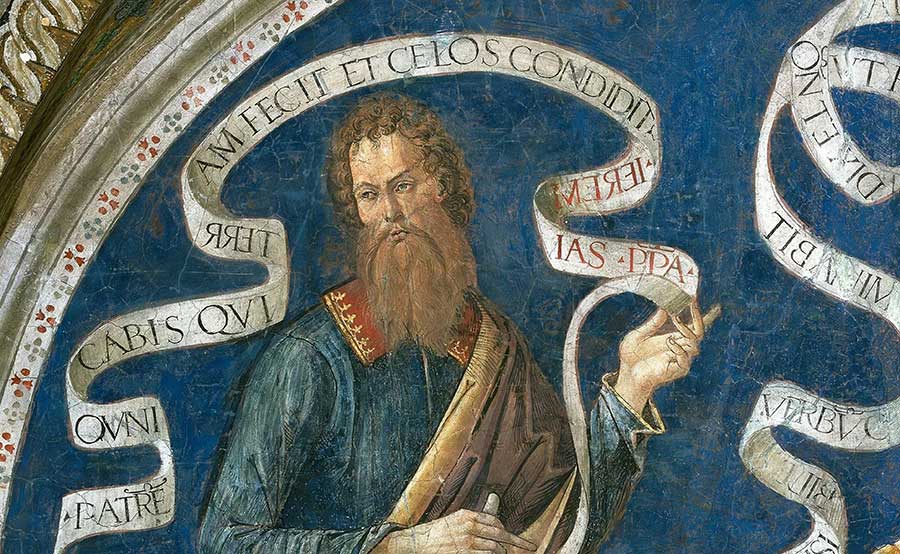
Of Sages & Prophets
The Grammar of Wisdom & the Rhetoric of Prophecy
The relationship of the passage of time to the flow of human speech is so obvious, perhaps, that we seldom think of it. In general, we do not speak in disjointed sounds. What we say has, in varying degrees, the quality of sequence. We link our words together in a certain order. That is to say, our normal speech courses its way through a sequence of time, each syllable falling into its place in the line.
Speech is also related to time in a more formal way through our verbs, especially in the past tenses of those verbs. After all, most things, when we talk about them, have already happened.
I say, “past tenses” because our sundry languages provide very different ways to speak of the past. In English we distinguish among past tense, perfect tense, pluperfect tense, and imperfect tense. In addition, there is the aorist tense in Greek and (they tell me) Sanskrit. These different ways of expressing the past give shape to what George Steiner called “geographies of remembrance.”
Because they refer to the past, it is obvious that these tenses are our only ways of thinking historically. Again, I believe George Steiner put it best: “It is the past tenses, in their bewildering variousness, which constitute history.” Anytime we speak of the past, we are engaged in “history.”
I offer these comments because of their application to the study of Holy Scripture. The entire idea of the Bible is historical; it is a long structural narrative, running from the Creation of the world to the founding of the Church. Salvation history is not simply an aspect or theme of the Bible. Book by book, it is the Bible’s foundational substance. With respect to either matter or form, not one word of God’s revelation can be separated from history.
In the following reflections, I have in mind to consider a few ways in which biblical language is related to biblical history. I propose to begin with simple ideas about grammar and finish with certain patterns of biblical rhetoric.
The Past Tense & a Tense Future
It seems reasonable to begin on the Bible’s opening page, with God’s first recorded words to the human race. We observe that this newly created man understands what God is saying. Indeed, language is already present in the world before man’s existence. The precedence of language is implied from the start. In the Bible, a first quality of language is its prior—even parental—authority over the human mind. Before he is anything else, wrote Karl Rahner, man is aHörer des Wortes, “a hearer of the word.”
We observe, as well, that when the Lord began to speak to man, he first used the imperative mode. Man, in his relationship to the Almighty, is first summoned to the obedience of faith. The imperative mode, as its primary grammatical structure, is surely the most appropriate to that relationship. Thus the Creator, inaugurating human existence within a moral universe, first delivers a series of five apodictic imperatives: “Be fruitful . . . multiply . . . replenish . . . subdue . . . have dominion.” Speech begins with the assertion of authority.
The other aspects of language—its need to predicate, for instance, its ability to question, and its capacity for hypothesis—all these become evident in due course, and they will be the wellsprings of literature and science, but above all, of history, for history is inseparable from syntax. From the moment God addressed man’s conscience, history was espoused to grammar; the twain were joined together as one flesh.
Then, continuing in this original message to man in Genesis 1, the Creator shifted from the imperative mode in order to introduce him to the past tense: “Behold, I have given (natatti) you every herb bearing seed. . . .” In these few words, man received his initial and seminal experience of historical narrative.
In the following chapter of Genesis—God’s second word to man—the language becomes more complex; the Almighty now has recourse to the future tense: “But of the tree of the knowledge of good and evil, thou shalt not eat (lo’ to’kal) of it: for in the day that thou eatest (beyom ’akalka) thereof, thou shalt surely die (tamouth).”
References to the future, however, are understandably fertile with possibilities, and close observation shows that, in this single verse, the future tense is used three different ways: First, as a more acute form of imperative (“Thou shalt not”); second, as a hypothesis (“in the day that thou eatest”); third, as a cautionary prophecy (“thou shalt surely die”). In short, a capacity for many-ness is found even in the single tense of a verb.
The future tense will become, in the course of biblical history, the idiom favored by the prophets. Amos and Ezekiel will be the masters of the hypothetical and the cautionary. In the form of prophecy, grammar endeavors to give structure and significance to the future.
Already in Genesis, however, we discern history’s relationship to speech. The innate extension of language to include both the past and the future is what makes history itself possible. The historical quality characteristic of human existence comes from God’s addressing man in sundry modes and in various tenses.
Times & Manners
Few lines in the King James Bible, I believe, are as elegant as the opening words of the Epistle to the Hebrews: “God, who at sundry times and in divers manners spake in time past unto the fathers by the prophets, hath in these last days spoken unto us by his Son. . . .” This anonymous book, which modestly describes itself as a “word of exhortation” (logos tes parakleseos—13:22), thus relates the patterns of biblical speech (“divers manners”) to the particulars of biblical history (“sundry times”).
Alas, nonetheless, “at sundry times and in divers manners,” for all its elegance, does not really cover the full force of the underlying Greek: polymeros kai polytropos. That is to say, the KJV does not adequately account for the prefix poly, meaning “many,”in each of these adverbs. This is not incidental; the fact of many-ness in God’s revelation, in both history and rhetoric, is essential to the author’s point.
Some earlier translations, I believe, more accurately convey the full sense of the Greek expression. Among these, perhaps the most felicitous are the Vulgate (multifariam multisque modis) and Luther’s version (manchmal und mancherleiweise).
Although I am unable to match the elevated rhetoric of the KJV, perhaps something along the lines of “many times and in myriad ways” better represents the full measure of the Greek expression.
However they are translated, it is important to observe that these two Greek adverbs, each with the identical prefix, hang together in such a way as to interpret one another. God spoke in many different ways because he spoke through many different people, people who lived in many different circumstances at specific points in history.
Two Rhetorical Styles
To illustrate this thesis, it is instructive to consider the significant differences between two rhetorical styles, that of the biblical prophet and that of the biblical sage. Without exaggerating this distinction—because in principle both callings may be found in a single person—it is profitable to examine some of the ways in which the prophet and the sage are dissimilar.
A first difference, and of great importance, has to do with how these two biblical types, the prophet and the sage, handle time and the events that take place within time.
Generally speaking, the prophet must deal with time on the move—as it approaches, so to speak. There is a pronounced tone of immediacy in the prophetic voice. The prophet’s words are burdened with the moral imperative of the instant, the kairos, the point where a decision is required. Events are taking place, or at least about to take place, which require the prophet to proclaim God’s understanding of what is happening and what is about to occur. The mind of the prophet is seized and preoccupied by the dynamisms of the active moment.
In the case of the sage, on the other hand, this is not necessarily so. The wisdom writer, the sage, is not necessarily caught up in time as it passes; on the contrary, he more often has a greater inner freedom to reflect on time, and to think about time that has elapsed and to ponder things that have already come to pass. For this reason, one does not expect to find in wisdom literature the pressing energy and sense of immediacy that are normal in the prophetic books. Although the sage may counsel some moral decision, it is not customary for him to demand it with the urgency of the prophet.
Let us compare, for instance, two biblical passages, in each of which a servant of God is carrying a heavy burden. Both men are deeply troubled and perplexed. But the two texts are very different from one another because of each speaker’s different relationship to time. The first man says:
Then I said, “I will not make mention of Him,
Nor speak anymore in His name.”
But His word was in my heart (belibbi) like a burning fire
Shut up in my bones;
I was weary of holding it back,
And I could not. (Jer. 20:9)
The second man declares:
I set my heart (w’et—libbi) to seek and search out by wisdom concerning all that is done under heaven; this burdensome task God has given to the sons of man, by which they may be exercised. I have seen all the works that are done under the sun; and indeed, all is vanity and grasping for the wind. (Eccl. 1:13–14)
Both speakers strive for understanding, each man addressing the testimony of his heart (leb). Both these complex writers are inwardly struggling; both are suffering—but so differently. Jeremiah, especially at the death of Josiah in 609 b.c., stares at the rushing, ominous, and very bleak future as it moves toward Jerusalem in the steady march of the Babylonian army. Not so Ecclesiastes, who ponders over history as a whole and concludes that all activity “under the sun” is just a “vanity of vanities.” The first man, a prophet, suffers from anxiety; the second man, a sage, is afflicted with ennui and frustration.
I cite another and more complex example. For this illustration, let us go to sixth-century Jerusalem and the construction of the second temple. When Israel’s exiles returned from Babylon in 538 b.c., they carried an official decree, issued by Cyrus himself, that their ancient temple should be rebuilt. Indeed, the materials necessary for that rebuilding were quickly procured.
For various reasons, nonetheless, chiefly opposition from local folks inimical to the returning exiles, the reconstruction was delayed until 520. Five years were required to finish it, and the temple was at last completed on March 12, 515.
Now it happens that that recorded delay receives two different—almost opposite— interpretations in Holy Scripture, one in the Book of Ezra and the other in two prophetic books: Haggai and Zechariah.
With respect to the building of the second temple, the claims of God are absolute; with respect to the pressing of those claims, nonetheless, we observe two quite different approaches.
We may start with the prophets, the two men alive and active in 520, the very men whose oracles inspired the project. The preoccupation of Haggai and Zechariah was immediate, determined, and of a compelling moral impulse. Those two prophets blamed the prolonged delay in the construction on a lack of resolve on the part of the returning exiles, whom they accused of losing their vision.
Instead of building God’s house, the returning Israelites had spent nearly two decades building their own houses. The people were reprimanded, therefore, for failing to seek first the kingdom of heaven. Thus, Haggai and Zechariah took charge of the “moment” and required the proper moral resolve from their countrymen; they demanded of the people a decision. This is what prophets do.
When we turn to the Book of Ezra, on the other hand, the outlook is significantly, even dramatically, different. In the passage that deals with this matter, we find the approach of the sage, the man of cultivated pondering, who considers the same history from a larger and more reflective angle. Writing some years after the crisis, he can indulge a perspective not burdened with an immediate moral concern.
Consequently, unlike Haggai and Zechariah, the author of Ezra utters not a word of reproach for the failure of the returning exiles about the delay in the temple’s reconstruction. He endeavors, rather, to examine that postponement from the more ample perspective of divine providence. To this author it was clear that the new temple had been built exactly when God wanted it built; and, ironically, it was built precisely when the two prophets insisted that the work should be done.
This sage reflected that the building of the second temple was, after all, required by a decree of Cyrus. Cyrus had spoken, but no temple should be built simply because a king says so. David, after all, had wanted to build a temple, but its construction had to wait until God said so. No more could the building of the second temple be just the execution of a decree of Cyrus than the building of the first temple was simply a project mandated by David. (It was further significant that each of these kings died before the construction was even begun.)
Now if David himself was not permitted to construct the Lord’s house, just what gives such authority to a Persian king? Truly, who among kings is authorized to build a house for the Lord? The Lord will see to the building of his own house at such time as he sees fit! The Book of Ezra, therefore, is not bothered by the delay in the construction of the temple. The author considers that event in a larger, more comprehensive history. He is not a prophet but a sage.
Two Styles of Wisdom
A second difference between the prophet and the sage may be described as one of intensity. Like the Torah itself, the word of the prophet almost always carries an apodictic tone. Perhaps the story of Elijah and the prophets of Baal most plainly illustrates this tone. We all know the story; there seems no need to rehearse all the details.
In the King James Version, the prophet challenges the attendant Israelites, “How long halt ye between two opinions? If the Lord be God, follow him: but if Baal, then follow him.” The Hebrew text is more colorful, with a nice play of sounds: posechim ‘al shetei hasse‘pim. The root pasach means to limp. The sense of the question is, “How long do you go limping on two crutches?” (1 Kings 18:21).
The Israelites, Elijah says, are limping on both feet. And they are limping on both feet because they want to have it both ways. They will limp forever, unless they make a choice. Indeed, Elijah will soon give them a little pyrotechnic display to suggest the right choice. Here are the options, he says: “The Lord or Baal.” There is no neutral ground. In this proclamation of Elijah we recognize the echo of the Decalogue: “The Lord thy God am I (Adonai Eloheka anoki). . . . There shall be for you no other gods in my stead.”
In the literature of the Bible’s wisdom tradition, however, a sense of the immediate and apodictic is not nearly so intense. It is in large measure replaced by what I may describe as a more persuasive and pedagogical tone. Thus, the Book of Proverbs warns the young man to be diligent, prudent, chaste, and hard-working. Otherwise, he will starve to death and bring disgrace on his family. Consequently, the conscientious father is encouraged to apply the rod to the backside of his errant son. He applies a rod, however; he does not call down fire and brimstone. The absolute moral imperative is replaced, or at least softened, by recourse to moral persuasion.
A Preference for Discussion
One of the important features of this second kind of rhetoric is a greater openness to unhurried reflection and sometimes even to differences of perspective. In prophetic rhetoric we never anticipate alternate points of view. We do not, for instance, expect the Prophet Elijah to say, “Well, on the other hand . . .” We would be very surprised to hear the Prophet Amos declare, “It really all depends on how you look at it.”
But occasional shifts of perspective are exactly what we find among the Bible’s sages. For instance, here are two sequential directions in the Book of Proverbs: “Answer not a fool according to his folly, lest thou also be like unto him. Answer a fool according to his folly, lest he be wise in his own conceit” (Prov. 26:4–5). That is to say, there is room for discretion. Sometimes a fool should not be answered; sometimes he should. The wise man will discern the right approach.
This capacity to observe the moral world from more than one direction is perhaps most characteristic of Ecclesiastes, or Qoheleth. Readers of this book have long despaired of reducing the message of this work to a single, unified, and consistent moral structure. On the contrary, there are loose ends lying around on every page. The author seems forever to be arguing with himself. Moreover, there is something distinctly subversive about this author; although he writes in the traditional form of the mashal, or “proverb,” he is reluctant to settle on a single, solid perspective.
Ecclesiastes is often overwhelmed by the inconsistent and cyclical structure of human experience, the cruel shortness of life, and the overshadowing urgency of death. Ecclesiastes is probably the least apodictic book in the Bible.
A Larger Audience
This second rhetorical style, which I have described as persuasive and pedagogical, relies less on the Bible’s great structural theological themes, such as the Torah, the Covenant, the People of God, and the history of Salvation.
In the Bible’s varied wisdom tradition, non-Israelite sources and connections were present from the beginning. There was always an international flavor in Israel’s explicit cultivation of wisdom. Of Moses himself, St. Stephen declared that he “was educated in all the wisdom of the Egyptians” (epaideuthe . . . pase sophia Aigyption—Acts 7:22). Moses was already a sage before he was called as a prophet.
And what shall we say of Solomon, the Bible’s traditional king/philosopher? The Bible takes care to set the wisdom of Israel’s third king on an international stage: “And Solomon’s wisdom excelled the wisdom of all the children of the east country, and all the wisdom of Egypt” (1 Kings 4:30).
In other words, Israel’s attention to the pursuit of wisdom is placed in the sweeping context of the whole Fertile Crescent. Remnants of this vast context, much older than Israel itself, are still preserved in Akkadian and ancient Egyptian texts. Moreover, the biblical Book of Proverbs explicitly includes collections of wisdom sayings from non-Hebrew sources.
In addition, historians of the relevant literature have long recognized the scores of parallels between these older sources and the didactic material of the Bible. These points of contact demonstrate Israel’s sense of taking part in a large international conversation about life and practical ethics, chiefly in the forms of proverbs and stories.
It would be tedious to supply a long list of these. I hope a single proverb will suffice by way of illustration. It comes from the Book of Tobit. The fourth chapter of this book, modeled on the style of the Book of Proverbs, contains the exhortation that the elder Tobit gives to his son. It consists of a traditional list of meshalim, or proverbs.
The one to which I call attention is composed of only four words, nine syllables, and examples of both assonance and alliteration: ho míseis, médeni poiéses. Which means, “What you hate, do to no one” (Tobit 4:15). The moral appeal of this injunction stands alone; it carries its own authority. It is nearly impossible to challenge. It is the absolute gold standard of moral wisdom. Indeed, until recently, everyone called it the “Golden Rule.”
This proverb seems substantially identical to the command in Leviticus (Lev. 19:18; cf. Matt. 5:43; 19:19; 22:39; Mark 12:31; Luke 6:27,31; Rom. 12:17–19; Gal. 5:14; James 2:8), “Thou shalt love thy neighbor as thyself.”
Tobit’s maxim is very different in structure and force, however. The Mosaic ordinance, “Thou shalt love thy neighbor as thyself,” is the standard apodictic of the Torah, which commonly uses the future tense instead of the simple imperative. It expresses the inexorable and unquestionable divine authority.
Tobit’s mashal, however, makes no such claim. It is a maxim of a wisdom taken to be obvious; its authority is conveyed in simple terms; its persuasive force relies, in heavy measure, on the integrity and the rhetorical structure of its sound.
The substance of Tobit’s proverb, when he gave it to his son, already bore the quality of a recognized ethical premise. Sometime around the year 516 b.c., according to Herodotus, Maeandrius promised the citizens of Samos, “I will not do the things I would rebuke in a neighbor.” Like Tobit, Maeandrius makes this declaration with a memorable rhetorical flourish: ta epiplésso . . . ou poiéso (Herodotus 3.142). Both men appeal to a kind of self-evident universal justice reflected in a . . . well, mot juste.
Various forms of this Golden Rule are found everywhere in the long moral tradition to which we are the heirs. And even further away. At about the very time Maeandrius addressed the citizens of Samos, Confucius was instructing the people of China, “Do not impose on others what you do not wish for yourself.” At the same time, Zoroaster was instructing the Persians, “That character is best that doesn’t do to another what isn’t good for itself.”
The substance of the Golden Rule is best known, of course, from the Sermon on the Mount: “Therefore all things whatsoever ye would that men should do to you, do ye even so to them” (Matt. 7:12; cf. Luke 6:31; Didache 1.2). Although Jesus “taught as one having authority” (Matt. 7:29), in this case he recognized much earlier authorities, declaring, “for this is the law and the prophets.”
Rhetorical & Moral Decline
Perhaps it is in connection with the Golden Rule that I should speak of the mounting moral dilemma of our times. The traditional Golden Rule is currently in very serious trouble. It has been for about a hundred years, ever since George Bernard Shaw declared, “Do not do unto others as you would that they should do unto you. Their tastes may not be the same.” If ever a standard had met the test of times and cultures, serving as a reliable and universal expression of the Natural Law, it was surely the Golden Rule. But that universal application itself was, for Shaw, the problem. No one, he believed, should be subject to an ethical preference except of his own making. Individual “taste” determined everything, and he held that view very rigidly. Indeed, as Chesterton observed, Shaw “started by saying there is no Golden Rule, and ends by asserting there must be an Iron Rule.” Try, for instance, to cope with the torment of everybody’s preferred pronouns these days. The weary soul pines away for the Plain of Shinar.
It is no surprise that the Golden Rule has been replaced by what is called the Platinum Rule, which says, “Treat other people the way they want to be treated.” It is my impression that this Platinum Rule is, at present, dominant in some of the larger and louder portions of society, especially the campus and many of the professions.
For a very long time in our Western democracies, starting with the two “Revolutions” near the end of the eighteenth century, our churches have thought it best to employ the Bible’s wisdom rhetoric in our public discourse. For example, in questions of public ethics we have normally invoked the inheritance and vocabulary of Natural Law, which has had a very long history among Christians, all the way back to the first chapter of the Epistle to the Romans.
By and large, modern Christians have employed the Bible’s prophetic rhetoric only to address specific problems, such as slavery and civil rights. Even on the question of the wholesale slaughter of babies, a subject about which the biblical prophets have left us a vast rhetorical legacy, we Christians have tended to stick with our accustomed appeal to Natural Law. In this case we call it “science,” however, because everybody wants to be on the right side of “science.”
How much longer can we rely on this style of rhetoric? I confess that I have diminishing hope for recourse to the wisdom rhetoric of the Bible in our common apologia. The editors of The New Criterion, when they began their enterprise forty years ago, remarked even then that public discourse had become “hopelessly ignorant, deliberately obscurantist, commercially compromised, or politically motivated.” Such an assessment would hardly begin to describe the garbage accumulating on the Public Square today, when it appears, once more, that “the wrath of God is revealed from heaven against all ungodliness and unrighteousness of men.” Appeals to logic, inherited wisdom, basic decency, empirical evidence, and common sense have become increasingly futile. Right now, it appears to me, much of this world is criminally insane. Although I am neither a prophet nor a sage, I do suspect that our fiery Tishbite on Mount Carmel may have the final word.
Patrick Henry Reardon is pastor emeritus of All Saints Antiochian Orthodox Church in Chicago, Illinois, and the author of numerous books, including, most recently, Out of Step with God: Orthodox Christian Reflections on the Book of Numbers (Ancient Faith Publishing, 2019).
A Journal of Mere Christianity—Delivered to Your Door
- Essays on theology, culture, and the Church
- Contributors from across the Christian traditions

Six print issues (one year) of Touchstone, plus full online access and PDF downloads for only $39.95.

Get a one-year full-access subscription to the Touchstone online archives for only $19.95.
bulk subscriptions
Order Touchstone subscriptions in bulk and save $10 per sub! Each subscription includes 6 issues of Touchstone plus full online access to touchstonemag.com—including archives, videos, and pdf downloads of recent issues for only $29.95 each! Great for churches or study groups.
Transactions will be processed on a secure server.
more on bible from the online archives

32.2—March/April 2019
on Preserving Physical & Spiritual Nourishment by Nathanael Devlin

5.3—Summer 1992
Everything You Need to Know About Morality & the Bible by David Mills
more from the online archives
32.2—March/April 2019
on Properly Rendering Things to Caesar & to God by Peter J. Leithart

31.1—January/February 2018
The Wisdom of the Victorian Quest for Innocence by David Sandifer
calling all readers
Please Donate
"There are magazines worth reading but few worth saving . . . Touchstone is just such a magazine."
—Alice von Hildebrand
"Here we do not concede one square millimeter of territory to falsehood, folly, contemporary sentimentality, or fashion. We speak the truth, and let God be our judge. . . . Touchstone is the one committedly Christian conservative journal."
—Anthony Esolen, Touchstone senior editor
