




Capturing Audiences
C. S. Lewis and the Craft of Communication by Steven Beebe
In 2002, while on sabbatical in Oxford, Steven Beebe, an internationally recognized communication educator and former president of the National Communication Association, discovered a partial and unpublished manuscript that C. S. Lewis and J. R. R. Tolkien had collaborated on, titled Language and Human Nature. Beebe dug into it, and the more he dug, the more he realized that while Lewis never referred to himself as an expert in communication, he should be considered such and that a book making such a claim was justified.
C. S. Lewis and the Craft of Communication not only positions Lewis as a master communicator but also suggests that his integration of rhetoric and poetics predates that of one of the greatest rhetoricians of the twentieth century, Kenneth Burke. Lewis once confessed to his father that he was a born rhetorician. He wrote to him as a young man saying, “I love to ride like a cork on the ocean of eloquence.” Later, Lewis would declare in The Discarded Image, “There is no antithesis, indeed no distinction, between Rhetoric and Poetry.”
How is rhetoric related to poetry? The Trivium expresses rhetoric as the application of language toward persuasion, logic as the study of correct thinking, and grammar as the mechanics of language. While poetry is an elevated study of grammar, it shares rhetoric’s attempt to apply language toward certain ends by evoking aesthetic sensibilities. Lewis’s apologetic stance occupied itself with both sense (logic) and sensibility (poetics).
HI TEA
The English custom of taking tea in the late afternoon inspired Beebe to use the acrostic “HI TEA” to express five elements Lewis saw as necessary to effective communication. Effective communicators are Holistic, Intentional, Transpositional, Evocative, and Audience-centered.
Holistic: This means communicators must convey their ideas to the whole person—to the ear as well as to the eye, to reason as well as to the imagination. As the quintessential Reasoning Romantic, Lewis believed reason was the organ of truth, while the imagination was the organ of meaning. Beebe writes, “By holistically combining reasoning and imagination at the same time, often in the same sentence, Lewis is able to augment the power of language to both inform and inspire, persuade and evoke beauty, and appeal simultaneously to the head and the heart.”
Intentional: This refers to communicators’ knowledge of what they are doing, of both what they are saying and how they are saying it. Lewis once said in an interview that writing was like a “lust” or scratching an itch. Messages come as a result of a strong impulse, and when they come, one must get them out. It is no coincidence that after his conversion Lewis became remarkably prolific and remained so for thirty years until his death in 1963.
A student once wrote Lewis asking his advice about writing and how to go about it. Lewis wrote back:
Turn off the radio. . . . Read all the books you can. . . . Write about what interests you. . . . Take great pains to be clear. . . . Remember that though you start by knowing what you mean, the reader doesn’t, and a single ill-chosen word may lead him to a total misunderstanding. . . . Don’t use a typewriter. The noise will destroy your sense of rhythm.
Transpositional: Beebe explains this principle as a “communication process of going from a higher, richer medium to a lower medium.” The principle concerns itself with using the most appropriate comparison, communicating for the “mind’s eye,” and creating well-crafted visual metaphors.
Arthur W. Hunt III is a former professor of public speaking at the University of Tennesse at Martin. He is now preparing to transition to ministry-related service and lives in the greater Memphis area.
A Journal of Mere Christianity—Delivered to Your Door
- Essays on theology, culture, and the Church
- Contributors from across the Christian traditions

Six print issues (one year) of Touchstone, plus full online access and PDF downloads for only $39.95.

Get a one-year full-access subscription to the Touchstone online archives for only $19.95.
bulk subscriptions
Order Touchstone subscriptions in bulk and save $10 per sub! Each subscription includes 6 issues of Touchstone plus full online access to touchstonemag.com—including archives, videos, and pdf downloads of recent issues for only $29.95 each! Great for churches or study groups.
Transactions will be processed on a secure server.
more from the online archives

32.4—July/August 2019
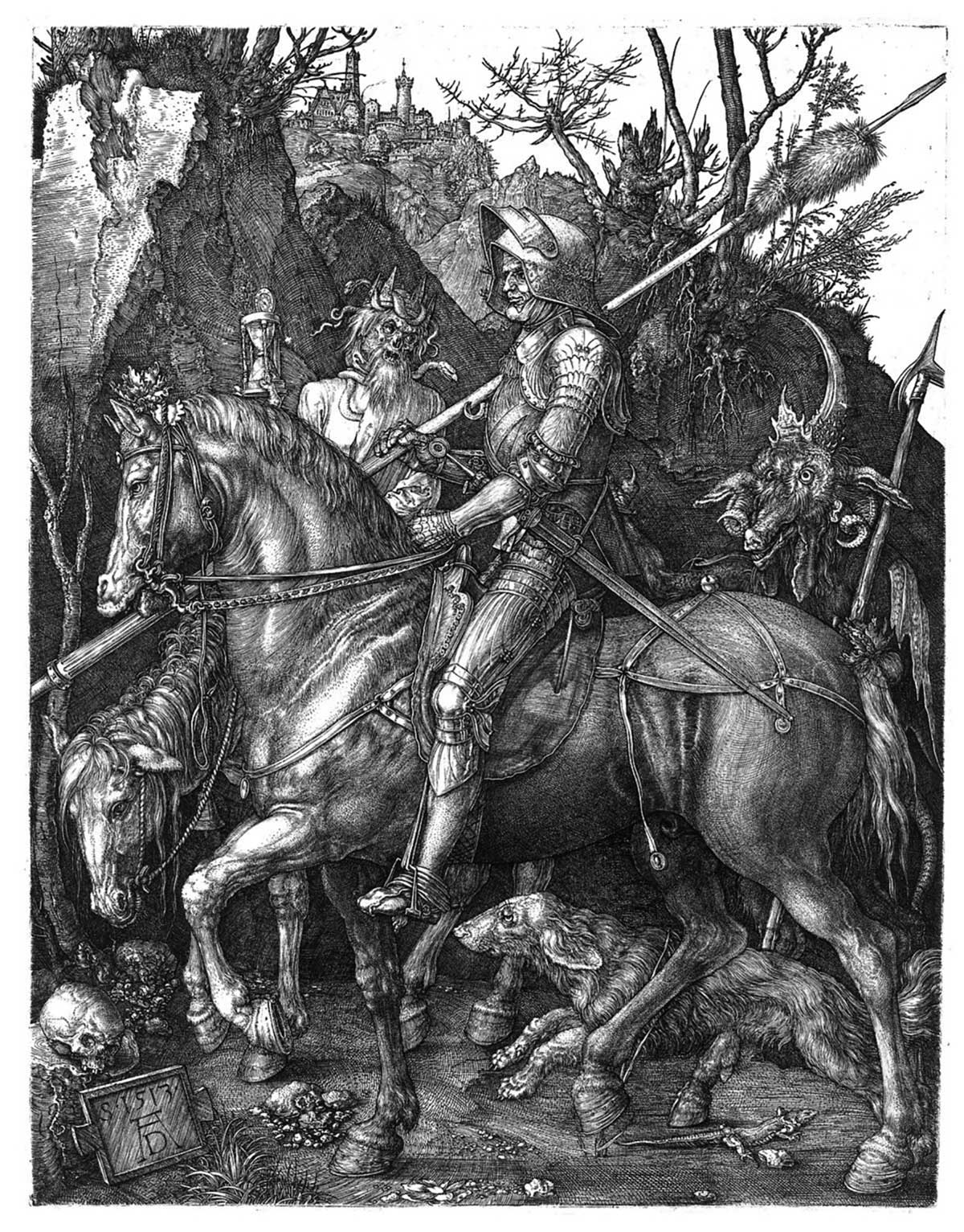
on Single-Mindedness in Durer's Ritter, Tod, und Teufel by Anthony Costello
calling all readers
Please Donate
"There are magazines worth reading but few worth saving . . . Touchstone is just such a magazine."
—Alice von Hildebrand
"Here we do not concede one square millimeter of territory to falsehood, folly, contemporary sentimentality, or fashion. We speak the truth, and let God be our judge. . . . Touchstone is the one committedly Christian conservative journal."
—Anthony Esolen, Touchstone senior editor
