





The Shores Beyond
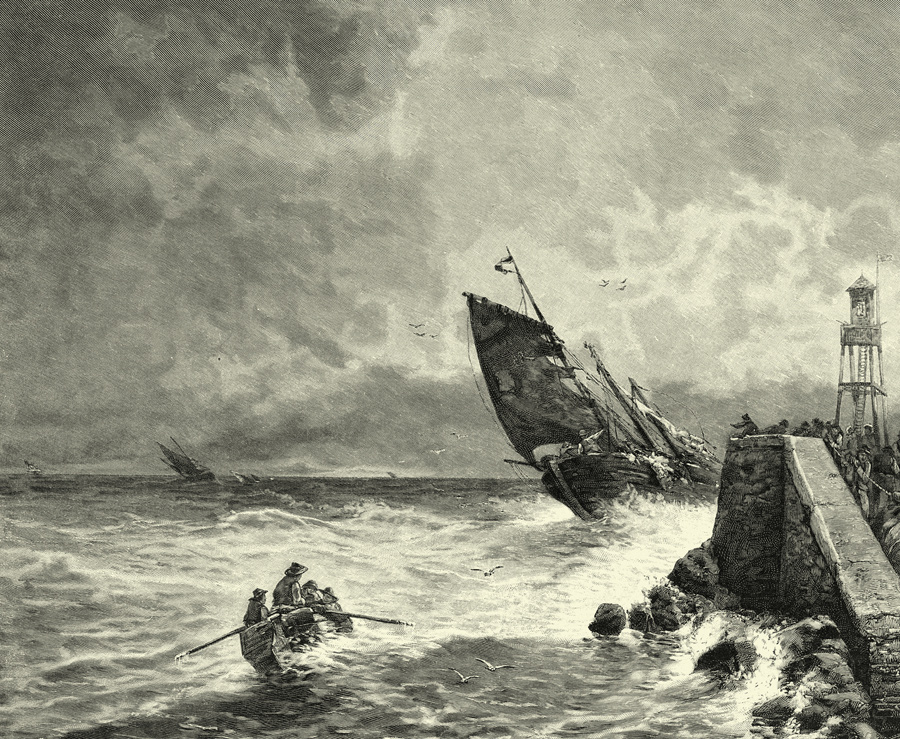
My family and I have long spent our summers on an island in Nova Scotia, home to a few fishing villages, inhabited mainly by Frenchmen and Scots, whose families have lived there for three hundred years. As late as Rudyard Kipling's novel Captains Courageous, the name of the main village, Arichat, was well known to men of the northeast who went down to the sea in ships. They risked their lives to comb the Grand Banks, in those days abundantly rich in cod and flounder; and some went whaling, to bring back the finest oil in the world for lamps and machines. It stirs something deep within me to consider that when a woman in the landlocked plains of Iowa lit her lamp at night, it was because men had gone round the Horn and braved the terrible storms and the cold, with ice sheeting the masts and sails.
Arichat still sends men out on fishing boats, and they had kept the long tradition of asking one of the Catholic priests to come to the harbor on a certain day in June, to bless the boats and their sailors. Then a pastor arrived who decided that that was too old-fashioned, and since they must eventually learn to do without a regular priest, they might as well get the idea now. He refused to bless the boats, the link was snapped, and something old and venerable and essential to the culture of the place was lost.
Yet I think we might all learn from such a custom as the blessing of ships. The metaphor is a natural one for all peoples who go forth on the water. Life is a voyage, and when it will end and where, no one knows. It is not a pleasure cruise, though the waters are often calm and the sun benign. Onward we go, "crossing the bar," as the elderly Tennyson put it, and if God is not our helmsman, expect the abyss to swallow us down.
THIS ARTICLE ONLY AVAILABLE TO SUBSCRIBERS.
FOR QUICK ACCESS:
Anthony Esolen is Distinguished Professor of Humanities at Thales College and the author of over 30 books, including Real Music: A Guide to the Timeless Hymns of the Church (Tan, with a CD), Out of the Ashes: Rebuilding American Culture (Regnery), and The Hundredfold: Songs for the Lord (Ignatius). He has also translated Dante’s Divine Comedy (Random House) and, with his wife Debra, publishes the web magazine Word and Song (anthonyesolen.substack.com). He is a senior editor of Touchstone.
A Journal of Mere Christianity—Delivered to Your Door
- Essays on theology, culture, and the Church
- Contributors from across the Christian traditions

Six print issues (one year) of Touchstone, plus full online access and PDF downloads for only $39.95.

Get a one-year full-access subscription to the Touchstone online archives for only $19.95.
bulk subscriptions
Order Touchstone subscriptions in bulk and save $10 per sub! Each subscription includes 6 issues of Touchstone plus full online access to touchstonemag.com—including archives, videos, and pdf downloads of recent issues for only $29.95 each! Great for churches or study groups.
Transactions will be processed on a secure server.
more on music from the online archives

33.3—May/June 2020
Bach's Cantata BWV 106, Gottes Zeit ist die allerbesteZeit (God's time is the very best time) by Ken Myers
more from the online archives
25.3—May/Jun 2012
Calls for Freedom, Democracy & Secularism End Up with None of the Above by Hunter Baker
calling all readers
Please Donate
"There are magazines worth reading but few worth saving . . . Touchstone is just such a magazine."
—Alice von Hildebrand
"Here we do not concede one square millimeter of territory to falsehood, folly, contemporary sentimentality, or fashion. We speak the truth, and let God be our judge. . . . Touchstone is the one committedly Christian conservative journal."
—Anthony Esolen, Touchstone senior editor
