





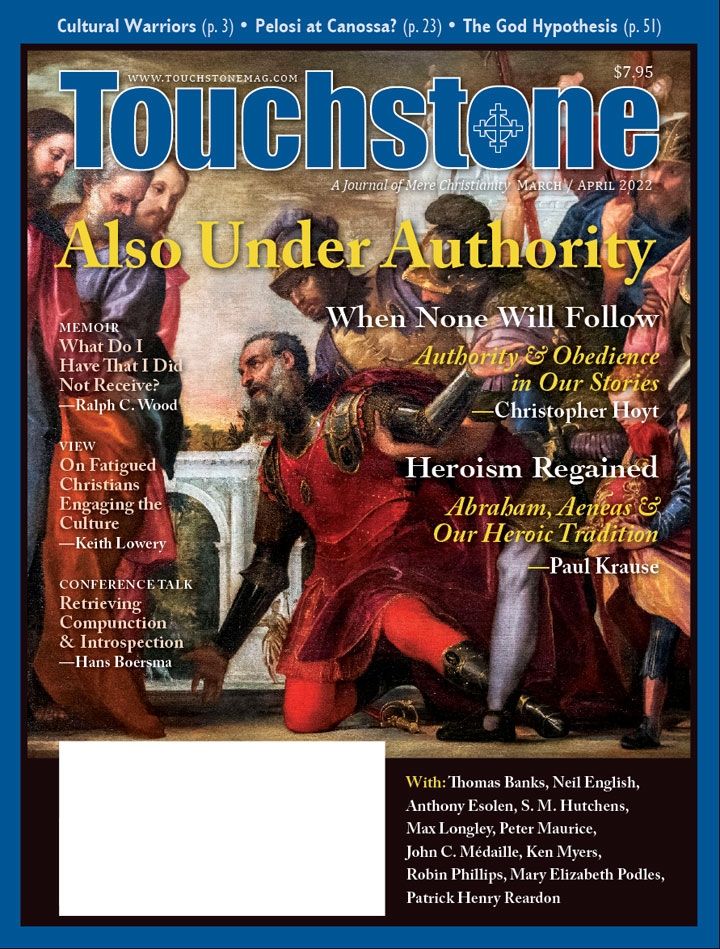
Heroism Regained
Paul Krause on Abraham, Aeneas & Our Heroic Tradition
Of the great epic poems, in the contest between Homer and Virgil, which reigns supreme? It is easy to suggest Homer. T. S. Eliot, however, knew that Virgil was much more central to the Western tradition than Homer was. It is true that Hector was one of the nine worthies of the medieval world, but it was "pious" Aeneas whom Western men should emulate; it was pious Aeneas who taught us about suffering and greatness rather than Achilles or Odysseus; and it was Virgil, not Homer, whom Dante selected as his pilgrim poet guide through hell and purgatory precisely because of the centrality of love in Aeneas's journey.
Two Pious Wanderers
The Aeneid has two central themes that lie at the heart of the Western psyche: pietas and fatum, piety and fate. Aeneas is the fated man of destiny. He is to be carried from the burning ashes of Troy across dangerous and foreign lands to save his people and build an eternal city whose walls and influence shall stretch across the world. Aeneas's mission is far more ambitious and bold than Odysseus's struggle to return home to Penelope and Telemachus. As noble as are his braving the storms of Poseidon and the temptations of Circe and Calypso, Odysseus has something to look forward to, something familiar, something to bring him happy rest upon a successful return.
By contrast, Aeneas has next to nothing. His family and household gods are carried on his back. He has no fatherland calling him home. He is venturing into the unknown by the decree of fate and in submissive obedience to the will of the gods. T. S. Eliot called the Aeneid "our classic" because of its distinctive maturity: the seed of Western literature had sprouted in Greece, but it blossomed in Virgil's pen. The call to return home is universal. The call to venture into the unknown and the duty to submit to that call are characteristically Western. Nevertheless, the call to venture forth needed Homer before it could be consummated in Virgil.
There is, however, another ancient hero with a story similar to Aeneas's who has had an even deeper impact on the Western tradition. Abraham is perfectly at home with his father in Ur Kaśdim. He has a good roof over his head and a comfortable life. His home isn't ravaged in the fires of war, yet God's calling of Abraham to journey into the desert wilderness with just his goods on his back and his flock of sheep by his side has echoes of Aeneas—for both are directed to set out into the unknown with only vague promises of establishing a home and a people that will inspire generations.
Abraham's call into the unknown to become the father of a great nation is the same as that of Aeneas. Of course, in a twist of providential irony, Abraham's seed would eventually conquer Rome just as Rome would first conquer the land of Abraham. These two stories are inextricably intertwined, and both tell of the same kind of man: a pious wanderer doing his duty to God and founding a nation.
Aeneas's Motivating Love
The rise of Athens and Greece in the Western psyche is a rather recent phenomenon. A welcome one, to be sure, but one that was previously subordinated to the Roman way and legacy. Virgil, not Homer, was taught as the American epic. Newspapers even printed translated excerpts from the Aeneid to expose the broader reading public to the great epic. Until the early twentieth century, the Aeneid was the seminal Western epic taught in school and university. The heroic adventure of its protagonist was the archetype for much of the West's heroic adventure literature; Melville's Moby-Dick, for instance, alludes to Virgil more than to Homer.
Virgil's epic has amor, or love, running through its pages. Aeneas's love for his father impels him to lift his father onto his back and carry him aboard the ships they will sail to escape the fires of Troy. Aeneas's love for his countrymen and his household gods leads him to brave the storms of Juno, who tries to shipwreck the Trojan on his providential mission. Aeneas even falls in love with Dido, the queen of Carthage, and St. Augustine tells us that, prior to his own conversion, this episode made him weep for Dido rather than for the depraved state of his soul.
Aeneas would have been happy to make a marriage and a home with Dido, but the gods had other plans. In obedience to their will, he proceeds to Sicily, whereupon Dido thrusts his blade into her heart and is burnt on a pyre of his left-behind goods. When in a vision Aeneas later sees Dido in the realm of dead, he weeps at the sight of her ghost and walks beside her—a testament of his love for her—as he tries to convince her that it was not his will that ruptured their prospective union but the decree of the gods. While Dido ignores Aeneas on account of her wounded heart, there can be no denying that Aeneas did, in fact, love her.
Paul Krause is the editor of VoegelinView and author of The Odyssey of Love: A Christian Guide to the Great Books (2021).
A Journal of Mere Christianity—Delivered to Your Door
- Essays on theology, culture, and the Church
- Contributors from across the Christian traditions

Six print issues (one year) of Touchstone, plus full online access and PDF downloads for only $39.95.

Get a one-year full-access subscription to the Touchstone online archives for only $19.95.
bulk subscriptions
Order Touchstone subscriptions in bulk and save $10 per sub! Each subscription includes 6 issues of Touchstone plus full online access to touchstonemag.com—including archives, videos, and pdf downloads of recent issues for only $29.95 each! Great for churches or study groups.
Transactions will be processed on a secure server.
more on literature from the online archives

32.2—March/April 2019
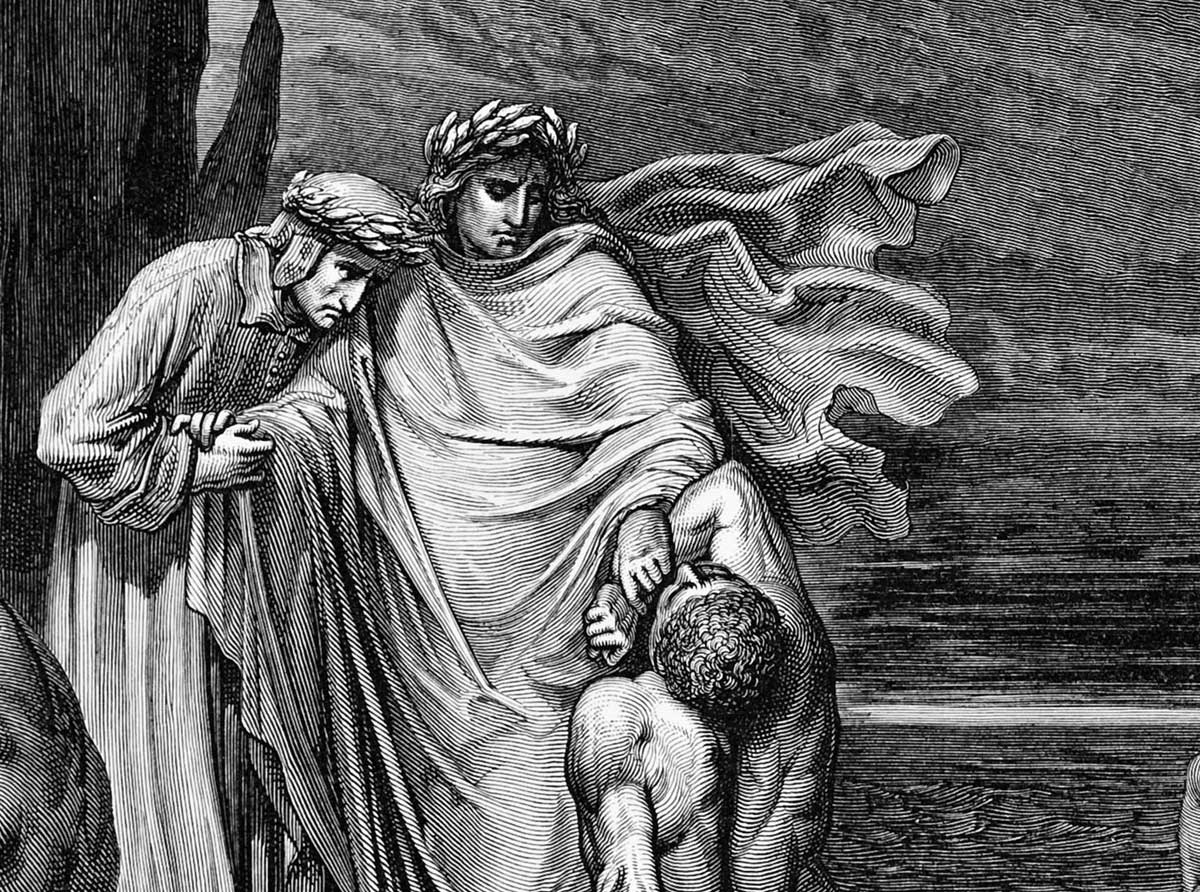
Misguided Mercy & Dante's Infernal Purgation by Joshua Hren
20.6—July/August 2007
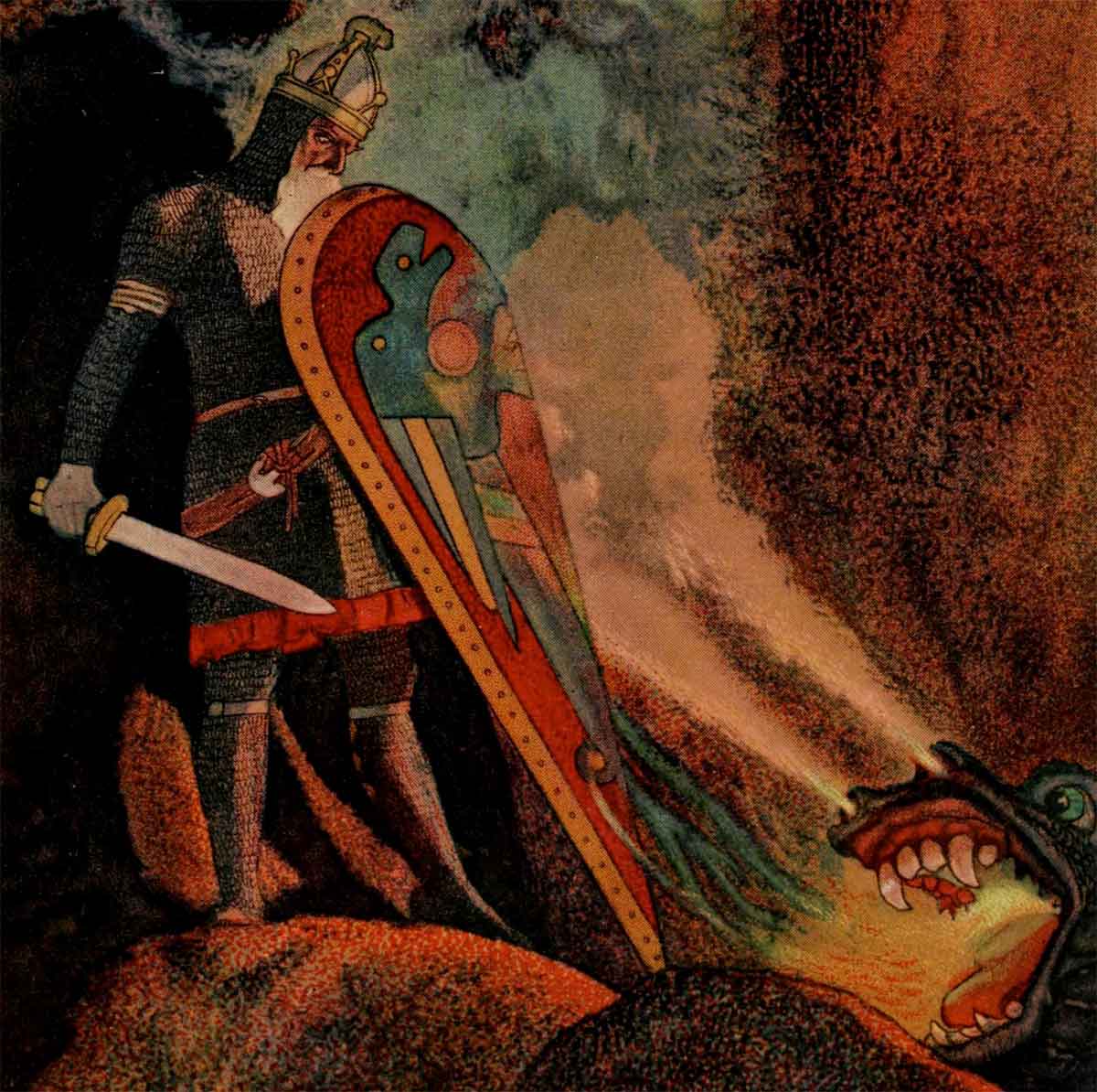
The Beowulf Poet Was a Shrewd Christian Apologist by Douglas Wilson
more from the online archives

29.5—Sept/Oct 2016
on Past & Present Atheism & the Invention of Happiness by Jordan Bissell

32.4—July/August 2019
Will Islamicization Become Its New Future by Peter Riddell
22.6—July/August 2009
on a Noble Defense Doomed by Darwinian Materialism by John G. West
calling all readers
Please Donate
"There are magazines worth reading but few worth saving . . . Touchstone is just such a magazine."
—Alice von Hildebrand
"Here we do not concede one square millimeter of territory to falsehood, folly, contemporary sentimentality, or fashion. We speak the truth, and let God be our judge. . . . Touchstone is the one committedly Christian conservative journal."
—Anthony Esolen, Touchstone senior editor
