




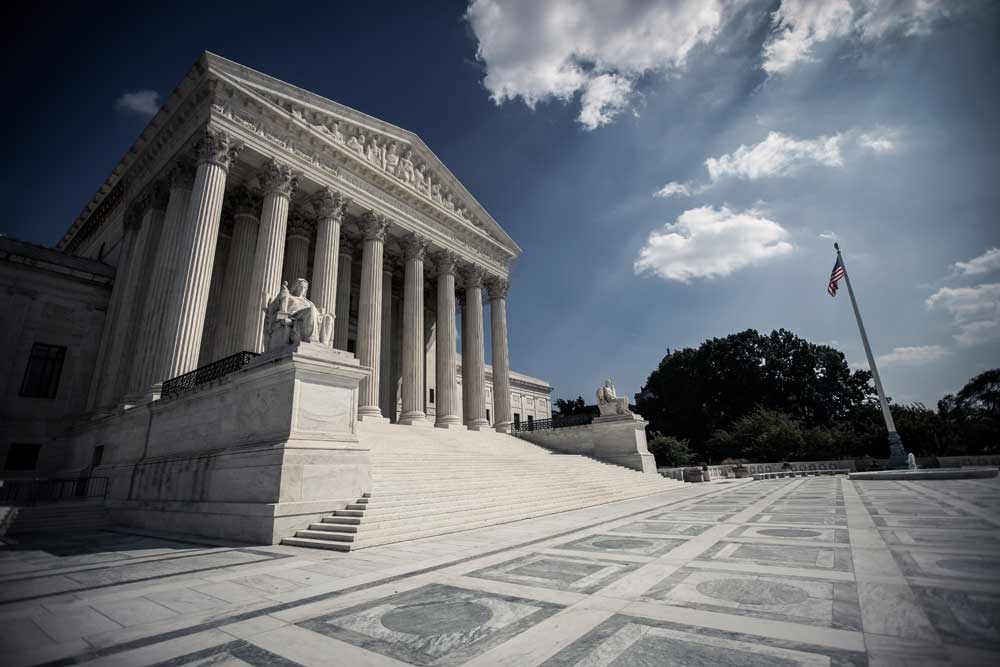
Degraded Free Exercise?
The Rise of Judicial Secularism & the Loss of Religious Freedom
The tendency to treat the First Amendment to the U.S. Constitution, guaranteeing freedom of religion, as an outmoded commodity to be tossed overboard at the first opportunity was on display in the Virginia House of Delegates on February 11, 2020, when Dr. Robert M. Grant, Jr., who happens to be black, led the assembly in an opening prayer. According to articles in the Western Journal and Virginia Mercury, the prayer went peacefully enough—until the preacher "stopped praying and went to meddling" by interjecting biblical principles into his supplication:
"I pray that you [delegates] may understand that all life is precious and worthy of a chance to be born. God is a giver of life and people have no right or authority to take life," Grant said. "The unborn has rights, and those rights need to be protected. I pray that this chamber will uphold the Virginia family. That the bills and laws being passed will always protect the biblical traditional marriage as God instructed the first man and the first woman in the Bible."
Upon hearing this, many of the Democrat delegates chastised the minister for delivering a sermon instead of a prayer and walked out of the assembly. To stop the exodus and terminate the uncomfortable homily, their caucus leader, Eileen Filler-Corn, gaveled the prayer to a premature end. Having thus squelched the offensive invocation, she then engaged in an astonishing act of hypocrisy by placing her hand over her heart and leading the remaining delegates in the pledge of allegiance.
In today's Democratic Party, this is what passes for freedom of religion, freedom of speech, and the freedom to speak truth to power—a fact that should surprise exactly no one. After all, this is the same party that exorcised all references to God from its 2012 national platform and tried to have the phrase "so help me God" omitted from all oaths taken before committees in the House of Representatives—just as President Obama omitted it during his 2013 swearing-in ceremony.
These passive and somewhat stealthy actions were designed to quietly push religion further into the shadows until 2015, when Hillary Clinton delivered the keynote speech at the Women in the World Summit. Not known for passivity or a stealthy approach to politics, Clinton elevated abortion, same-sex "marriage," and transgender "rights" over religious freedom before an adoring and sympathetic audience of world leaders, industry icons, movie stars, CEOs, activists, and others. Before such a group, she could openly and without fear of opposition declare that "deep-seated cultural codes, religious beliefs, and structural biases have to be changed." She did not specify just how she would impose and enforce such changes, but the phrase "under penalty of law" comes to mind.
Indispensable Supports
How can a national political party defend and celebrate practices that are immoral at best and barbaric at worst? How has the old immorality become the new morality, which, we are told, we must swallow whole and without rebuttal? One answer can be found in William Herberg's 1951 treatise, Judaism and Modern Man—An Interpretation of Jewish Religion. In chapter 9, "The Divine Imperative: Ethics and Religion," Herberg paints this vivid word picture:
The attempt made in recent decades by secularist thinkers to disengage the moral principles of western civilization from their scripturally based religious context, in the assurance that they could live a life of their own as "humanistic" ethics, has resulted in our "cut flower culture." Cut flowers retain their original beauty and fragrance, but only so long as they retain the vitality that they have drawn from their now-severed roots; after that is exhausted, they wither and die. So with freedom, brotherhood, justice, and personal dignity—the values that form the moral foundation of our civilization. Without the life-giving power of the faith out of which they have sprung, they possess neither meaning nor vitality. Morality ungrounded in God is indeed a house built upon sand, unable to stand up against the vagaries of impulse and the brutal pressures of power and self-interest.
Herberg is correct that our society is withered and dying, but the secularistic stem-cutting process he describes is more than a few decades old, even older than America itself. It can be traced back to the Age of Enlightenment, which began in the seventeenth century. In contrast to previous centuries, the Age of Enlightenment elevated raw human reason above all else and revolted against any external authority, including divine and moral authority. Although the American Founders grew up in this age, that view was so antithetical to the American spirit that President George Washington singled it out for criticism in his Farewell Address:
Of all the dispositions and habits which lead to political prosperity, religion and morality are indispensable supports. In vain would that man claim the tribute of patriotism, who should labor to subvert these great pillars of human happiness, these firmest props of the duties of men and citizens. The mere politician, equally with the pious man, ought to respect and to cherish them. A volume could not trace all their connections with private and public felicity. Let it simply be asked: Where is the security for property, for reputation, for life, if the sense of religious obligation desert the oaths which are the instruments of investigation in courts of justice? And let us with caution indulge the supposition that morality can be maintained without religion. Whatever may be conceded to the influence of refined education on minds of peculiar structure, reason and experience both forbid us to expect that national morality can prevail in exclusion of religious principle.
J. L. Johnson is a U.S. Navy veteran who holds a BA (magna cum laude) in Bible and Biblical Languages from Oklahoma Christian College, and has served as a pulpit minister and teacher for churches in Oklahoma, Louisiana, and Texas. He also holds an MS in Communication Disorders from the University of Texas at Dallas, and before his recent retirement, he worked as a speech-language pathologist. He has written discipline-specific articles for various publications, and has published articles of a more general nature in The American Thinker and Human Events.
A Journal of Mere Christianity—Delivered to Your Door
- Essays on theology, culture, and the Church
- Contributors from across the Christian traditions

Six print issues (one year) of Touchstone, plus full online access and PDF downloads for only $39.95.

Get a one-year full-access subscription to the Touchstone online archives for only $19.95.
bulk subscriptions
Order Touchstone subscriptions in bulk and save $10 per sub! Each subscription includes 6 issues of Touchstone plus full online access to touchstonemag.com—including archives, videos, and pdf downloads of recent issues for only $29.95 each! Great for churches or study groups.
Transactions will be processed on a secure server.
more on America from the online archives
30.5—Sept/Oct 2017
The Christian Cure for What Ails Modern Politics by David Bradshaw
29.4—July/August 2016
Russell Kirk: American Conservative by Bradley J. Birzer by Hunter Baker
29.2—March/April 2016
The History of Family Strength in America May Reveal Good News by Allan C. Carlson
more from the online archives

26.1—Jan/Feb 2013
The Alternate & Alternative Worlds of H. P. Lovecraft & C. S. Lewis by C. R. Wiley

30.3—May/June 2017
on the Misuse of Property Rights to Justify Slavery & Abortion by Robert Hart
calling all readers
Please Donate
"There are magazines worth reading but few worth saving . . . Touchstone is just such a magazine."
—Alice von Hildebrand
"Here we do not concede one square millimeter of territory to falsehood, folly, contemporary sentimentality, or fashion. We speak the truth, and let God be our judge. . . . Touchstone is the one committedly Christian conservative journal."
—Anthony Esolen, Touchstone senior editor
