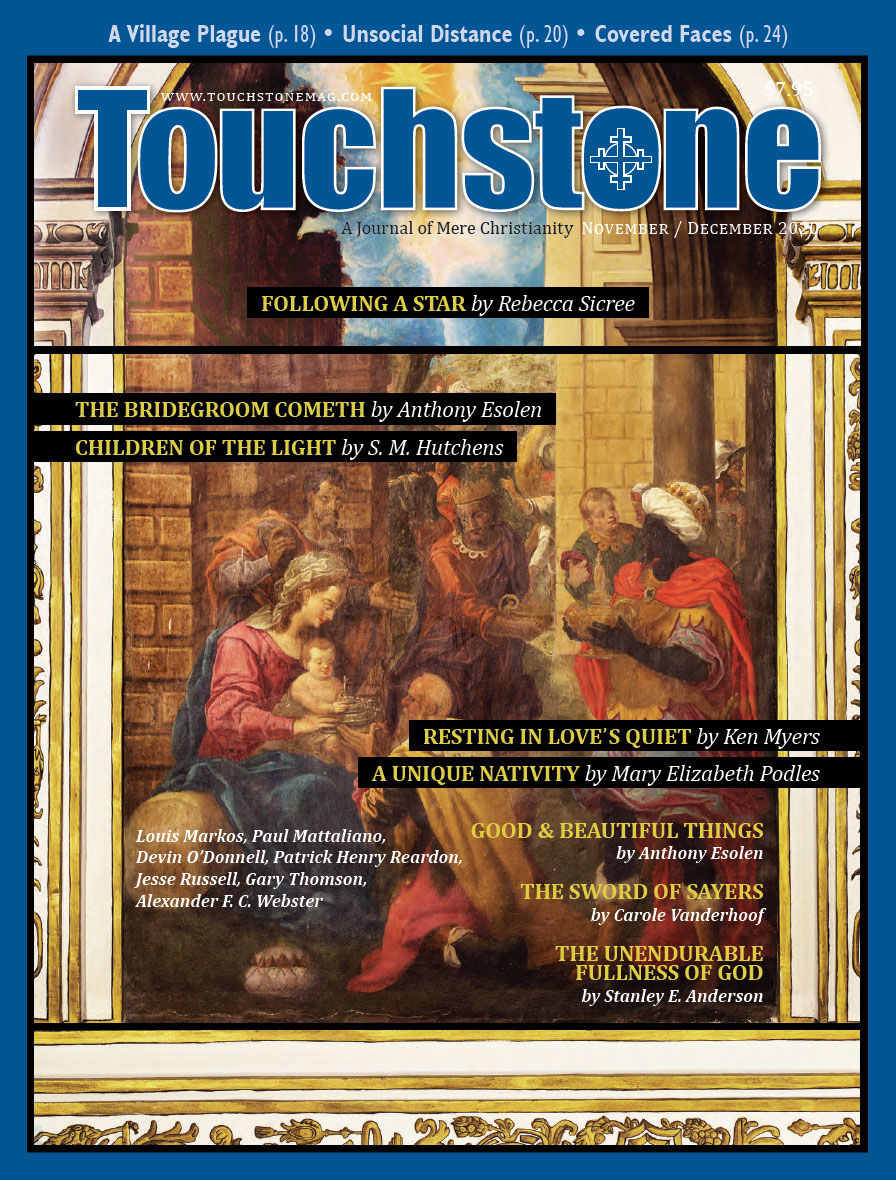
Resting in Love's Quiet Watch by Ken Myers

From Heavenly Harmony

Resting in Love's Quiet Watch

Josef Rheinberger and his Nine Advent Motets

Born in 1839 in the small city of Vaduz, the capital of Liechtenstein, Josef Rheinberger was a poster-child for musical prodigies. His father, a financial agent for the tiny principality's monarch, was not himself musically gifted. But acknowledging his son's remarkable abilities, he arranged for Josef—then only five years old—to be taught by a music teacher in Schlanders, 170 kilometers away in northern Italy. There the boy was taught music theory, piano, and organ. A second pedal board was affixed to the instrument to accommodate his short legs.

The investment paid off, as young Josef's native talent prospered. At the ripe old age of seven, he was appointed organist at the parish church in his hometown, and the next year his first composition—a three-part Mass with organ accompaniment—was used in the parish's liturgy. Having heard of this work and its eight-year-old composer, the bishop of the ancient Swiss town of Chur invited Josef's father to bring his talented son to the cathedral so the church leaders could confirm for themselves the capabilities of a potential treasure for the church's musical life.

Seated at the cathedral's organ keyboard (presumably Josef's legs were now long enough to reach the pedals without special amendments), a score for a setting of the Marian hymn Salve Regina was set in front of him, and he was told to accompany the singing by the bishop and clergy. They hadn't sung for very long before Josef stopped playing, exclaiming, "But, Herr Bishop, you continually sing out of tune." The response of the bishop was not recorded.

Josef Gabriel Rheinberger ended up studying at the Munich Conservatory during his teens; by the time he was twenty, he was on the conservatory's faculty, and in 1867, he was made a full professor, a position he kept until his death in 1901. Since then, his reputation and influence as a teacher of composition has overshadowed his output as a composer, which is not inconsiderable. Among his own works, the best known are those for organ, including twenty organ sonatas, and a number of other miscellaneous smaller pieces. He also produced two operas, two symphonies, a piano concerto, and a large body of chamber music and lieder.

Sacred Choral Works

While the organ works are the most celebrated and performed—church organists occasionally play movements from the sonatas as preludes or postludes—his catalog of sacred choral compositions deserve much more attention than they have received. Reminiscent of the choral works of Mendelssohn and Brahms, his church music includes fourteen Masses, three requiems, a number of motets, and several cantatas.

Among the motets, the most performed is a work he wrote when he was just 15, Abendlied ("Evening song"), with a text taken from St. Luke's account of the disciples who met Jesus on the road to Emmaus: "Bide with us, for evening shadows darken, and the day will soon be over." This poignant work for six-part a cappella choir displays Rheinberger's sensitive attention to (in Barbara Mohn's words) "songlike melodic lines and a well-balanced harmonic development."

A more extensive, more mature, and subtler work is his 1878 Mass in E-flat (Opus 109), dedicated to Pope Leo XIII, known as the Cantus Missae. It is Rheinberger's only Mass setting scored for eight unaccompanied vocal parts; other Masses include works for all-male or all-female voices as well as conventional four-part settings, and some larger liturgical works, such as his Stabat mater (Opus 138), include organ and or string accompaniment. Music theorist Scott Foglesong judges the Cantus Missae "a finely-crafted polyphonic Mass for antiphonally placed double choir in the late-Renaissance Flemish and Venetian spirit, albeit channeled through Mendelssohn."

About the same time he composed that Mass, he wrote a set of five Hymnen (Opus 107), dedicated to the choir at the St. Thomas Church in Leipzig, the choir that Bach employed during the composition of most of his cantatas. The fifth of these short works, Christus factus est, is based on a text from Philippians: "Christ became obedient for us unto death, even to death, death on the cross. Therefore God exalted him and has given him a name which is above all names." The first half of this brief hymn is a slow and harmonically tense evocation of Christ's suffering on the cross, reminiscent of settings by Renaissance composers. But when the text turns the corner and affirms Christ's exaltation, Rheinberger bursts into a joyous and enthusiastic fugue, the sort of conclusion the good burghers at St. Thomas had heard many times. Perhaps Rheinberger wanted to remind his fellow Catholics that Palestrina was not the only worthy model to emulate in the composition of new music for worship.

Nine Christmas Scenes


Ken Myers is the host and producer of the Mars Hill Audio Journal. Formerly an arts editor with National Public Radio, he also serves as music director at All Saints Anglican Church in Ivy, Virginia. He is a contributing editor for Touchstone.

A Journal of Mere Christianity—Delivered to Your Door

  • Essays on theology, culture, and the Church
  • Contributors from across the Christian traditions

Subscribe (Print + Online)

Six print issues (one year) of Touchstone, plus full online access and PDF downloads for only $39.95.

Subscribe (Online Only)

Get a one-year full-access subscription to the Touchstone online archives for only $19.95.


bulk subscriptions

Order Touchstone subscriptions in bulk and save $10 per sub! Each subscription includes 6 issues of Touchstone plus full online access to touchstonemag.com—including archives, videos, and pdf downloads of recent issues for only $29.95 each! Great for churches or study groups.

Transactions will be processed on a secure server.


more from the online archives
29.1—Jan/Feb 2016

Wilberforce for Good

on Marriage, Moral Corruption & the Christian Duty of Witness by Regis Nicoll

33.2—March/April 2020

Christ Chapel at Hillsdale

An Architectural Sign of Mere Christianity by Michael Ward

22.5—June 2009

A Law for All Seasons

C. S. Lewis on Civilization & the Natural Order by Timothy L. Hall

calling all readers

Please Donate

"There are magazines worth reading but few worth saving . . . Touchstone is just such a magazine."
—Alice von Hildebrand

"Here we do not concede one square millimeter of territory to falsehood, folly, contemporary sentimentality, or fashion. We speak the truth, and let God be our judge. . . . Touchstone is the one committedly Christian conservative journal."
—Anthony Esolen, Touchstone senior editor

Support Touchstone

00