




As It Is Written . . .
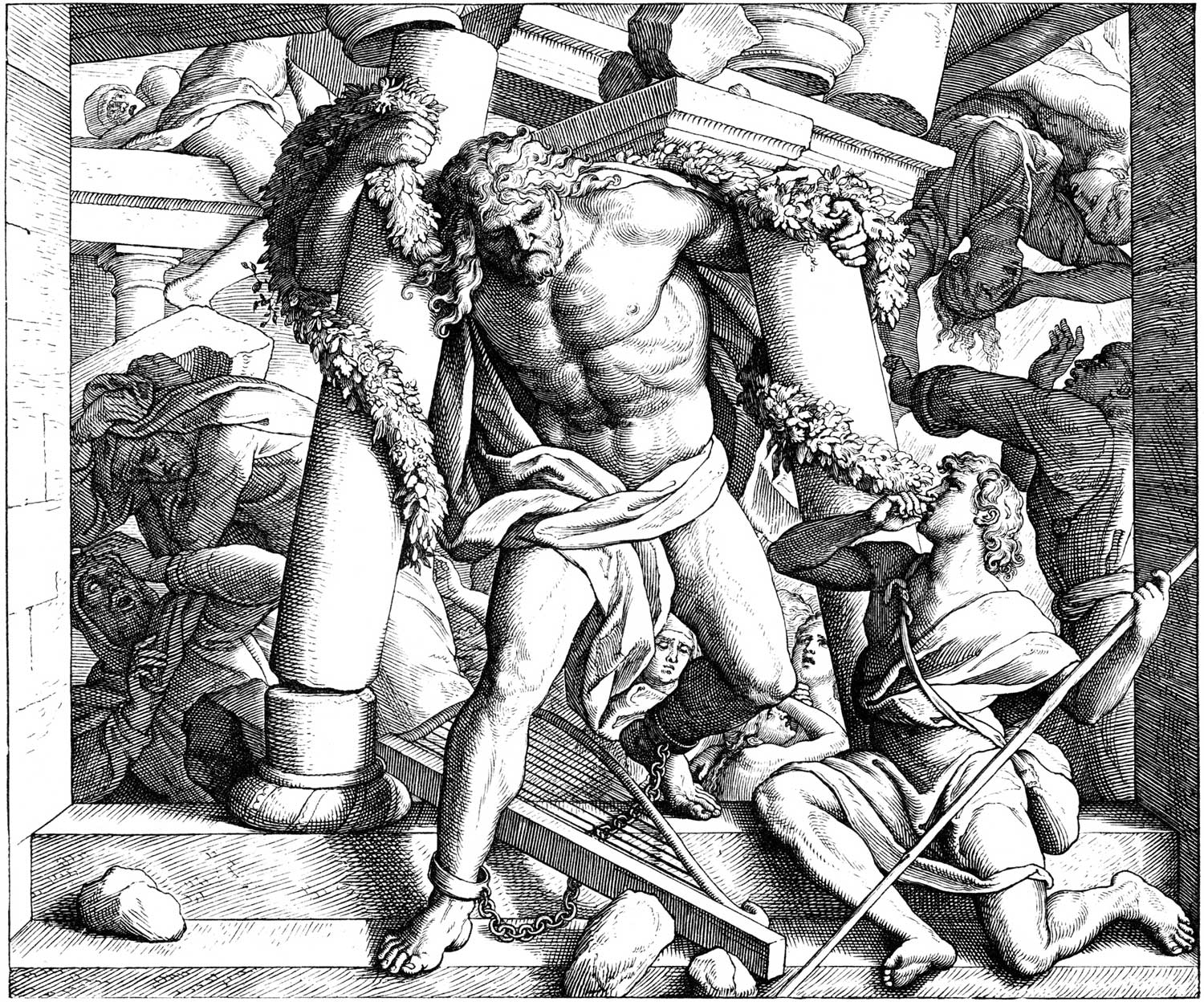
The Age of Samson
Much of biblical narrative is structured on a fourfold sequence of sin, punishment, repentance, and deliverance. We find a succinct example of this structure in Psalm 107 (LXX 106); indeed, this psalm gives four examples of this fourfold structure. In each of these situations (desert wandering, prison, sickness, and peril at sea), we learn, those who “were afflicted because of their iniquities,” “cried to the Lord in their distress,” and then “he delivered them.” The Lord “led them forth on the right way,” “brought them out of darkness,” “sent his word and healed them,” and “guided them to the haven they sought.”
The first twelve chapters of the Book of Judges provides a longer and more elaborate example of this same pattern. As each of Israel’s charismatic leaders is introduced, the reader discerns a fairly consistent historical outline: First, the Israelites are unfaithful to the covenant. Next, the Lord, by way of turning their hearts to repentance, hands them over to one-or-another of their oppressing neighbors. Then the people, tiring of the oppression, repent and cry out to God, and he, in response, raises up a new “Judge” to lead and deliver them.
This is the outline we find in the accounts of Othniel, Ehud, Deborah and Barak, Gideon, and Jephthah. In all these accounts there is a clear, coherent, and causal “logic” in the narrative structure: infidelity, punishment, repentance, deliverance.
Abrupt Change
This pattern changes abruptly, however, when we come to the history of Samson. As this story begins, there is no mention of the people’s repenting or turning to the Lord. The text says simply, “Again the children of Israel did evil in the sight of the Lord, and the Lord handed them over into the hand of the Philistines for forty years” (13:1). The people do not cry to the Lord in their distress. Nor is there the slightest suggestion that they repent.
Thus, the moral clarity and coherence of the earlier pattern breaks down, as though the Israelites, at this point in their history, no longer have the ability to turn to God. So, when God mercifully intervenes and raises up a new deliverer, he does so without a change of heart on the part of the people. Even by the end of the Samson story, there is no sign of Israel’s repentance. It is as though the people are beyond repentance. This is new; this is different.
The attitude of Samson’s father, Manoah, serves to illustrate the new problem. When the visiting angel speaks with him, Manoah immediately begins to ask questions about the child who will be born: “What will be the boy’s rule of life,” he inquires of the angel, “and his work?” (13:12). It appears to be the case that his query is inspired by a spirit of curiosity rather than of faith.
God did not dispatch this messenger, however, simply to satisfy a human curiosity; so the angel responds that he has already said all he has to say—to Manoah’s wife. Manoah is the nervous questioner, but all the needful information had already been conveyed in the first apparition. There is nothing to add. The angel simply repeats what he had said before, and this time with less detail
(13:13–14).
In short, the angel is not going to explain himself. He was sent to earth to convey a promise and a command, not to give a news flash. He was proclaiming God’s plan of redemption and man’s place in that plan. The salvific initiative is God’s. The proper response to the message is obedience, not a nosiness for more details.
A Modern Man
Manoah, that is to say, is much like the rest of the Israelites of his time. None of them have been serving God and seeking his will. And now, when God begins to reveal his plan for the people’s deliverance, the father of Samson is full of irrelevant questions. Perhaps he wants a more active role in the plan. There isn’t one. God does not really need Manoah.
Manoah’s character is a combination of audacious, inquisitive, controlling, and superstitious. Visiting angels tend to become annoyed with such men (compare Luke 1:17–20).
In some ways, Manoah seems to be something of a modern man—shallow, audacious, recklessly inquisitive, and superstitious. He exemplifies the spiritual attitude of his generation, which craves quick and easy answers to impossibly complex questions. They are a generation disposed to wear their shoes at the Burning Bush. And how does God handle such a generation? He sends a man like Samson to knock some heads together.
Patrick Henry Reardon is pastor emeritus of All Saints Antiochian Orthodox Church in Chicago, Illinois, and the author of numerous books, including, most recently, Out of Step with God: Orthodox Christian Reflections on the Book of Numbers (Ancient Faith Publishing, 2019).
A Journal of Mere Christianity—Delivered to Your Door
- Essays on theology, culture, and the Church
- Contributors from across the Christian traditions

Six print issues (one year) of Touchstone, plus full online access and PDF downloads for only $39.95.

Get a one-year full-access subscription to the Touchstone online archives for only $19.95.
bulk subscriptions
Order Touchstone subscriptions in bulk and save $10 per sub! Each subscription includes 6 issues of Touchstone plus full online access to touchstonemag.com—including archives, videos, and pdf downloads of recent issues for only $29.95 each! Great for churches or study groups.
Transactions will be processed on a secure server.
more on bible from the online archives
5.3—Summer 1992
Everything You Need to Know About Morality & the Bible by David Mills
24.3—May/June 2011
The Making & Endurance of the King James Bible, 1611-2011 by Barton Swaim
32.3—May/June 2019
on the Implications of Changing the Pater Noster by John M. McCarthy
more from the online archives
22.6—July/August 2009
on a Noble Defense Doomed by Darwinian Materialism by John G. West


30.3—May/June 2017
C. S. Lewis Assesses the Religion of Mohammed by Jacob Fareed Imam
calling all readers
Please Donate
"There are magazines worth reading but few worth saving . . . Touchstone is just such a magazine."
—Alice von Hildebrand
"Here we do not concede one square millimeter of territory to falsehood, folly, contemporary sentimentality, or fashion. We speak the truth, and let God be our judge. . . . Touchstone is the one committedly Christian conservative journal."
—Anthony Esolen, Touchstone senior editor
