





From Heavenly Harmony
A Praetorius Christmas
by Ken Myers
Of the many recordings of Christmas music in my library (on vinyl, CD, or digital format), relatively few of them feature music by a single composer. Most are anthologies of works by a variety of composers and arrangers: carols, motets, chants, anthems, and extracts from Christmas cantatas or oratorios. But one composer stands out as a notable exception: Michael Praetorius. I have at least five recordings in my collection that concentrate on compositions and harmonizations of Christmas (and Advent) music by this great (if under-appreciated) late Renaissance composer.
Musicologist Walter Blankenburg expresses a consensus among his colleagues in proclaiming that Praetorius (1571–1621) was "the most versatile and wide-ranging German composer of his generation and one of the most prolific, especially of works based on Protestant hymns." In his first published work, Musae Sioniae (The Muses of Zion, in nine volumes, 1605–1610), Praetorius presented 1,244 compositions that explore various methods of setting Lutheran chorale melodies—the backbone of Protestant liturgical life. These and other works earned him the title, "Conservator of the Chorale." Conductor and scholar Peter Holman contrasts the achievements of Praetorius with those of the better-known Heinrich Schütz (1585–1672): "While Schütz was writing freely for an expert court ensemble in an idiom derived from Gabrieli, Praetorius devoted himself to marrying the Italian Baroque style to the Lutheran chorale, and to writing music that could be performed, if necessary, by the humblest village choir."
In Dulci Jubilo
You may not live in a village, but it's likely that you've experienced a church choir or even a congregation singing Praetorius's 1609 harmonization of the fifteenth-century German folk carol Es ist ein Ros entsprungen (variously translated as "Lo how a rose e'er blooming," "I know a rose-tree springing," "A spotless rose," etc.). The delicacy and quiet confidence of the harmonic movement in this work echoes the imagery of the Christ-child as a fresh and vulnerable flower.
Almost as familiar are his numerous settings of an even older (thirteenth century?) and more robust Christmas hymn, In dulci jubilo, a melody most associated with the words "Good Christian men, rejoice!" Praetorius's arrangements have been recorded by countless ensembles, some of them with intricately intertwined a capella voices, some with large choirs augmented by jubilant brass and organ.
A splendid example of the more intimate In dulci jubilo can be heard on a 1999 album entitled Praetorius: Puer natus in Bethlehem—Renaissance Christmas Music, sung by the ensemble Viva Voce. Their performance weaves together three different arrangements by Praetorius of this simple tune. The first stanza features three sopranos and a tenor, the three women's voices dancing around one another playfully, the tenor coming in every six or seven measures with a short statement of the text. The next two stanzas are sung by the tenor accompanied by a lute, while the final stanza is sung by four standard parts (soprano, alto, tenor, bass) accompanied by a small organ. As in the sixteen other pieces on this quietly delightful recording, the vocal clarity of this six-voice ensemble brings out the subtle harmonies Praetorius lovingly constructed.
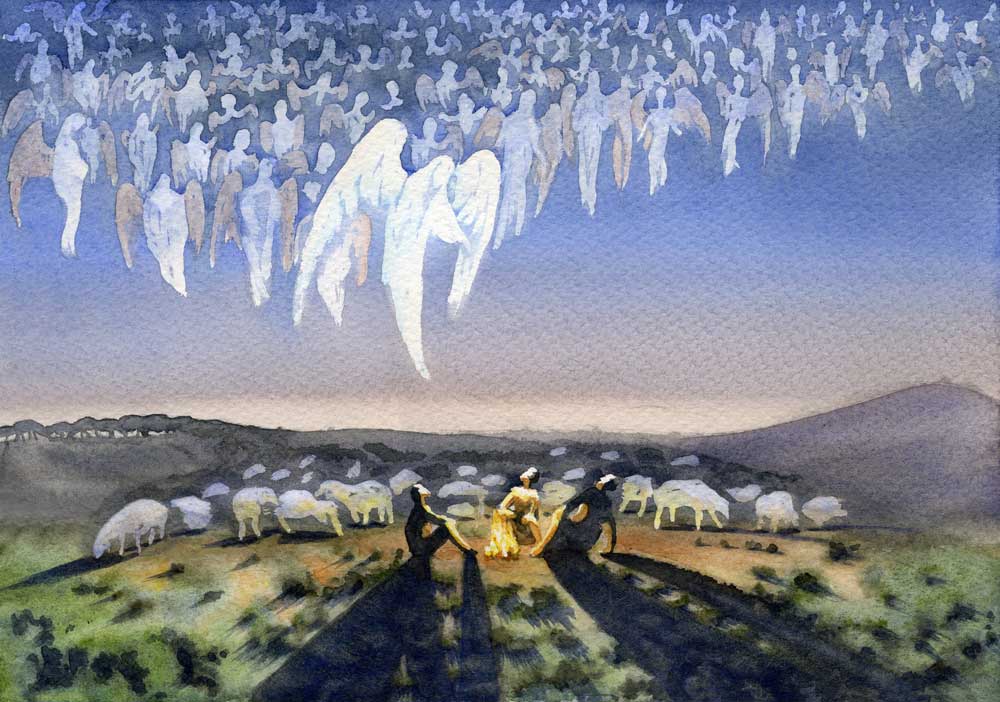
The text of In dulci jubilo was traditionally believed to have been taught by angels (the muses of Zion) to a German Dominican monk named Heinrich Seuse (c.1295–1355). Herr Seuse had been a student of the great mystic Meister Eckhart, and in 1328 he published a book called The Little Book of the Eternal Wisdom, which contains numerous accounts of visionary experiences and visitations, in which the author always refers to himself in the third person as "the Servant." In one of these accounts, a group of angels in the form of a youth and his fellows visit the Servant, sent from God
to bring him heavenly joys amid his sufferings; adding that he must cast off all his sorrows from his mind and bear them company, and that he must also dance with them in heavenly fashion. Then they drew the Servant by the hand into the dance, and the youth began a joyous song about the infant Jesus, which runs thus: "In dulci jubilo," etc.
If the setting of In dulci jubilo sung by Viva Voce displays the quietly joyful capacities of Praetorius's versatile skills, the setting sung on the 1994 recording Praetorius: Christmette (Christmas Mass) reveals a composer who also imagined heavenly choirs in their most glorious and spectacular mode. Working from a 1619 score for four choirs, six trumpets, and drums, the Gabrieli Consort and Players, conducted by Paul McCreesh, have added strings, woodwinds, and organ to the mix. (This is in keeping with Praetorius's description of his composing "for choirs of voices, organs, and other instruments.") All the stops are appropriately pulled out for the final stanza of this hymn to the infant Jesus, understood not merely in the humble setting of a Bethlehem stable, but in a more cosmic context: "Where are joys more deep than heaven's are? In heaven are angels singing new songs, in heaven the bells are ringing in the courts of the King. O that we were there!"
Christmas Morning Mass
Ken Myers is the host and producer of the Mars Hill Audio Journal. Formerly an arts editor with National Public Radio, he also serves as music director at All Saints Anglican Church in Ivy, Virginia. He is a contributing editor for Touchstone.
A Journal of Mere Christianity—Delivered to Your Door
- Essays on theology, culture, and the Church
- Contributors from across the Christian traditions

Six print issues (one year) of Touchstone, plus full online access and PDF downloads for only $39.95.

Get a one-year full-access subscription to the Touchstone online archives for only $19.95.
bulk subscriptions
Order Touchstone subscriptions in bulk and save $10 per sub! Each subscription includes 6 issues of Touchstone plus full online access to touchstonemag.com—including archives, videos, and pdf downloads of recent issues for only $29.95 each! Great for churches or study groups.
Transactions will be processed on a secure server.
more on Christmas from the online archives

28.6—Nov/Dec 2015
on the Deepest Longings of the Restless & the Lonely by William Graddy

35.6—Nov/Dec 2022
on the Divine Promise Fulfilled by the Child of Bethlehem by James M. Kushiner
more from the online archives

27.6—Nov/Dec 2014
Tales of Forbidden Stereotypes
Real-Life Men & Women & the Tragic Loss of Human Comedy by Anthony Esolen

33.2—March/April 2020
Lewis, Chesterton, et al. Against the Frauds, Experts & Revisionists by Vigen Guroian

37.5—Sept/Oct 2024
Why Law Schools Can't Teach Law
A sidebar to How Law Lost Its Way by Adam MacLeod
calling all readers
Please Donate
"There are magazines worth reading but few worth saving . . . Touchstone is just such a magazine."
—Alice von Hildebrand
"Here we do not concede one square millimeter of territory to falsehood, folly, contemporary sentimentality, or fashion. We speak the truth, and let God be our judge. . . . Touchstone is the one committedly Christian conservative journal."
—Anthony Esolen, Touchstone senior editor
