





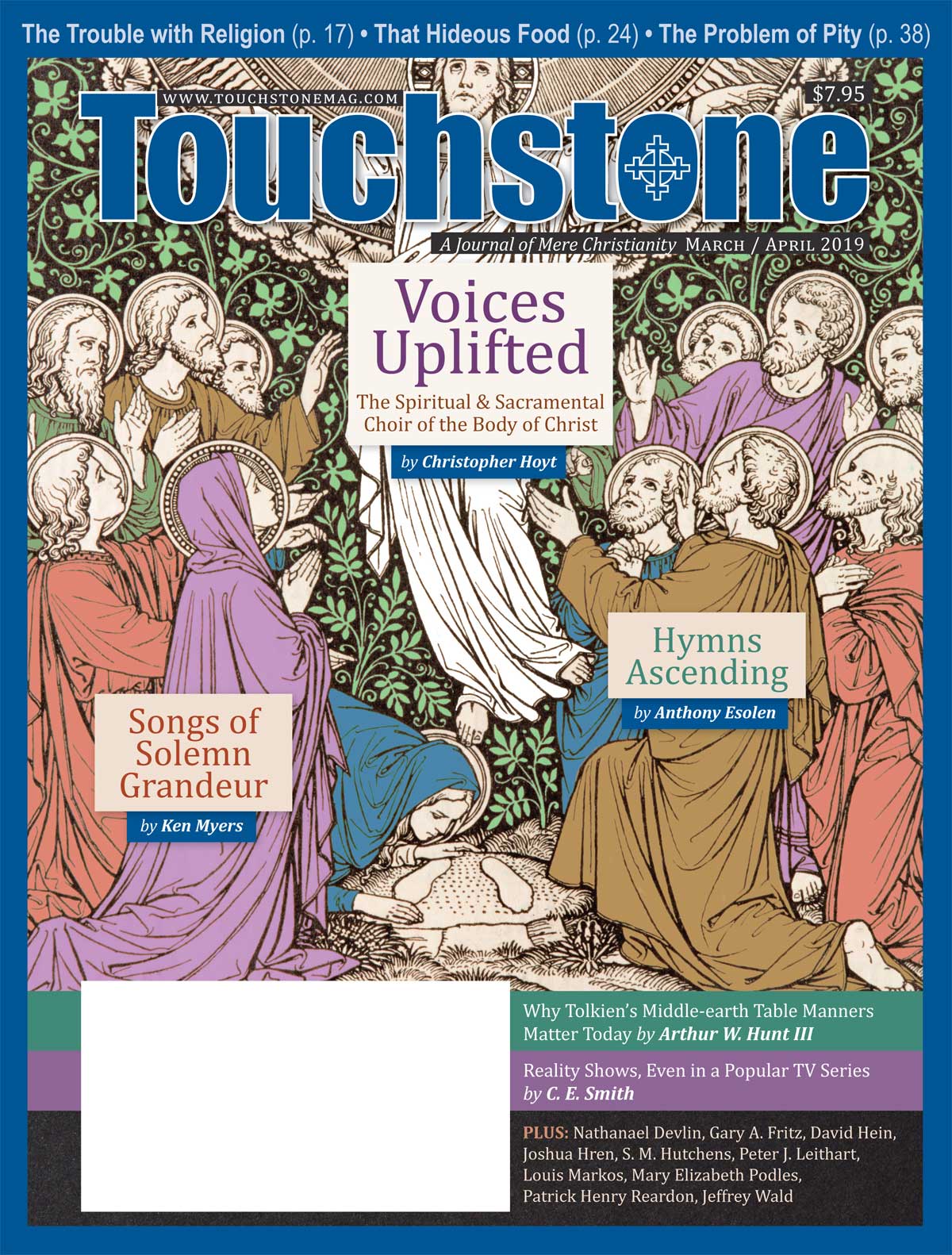
Illuminations
Hymns Ascending
by Anthony Esolen
Who in our time writes hymns? If I may judge from my church, the Roman Catholic, it's a small cadre of usually liberal priests, former priests, nuns, and former nuns. Only one or two of these are both orthodox and any good at writing poetry. I'm not asking for greatness, but solid competence; not filet mignon, but Irish stew. Then there are all the meals that are both tasteless and laced with arsenic—but that is another article.
So it seems as if I enter a different world when I read a hymn-poem by a bishop, of all strange creatures, who was also an author of a variety of books, a biblical archaeologist, the brother of a bishop, the son of a master of Trinity College, and the nephew of one of the greatest poets who ever lived. His name is Christopher Wordsworth, and the hymn I have before me is "See, the Lord Ascends in Triumph," written for the feast of the Ascension, and published in The Holy Year, or, Hymns for Sundays, Holidays, and Other Occasions Throughout the Year (1865), for the Anglican Church.
Bishop Wordsworth and his collaborator, William Henry Monk, give us hymns for each Sunday in succession, and for special days within the week, according to the readings set down for the divine service. It is the reverse of our current practice: a hymn-writer bubbles up with some pious emotion or some political desideratum, drapes it in gauze and bad grammar, and then a choir director figures out when it might be good to sing it, or just sings it ad libitum, because our sense of the liturgical year is pretty vague.
But to do well what Bishop Wordsworth did, you have to bring together the whole of Scripture as it applies to the feast and its readings. In the case of this Ascension hymn, the result is impressive and illuminating.
The Beginning of Something New
In the first two stanzas, Wordsworth alludes to Psalm 110, as the King of Glory, who has vanquished death by death, enters in triumph through the eternal gates of heaven. So far, no surprises. Those come with the third stanza. For we are apt to think of the Ascension as the end of something; deeply confused Christians may think of it as the end of Jesus' life in the flesh. It is instead a consummation of the whole of the history of salvation, and the beginning of something new. Here is the third stanza:
While he raised his hands in blessing,
He was parted from his friends;
While their eager eyes behold him,
He upon the clouds ascends;
He who walked with God and pleased him
Preaching truth and doom to come,
He, our Enoch, is translated
To his everlasting home.
The old Enoch mysteriously walked with God, says the sacred author, "and he was not, for God took him" (Gen. 5:24). Our Enoch departs from us to be the more present to us and for us. The old Enoch, as traditional interpretation had it (Wordsworth could have read it in Milton's Paradise Lost), preached righteousness and the need for repentance to a people stiff of neck and hard of hearing. That was why the Lord took him from their midst. But Jesus has been marked by the Father in a public way: "This is my beloved Son, with whom I am well pleased" (Matt. 3:17). His ascension is witnessed by many of his disciples. Enoch disappears, and is not going to return, but Jesus will return, say the young men who appear to the disciples, "the same way as you saw him go into heaven" (Acts 1:11), "with the archangel's call, and with the sound of the trumpet of God" (1 Thess. 4:16).
The Wisdom of Hebrews
But between the Ascension and the Second Coming, we have the birth of the Church, the full reality whereof the events and persons and rituals of the Old Covenant were types and shadows. Here, steeped in the wisdom of the Letter to the Hebrews, Wordsworth presents the work of Christ as transcending the old, and filling the present with vigorous action:
Anthony Esolen is Distinguished Professor of Humanities at Thales College and the author of over 30 books, including Real Music: A Guide to the Timeless Hymns of the Church (Tan, with a CD), Out of the Ashes: Rebuilding American Culture (Regnery), and The Hundredfold: Songs for the Lord (Ignatius). He has also translated Dante’s Divine Comedy (Random House) and, with his wife Debra, publishes the web magazine Word and Song (anthonyesolen.substack.com). He is a senior editor of Touchstone.
A Journal of Mere Christianity—Delivered to Your Door
- Essays on theology, culture, and the Church
- Contributors from across the Christian traditions
Subscribe (Print + Online) 
Six print issues (one year) of Touchstone, plus full online access and PDF downloads for only $39.95.
Subscribe (Online Only) 
Get a one-year full-access subscription to the Touchstone online archives for only $19.95.
bulk subscriptions
Order Touchstone subscriptions in bulk and save $10 per sub! Each subscription includes 6 issues of Touchstone plus full online access to touchstonemag.com—including archives, videos, and pdf downloads of recent issues for only $29.95 each! Great for churches or study groups.
Transactions will be processed on a secure server.
more on music from the online archives

33.3—May/June 2020
Bach's Cantata BWV 106, Gottes Zeit ist die allerbesteZeit (God's time is the very best time) by Ken Myers
more from the online archives
28.5—Sept/Oct 2015
on Our Sacred Duty to Teach the Devil to Death by Marcus Johnson
18.10—December 2005
on an Apostle’s Encounter with the Son’s Children by Anthony Esolen
calling all readers
Please Donate
"There are magazines worth reading but few worth saving . . . Touchstone is just such a magazine."
—Alice von Hildebrand"Here we do not concede one square millimeter of territory to falsehood, folly, contemporary sentimentality, or fashion. We speak the truth, and let God be our judge. . . . Touchstone is the one committedly Christian conservative journal."
Support Touchstone
—Anthony Esolen, Touchstone senior editor
