Room for Dining by Arthur W. Hunt III

Feature

Room for Dining

Why Tolkien's Middle-earth Table Manners Matter Today
by Arthur W. Hunt III

So you are watching television and Will Ferrell appears in a commercial scrolling his smartphone and says, "This filter makes me look like a cat. It's so funny it's making me cry." His family stares at him pathetically because he is doing this in the middle of dinner. The public service announcement you have just seen is sponsored by Common Sense Media and is part of its #DeviceFreeDinner campaign.

Common Sense Media is not the only voice on television promoting proper table manners. Every week on the hit show Blue Bloods the Reagan family sits down to a device-free Sunday dinner. The show stars Tom Selleck as New York City's Police Commissioner and is reminiscent of the old western series Bonanza, where the central character is a strong father figure who maintains law and order with the help of his offspring. If any member of the Reagan family were to pull out a smartphone at the table, he might find himself washing the dishes at the Reagan kitchen sink.

These glimpses of proper behavior at the table come to us in what sociologists and psychologists call an age of distraction. The average American adult checks his phone every six-and-a-half minutes, says Sherry Turkle, author of Reclaiming Conversation: The Power of Talk in a Digital Age. Turkle, who has written extensively on human–technology interaction, adds that with 44 percent of teens not unplugging themselves from their devices ever, it is easy to understand how the typical family now manages six or seven simultaneous streams of information during the dinner hour.

Before Common Sense Media's ad campaign, before Blue Bloods, and before social scientists started writing about our national attention deficit disorder, the English weaver of Middle-earth magic, J. R. R. Tolkien, was showing his readers what a proper table should look like. Readers around the globe have come to appreciate Tolkien for creating a fantasy world into which they can retreat, but the creator of The Hobbit and The Lord of the Rings was actually shooting for something more ambitious than providing reading pleasure. He was also concerned with cultural renewal.

Tolkien's Subversive Purpose

To Tolkien's mind, there were few better media for conveying moral teaching than a good fairy-story, by which he meant a deep-rooted tale, told as such and not as a thinly disguised moral allegory. Middle-earth is earth, through which the Oxford mythmaker summons an array of compelling Christian motifs set against the growing darkness coming out of Mordor.

In Defending Middle-Earth (Mariner Books, 2004), Patrick Curry claims that Tolkien's work remains popular because it resonates with the often-unarticulated view "that we are now living in a time when the project of modernity is approaching exhaustion." The villains in Tolkien's story worship power and are its slaves, says Curry. The technological and instrumental power commanded by Sauron reveal "the epitome of modernism gone mad." In the end, Tolkien whispers in our ear that life does not have to be this way; the Shire can be taken back.

The table motif is one important element of Tolkien's mythology that expresses hospitality after the Judeo-Christian tradition. Extending hospitality to strangers and sojourners was enjoined on the people of ancient Israel because they were strangers and sojourners themselves. Such hospitality usually involved sharing a meal, as when Abraham entertained the three strangers who announced that Sarah would conceive and bear a son in her old age. Early Christians saw hospitality as a way of imitating Christ, who instructed his followers to invite the poor and handicapped to their banquets. Hospitality was especially required of leaders of the church. Ultimately, the Christian meal points to our future fellowship with Christ in heaven, a foretaste of which is given in the Eucharist.

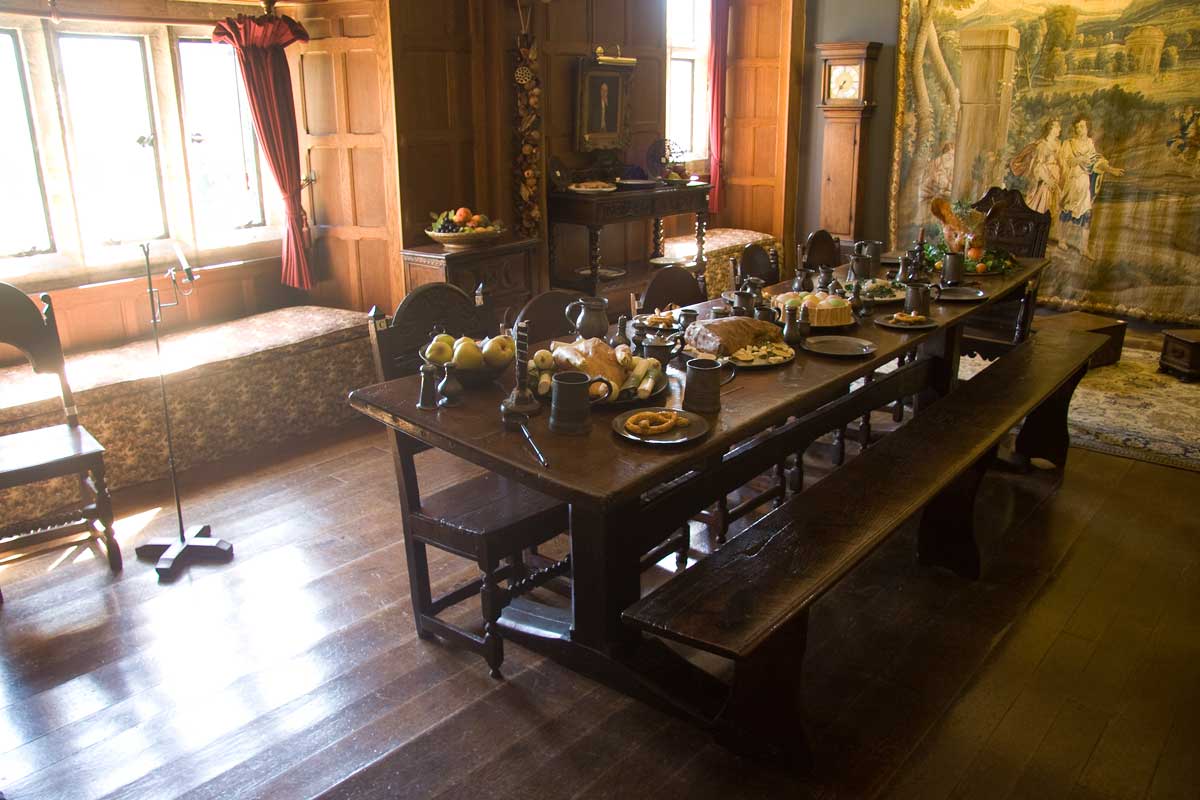
When reading Tolkien's Middle-earth myth, one is struck by the frequency of scenes centered on meals. The action is zipping along, and then we find ourselves in the middle of an amazing table spread. All of Tolkien's motifs are rich in symbolic meaning. For example, we get glimpses of Christ's personality and mission from Frodo's bearing of the ring, from Gandalf's resurrection after defeating the Balrog, and from Aragorn's actions as healer and king-in-waiting. Tolkien's table motif has its own symbolic meaning and furthers his subversive goal of cultural restoration.

The pattern that Tolkien sets up in both The Hobbit and The Lord of the Rings is an alternating pattern of travel and rest, travel and rest. This pattern is especially evident in the early stages of both works, when the travelers are invited to lodge with various hosts. The table motif serves as a purposeful lull, punctuating the escalating action as the journey progresses. The respites echo times of fasting and feasting found in the Christian calendar. They are episodes of wonder, fellowship, and replenishment, contrasting with the travail and despair of the road.


Arthur W. Hunt III is a former professor of public speaking at the University of Tennesse at Martin. He is now preparing to transition to ministry-related service and lives in the greater Memphis area.

A Journal of Mere Christianity—Delivered to Your Door

  • Essays on theology, culture, and the Church
  • Contributors from across the Christian traditions
Subscribe (Print + Online)

Six print issues (one year) of Touchstone, plus full online access and PDF downloads for only $39.95.

Subscribe (Online Only)

Get a one-year full-access subscription to the Touchstone online archives for only $19.95.


bulk subscriptions

Order Touchstone subscriptions in bulk and save $10 per sub! Each subscription includes 6 issues of Touchstone plus full online access to touchstonemag.com—including archives, videos, and pdf downloads of recent issues for only $29.95 each! Great for churches or study groups.

Transactions will be processed on a secure server.


more on J. R. R. Tolkien from the online archives
34.6—Nov/Dec 2021

The Morgul Blade

on Experiencing Grief at Christmastime by Keith Lowery


more from the online archives

27.3—May/June 2014

Religious Freedom & Why It Matters

Working in the Spirit of John Leland by Robert P. George

14.1—January/February 2001

The Christian Heart of Fatherhood

The Place of Marriage, Authority & Service in the Recovery of Fatherhood by John M. Haas

29.5—Sept/Oct 2016

The True Atheist Myth

on Past & Present Atheism & the Invention of Happiness by Jordan Bissell

calling all readers

Please Donate

"There are magazines worth reading but few worth saving . . . Touchstone is just such a magazine."
—Alice von Hildebrand

"Here we do not concede one square millimeter of territory to falsehood, folly, contemporary sentimentality, or fashion. We speak the truth, and let God be our judge. . . . Touchstone is the one committedly Christian conservative journal."
—Anthony Esolen, Touchstone senior editor

Support Touchstone

00