




View
A Peculiar Sickness
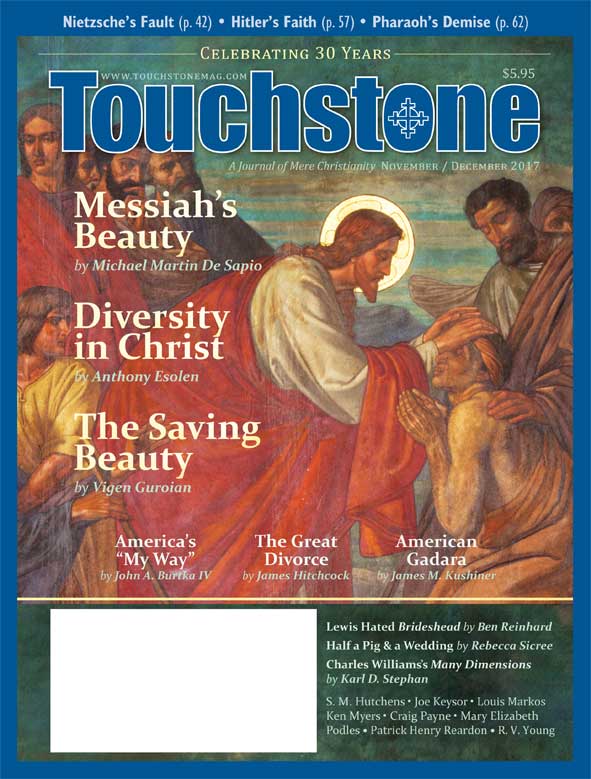
John A. Burtka IV on Individualism in America & Its Cure
While reclining at my desk after a day's work, I caught myself singing along to Frank Sinatra's 1969 sensation, "My Way." As I mouthed each line of the song, I realized that many of our contemporary woes—spiritual isolation, social alienation, and cultural fragmentation—have their root, not exclusively in technology, social media, or the millennial generation, but much farther back in our American tradition.
The song, which, I admit, conjures up a sense of mutual triumph in Sinatra's rugged individualism and worldly success, memorializes an egotistical creed:
For what is a man, what has he got?
If not himself, then he has naught;
To say the things he truly feels
And not the words of one who kneels;
The record shows I took the blows
And did it my way.
The story of self-referential individuals, refusing to bow to earthly or heavenly authority, has been a hallmark of our American tradition going back from Sinatra to Twain to Emerson, and it reflects two vices prominent in democratic societies: individualism and materialism.
When Alexis de Tocqueville toured the United States in the 1830s, cataloguing the virtues and vices of American democracy, he warned that "individualism is a sickness peculiar to the human heart in democratic times" (Democracy in America [Liberty Fund, Inc., 2010], p. 881). What's wrong with individualism? According to Tocqueville, it begins as a rather harmless form of isolation and withdrawal rooted in self-interest, but rapidly grows, choking out public and private virtue along the way.
Due to equality of conditions in democratic societies, individuals lose the cultural glue that binds them to their ancestors, descendants, and land. Furthermore, the bonds that united the classes together in an aristocracy and provided for mutual support and shared responsibilities no longer exist. While the benefits of democracy and equality are well known, their vices are subtle and destructive.
The independence of the individual and nuclear family in democratic times creates a state of perpetual agitation and restlessness. In the course of eighty years, each person is responsible for earning an education, finding a spouse, starting a career, saving for a home, rearing children, paying for the children's college tuition and weddings, preparing for retirement, and then rolling the dice on whether he or she will have enough money in the bank to make it to the grave.
Tocqueville calls this movement and worry inquiétude, and it has the effect of turning each person's gaze inward, and consequentially towards "excessive material enjoyments" (745). This "dangerous sickness," materialism, "must be particularly feared among a democratic people because it combines with the vice of the heart most familiar to these people" (957). And when combined with individualism, the pursuit of material well-being unleashes animal-like passions that can degrade mankind and the environment if they are not checked by religious faith and piety. For Tocqueville, Christianity in America serves as the primary instrument capable of lifting people's eyes beyond individualism and materialism, towards eternity and virtue.
The Fearful Seek Order
Before explaining why faith plays such an indispensable role in Democracy in America, I will elaborate on why Tocqueville fears unbelief in a democracy. Virtue is hard and requires that people sacrifice hundreds of fleeting pleasures each day. To be virtuous is to take the long view that restraint in the present will lead to happiness in the future. With few exceptions, people require the eternal rewards and punishments of religion to inspire them toward virtuous action. When the masses abandon religious faith and authority, however, they "are soon frightened by the sight of limitless independence" (745).
A Journal of Mere Christianity—Delivered to Your Door
- Essays on theology, culture, and the Church
- Contributors from across the Christian traditions

Six print issues (one year) of Touchstone, plus full online access and PDF downloads for only $39.95.

Get a one-year full-access subscription to the Touchstone online archives for only $19.95.
bulk subscriptions
Order Touchstone subscriptions in bulk and save $10 per sub! Each subscription includes 6 issues of Touchstone plus full online access to touchstonemag.com—including archives, videos, and pdf downloads of recent issues for only $29.95 each! Great for churches or study groups.
Transactions will be processed on a secure server.
more on america from the online archives
29.4—July/August 2016
Russell Kirk: American Conservative by Bradley J. Birzer by Hunter Baker
29.2—March/April 2016
The History of Family Strength in America May Reveal Good News by Allan C. Carlson
30.5—Sept/Oct 2017
The Christian Cure for What Ails Modern Politics by David Bradshaw
more from the online archives
22.5—June 2009
C. S. Lewis on Civilization & the Natural Order by Timothy L. Hall

33.2—March/April 2020
Encounters with Faith & Forgiveness in Communities of Faith by Nicole M. King
31.1—January/February 2018
Getting Sex Wrong Is a Foundational Error by James M. Kushiner
calling all readers
Please Donate
"There are magazines worth reading but few worth saving . . . Touchstone is just such a magazine."
—Alice von Hildebrand
"Here we do not concede one square millimeter of territory to falsehood, folly, contemporary sentimentality, or fashion. We speak the truth, and let God be our judge. . . . Touchstone is the one committedly Christian conservative journal."
—Anthony Esolen, Touchstone senior editor
