




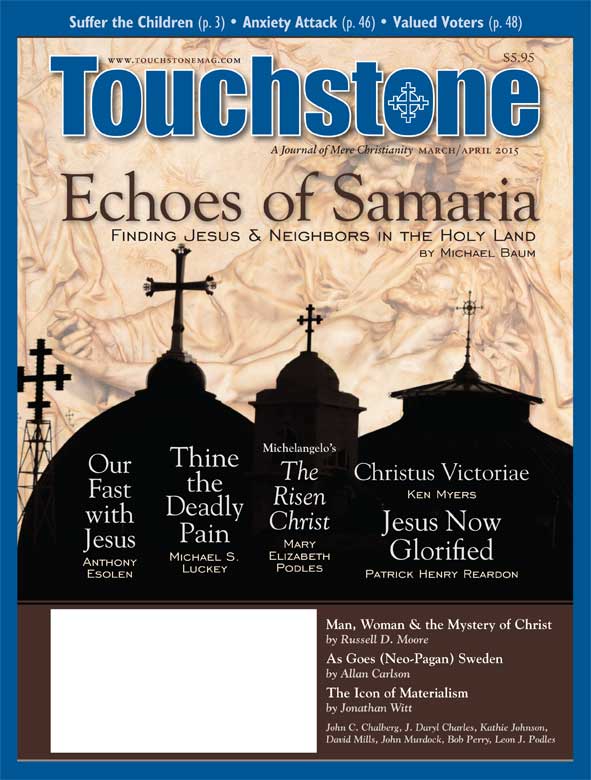
Feature
Echoes of Samaria
Finding Jesus & Neighbors in the Holy Land
by Michael Baum
As we finished the climb, Burqin spread out tranquilly below us: a place of profound poverty near the northern edge of what the world knows as the "West Bank" but Israel and the Bible know as "Samaria." Burqin houses perhaps 6,000 Muslims, with about twenty Christian families maintaining their ancient faith and tending their ancient church. Sasha, an American Orthodox expatriate who has lived in Jerusalem since about 2000 as a professional tour guide, tries to bring foreign pilgrims whenever he can. International visitors are a status symbol in a town that seldom gets outside attention of any kind. Visitors buy handmade olive-oil soap, which the church in turn buys from Muslim neighbors, helping nurture good relations.
It was May 2013, and this was our tour's first stop in Samaria. Burqin today is a "B area" under the Oslo Accords—administered by the Palestinian Authority but subject to Israeli security. On our arrival in Tel Aviv four days earlier, Sasha told us that current political conditions were favorable to visiting some parts of the region that are often off-limits. Ironically, only a year later, these same areas were to become scenes of lethal violence between Palestinian and Israeli forces during the 2014 Hamas-Israel hostilities in Gaza.
Though dedicated to St. George, the great soldier-saint whose name seems to appear on half the Orthodox churches in the Mideast, the Burqin church is better known, in ancient tradition, as the church of the Ten Lepers. (The name "Burqin" itself may derive from an old Arabic word for leper.) The church burrows into the hill: one interior wall is living limestone, and an archway in that wall leads into a tiny cave that now serves as a side chapel. Barely large enough for a narrow iconostasis (icon screen) and a few stacidia (high chairs with arm rests for brief respite from standing through long Orthodox services), the little cavern our group squeezed into that morning had, twenty centuries before, sheltered ten diseased fugitives until an itinerant rural rabbi came along and one leper cried out: "Jesus, Master,
have mercy on us!"
The serious-faced Arab Christian man who had unlocked the church for us stood by as we explored, took pictures, and venerated icons. Then he stepped forward and pulled down one of the lampadas (hanging oil lamps) on the iconostasis, dipping out some of the oil so one of our priests could anoint us for a blessing. Afterwards he escorted us to a low side building off the courtyard, where he and his wife served us sweetened coffee—the typical hospitality of the Mideast. For the first time he smiled, broadly. We stayed for a few minutes of fellowship, with Sasha translating, bought some of the Muslim-manufactured soap, and departed.
Face to Face with Scripture
That day at Burqin typified how our tour—the first time my wife and I had set foot in the Holy Land—brought us face to face with aspects of Scripture we had always known but never fully appreciated, or else knew in fragments but had never put together. Particularly: the Samaritans. "The Good Samaritan" apart, we had always known of Jesus' encounters with these estranged cousins of the Jews. But the full, cumulative significance only truly registered as we traveled the few square miles of Samaria and venerated the physical sites where these events took place. Contemplating the Samaritans shed light on the mystery of Jesus' coming, and provided new context for today.
The heart of ancient Samaria is about twenty miles from Burqin—a long day's walk. The modern-day town of Nablus, roughly biblical Shechem (possibly also Sychar), occupies the plain where Joshua first led the children of Israel across the Jordan and into the Promised Land (Josh. 8). Nablus nestles between two round-topped hills that rise so abruptly from the plain they're called "mountains." Mt. Gerizim and Mt. Ebal are also respectively named the "Mountain of Blessings" and "Mountain of Cursings" because that's where Joshua directed the heads of the twelve tribes of Israel to stand (six on each hill) and alternately declaim blessings on those who would obey God's commandments and curses on those who would not (Josh. 8:33). Mt. Gerizim gradually lost place as a site of worship to Jerusalem, especially after Solomon built the Temple, but the mount retained local veneration and is still regarded as a holy place by surviving Samaritans to this day.
After the glory days of David and Solomon, the children of Israel entered one of their periods of backsliding from God's commandments. The kingdom was divided, with the ten tribes in the north descending deeper into decadence until finally Assyria—the eighth-century b.c. regional superpower—invaded and sent the northern tribes into exile, never to be heard from again. Assyria also invaded Samaria and imported foreign populations, but Judea remained an independent Jewish state for about another 150 years. Then Assyria itself fell to Babylon, which invaded Judea and, in several successive forays, led them, too, into exile. Anyone shocked by the current chaos and bloodshed in the Mideast need only read through Jeremiah, 1 and 2 Kings, and Lamentations to see that it's always been like that and worse.
Competing Traditions
In less than fifty years, though, the chastened Jews experienced a reprieve at the hands of a rare enlightened despot of the ancient world, Cyrus of Persia. He conquered Babylon and set about repatriating many of the peoples the former empire had kidnapped. Seemingly wanting good relations with any god who would listen, he and his successors sent the Jews back to their homeland with instructions and support to rebuild the Temple so they could pray for him. Which apparently they did: Isaiah even calls Cyrus "messiah" (Isaiah 45:1), the only time in Scripture that term is applied to a non-Jew.
Michael Baum is a management consultant, former English teacher, and writer with degrees in English literature and education from Yale University and an MBA from Northwestern. He and his wife live near Madison, Wisconsin, where they attend St. Ignatius Antiochian Orthodox Church. Their three adult children and five grandchildren attend Orthodox churches in Illinois, Wisconsin, and Indiana.
A Journal of Mere Christianity—Delivered to Your Door
- Essays on theology, culture, and the Church
- Contributors from across the Christian traditions

Six print issues (one year) of Touchstone, plus full online access and PDF downloads for only $39.95.

Get a one-year full-access subscription to the Touchstone online archives for only $19.95.
bulk subscriptions
Order Touchstone subscriptions in bulk and save $10 per sub! Each subscription includes 6 issues of Touchstone plus full online access to touchstonemag.com—including archives, videos, and pdf downloads of recent issues for only $29.95 each! Great for churches or study groups.
Transactions will be processed on a secure server.
more from the online archives

30.5—Sept/Oct 2017
The Critical History Before, During & After Martin Luther by James Hitchcock
33.2—March/April 2020
An Architectural Sign of Mere Christianity by Michael Ward
calling all readers
Please Donate
"There are magazines worth reading but few worth saving . . . Touchstone is just such a magazine."
—Alice von Hildebrand
"Here we do not concede one square millimeter of territory to falsehood, folly, contemporary sentimentality, or fashion. We speak the truth, and let God be our judge. . . . Touchstone is the one committedly Christian conservative journal."
—Anthony Esolen, Touchstone senior editor
