




View
Virtue Reanimated
Collin Garbarino on the Subversive Conservatism of Pixar
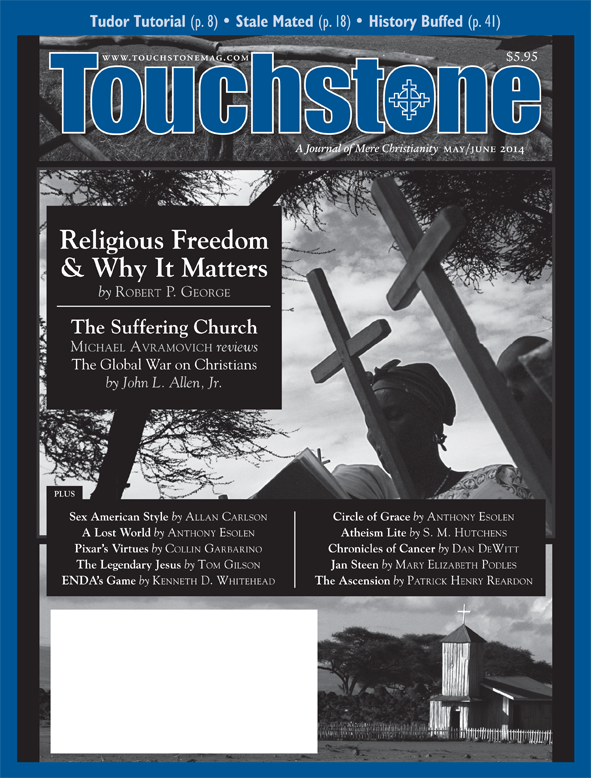
Pixar might be the most subversive force for good in contemporary American popular culture. Since the release of its first feature film, Toy Story, in 1995, the studio has been creating superb animated films, with innovative computer animation, engrossing storylines, tightly knit plots, likeable characters, and compelling themes. Where other studios rely on celebrity voiceovers and pop culture references to entertain the teens and parents during an otherwise banal kids' movie, Pixar weaves seamless narratives that appeal to both children and adults. But it does not merely provide stylish entertainment; in most cases, these films identify some form of cultural cancer and attempt to remove it.
Pixar did not begin as an edgy, countercultural media outlet. Its subversive tendencies have grown as the studio has matured. The early movies each brought something fresh to the screen visually, but the stories all emphasized a common theme: the importance of relying on friends and family when one is faced with challenges that demand personal growth. Though this theme remained prominent in subsequent Pixar movies, other, more controversial ideas began to be added.

With the release of The Incredibles in 2004, Pixar began getting a little edgy. This movie critiqued our culture of mediocrity and sense of entitlement by showing that, contrary to what is taught on Sesame Street, not everyone is exceptional. This theme is also expressed in Ratatouille (2007), which taught that not everyone can grow up to be a master chef.
Cars (2006) showed children the dangers of careerism and attempted to redefine the American idea of success by questioning America's nomadic spirit and emphasizing community over the individual. WALL-E (2008) indicted the culture of consumerism, while Up (2009) both portrayed the joy of a faithful marriage and condemned the American tendency to segregate the generations.
I like to think of Toy Story 3 (2010) as a cultural apologetic for the existence of God. The toys are trying to stay faithful to their owner in a fallen world, while Lots-O-Huggin' Bear sounds like a New Atheist: "But we don't need owners here at Sunnyside! We own ourselves! We're masters of our own fate! We control our own destiny!" At the climax, Lotso asks, "Where's your kid [owner] now, Sheriff?!" The film portrays a true test of faith.
This brings us to Pixar's two most recent offerings, Brave and Monsters University. While critics largely approved of both movies, they didn't think they compared well with Pixar's earlier films. Many thought Brave too much a typical princess movie, and complained that Monsters University didn't break new ground. But both of these critiques are meritless.
A Princess Tale
Brave, coproduced with Disney, introduces audiences to Merida, a headstrong Scottish princess. The genre of the modern princess film is a familiar one by now, having been pioneered by Disney's The Little Mermaid in 1989. Brave, however, contains some very subversive ideas, which are subtly woven into a traditional film about a Disney princess.
The movie begins by posing the question, "What does it mean to be brave?" The narrator tells the audience that bravery means "changing your fate." So what is the fate that Merida needs to change?
The audience knows how things should go. Like Ariel in The Little Mermaid, the princess must feel trapped by societal or familial expectations, and she must throw off those expectations and finally achieve happiness by following her heart.
Merida's story follows this pattern to a certain extent. She does indeed long to lead her own life instead of the one society expects of her. She takes after her jocular father rather than her more staid mother. She rides her horse with abandon, becomes an expert with the bow and arrow, and even brings her weapons to the dinner table. She's appalled at the prospect of becoming like her mother, the queen, and resents the training that her mother has given her to prepare her for marriage.
Collin Garbarino is an Assistant Professor of History at Houston Baptist University. He lives with his wife and four children in Sugar Land, Texas.
A Journal of Mere Christianity—Delivered to Your Door
- Essays on theology, culture, and the Church
- Contributors from across the Christian traditions

Six print issues (one year) of Touchstone, plus full online access and PDF downloads for only $39.95.

Get a one-year full-access subscription to the Touchstone online archives for only $19.95.
bulk subscriptions
Order Touchstone subscriptions in bulk and save $10 per sub! Each subscription includes 6 issues of Touchstone plus full online access to touchstonemag.com—including archives, videos, and pdf downloads of recent issues for only $29.95 each! Great for churches or study groups.
Transactions will be processed on a secure server.
more from the online archives



32.1—January/February 2019
Divine Love & the Love of Man & Woman Surpass Mere Consent by Anthony Esolen
calling all readers
Please Donate
"There are magazines worth reading but few worth saving . . . Touchstone is just such a magazine."
—Alice von Hildebrand
"Here we do not concede one square millimeter of territory to falsehood, folly, contemporary sentimentality, or fashion. We speak the truth, and let God be our judge. . . . Touchstone is the one committedly Christian conservative journal."
—Anthony Esolen, Touchstone senior editor
