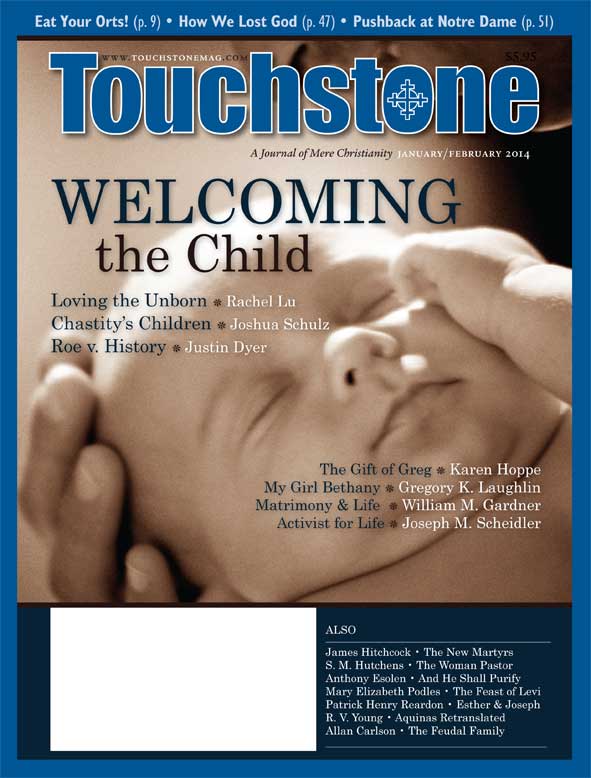
Love's Beckoning
Loving the Unborn Is Difficult but Necessary If Human Love Is to Survive
There are many ways to measure the tragedy of abortion, but the starkest, perhaps, is by numbers. We are told that the Rwandan genocide claimed about half a million innocent lives. The Khmer Rouge killed as many as two million. An estimated six million were killed in the Holocaust. And according to National Right to Life, more than 52 million American lives have been lost to abortion over the last 40 years.
To the pro-life individual, this reality is horrible to contemplate. It is a bitter reminder of what happens when a society feels at liberty to decide which human beings are worthy of respect and protection, and which are not. Pro-choice Americans, however, are generally unmoved by these comparisons to historical atrocities. This is unsurprising, and not only because the unjust invariably find rationales for their evil deeds. The average pro-choice person feels confident that he is not a kindred spirit of the Hutus or the Nazis because he supposes that these oppressors felt a real hatred for their victims, actually wanting them to suffer and die. He, by contrast, does not actively despise the unborn. He simply doesn't care about them.
Apathy, of course, is not exonerating, and most Americans today cannot even claim ignorance as an excuse. Biology has demonstrated that a new human being is created at the moment of conception, and further, that the conceptus develops recognizably human features with astonishing speed. Abortion clinic workers who tell women that their 12-week fetus is little more than an amorphous lump of cells cannot, in this day and age, claim invincible ignorance. Quite simply, they are telling lies.
The Unborn's Handicap
The pro-life movement has worked tirelessly to acquaint the general public with these biological facts, and its success in this area has been considerable. Most people are now aware that "abortion stops a beating heart," and this general awareness very likely explains why Americans have shown a gradual but appreciable drift towards the pro-life position in recent years. Nonetheless, most Americans remain relatively unbothered by such practices as IVF and embryonic stem-cell research, both of which involve the deliberate destruction of newly conceived individuals. First-trimester abortions are still regarded by many as ethically trivial. It is only as the fetus approaches its full term of gestation that the tide of public opinion turns markedly in favor of its protection.
For the disciplined pro-life thinker, these trends are maddening. What mysterious threshold do people think they have discovered lying between the blastocyst and the fetal stage of development? Why do we applaud the March of Dimes for its Herculean efforts to save 23-week-old fetuses, while we shrug indifferently at the fate of smaller, but equally unique human beings that are destroyed by the millions, not only at Planned Parenthood but also at the local fertility clinic?
The truth is that ordinary people rarely reflect on metaphysical thresholds. They learn to value others relationally, through love, and they wish to protect those individuals whom they recognize as potential objects of love. This puts the unborn in an uncertain position. As a blastocyst, the newly conceived individual is probably not loved by his human family, because his existence has not yet been detected. Over the course of the pregnancy, his presence becomes increasingly evident, and anticipation grows among his human connections as they prepare to welcome the newborn. After birth, the child impresses himself on us quite strongly as a being worthy of protection and love, and at that point, nearly all modern people agree that it is ethically unacceptable to kill him. (Interestingly, even this has not always been the case historically; many societies have sanctioned the killing or homicidal neglect of newborns. This may reflect, among other things, the way that a high infant mortality rate encourages parents to deliberately distance themselves from their offspring until long-term survival seems probable.)
Advocating for the unborn is challenging because it requires us to foster sympathy for a group of people who cannot be sympathetically engaged. Activism typically involves giving victims a voice, but there is no obvious way to give voice to someone whose lungs have yet to develop. However just the pro-life cause may be, we will always have to contend with this natural obstacle. It is difficult to persuade people to make sacrifices for those for whom they care little, and difficult to make people care about those whom they cannot love.
Given this handicap, it is impressive that the pro-life movement really has made considerable progress in influencing public opinion. Still, the struggle remains a difficult one. Philosophically, we can make the case for the value of unborn life, but as a rule, love is more potent than justice, and far more effective at inspiring the strong to protect the weak.
Von Hildebrand's Insight
Rachel Lu is a Senior Contributor at The Federalist, as well as a frequent contributor to Crisis Magazine, Ricochet and other publications. A convert to Roman Catholicism, she teaches philosophy at the University of St. Thomas, and lives with her husband and three boys in St. Paul, Minnesota.
A Journal of Mere Christianity—Delivered to Your Door
- Essays on theology, culture, and the Church
- Contributors from across the Christian traditions

Six print issues (one year) of Touchstone, plus full online access and PDF downloads for only $39.95.

Get a one-year full-access subscription to the Touchstone online archives for only $19.95.
bulk subscriptions
Order Touchstone subscriptions in bulk and save $10 per sub! Each subscription includes 6 issues of Touchstone plus full online access to touchstonemag.com—including archives, videos, and pdf downloads of recent issues for only $29.95 each! Great for churches or study groups.
Transactions will be processed on a secure server.
more from the online archives

calling all readers
Please Donate
"There are magazines worth reading but few worth saving . . . Touchstone is just such a magazine."
—Alice von Hildebrand
"Here we do not concede one square millimeter of territory to falsehood, folly, contemporary sentimentality, or fashion. We speak the truth, and let God be our judge. . . . Touchstone is the one committedly Christian conservative journal."
—Anthony Esolen, Touchstone senior editor